Tuesday, July 24, 2012
Tuesday, July 10, 2012
Articulating Absence: Ghosts in Disney Theme Parks
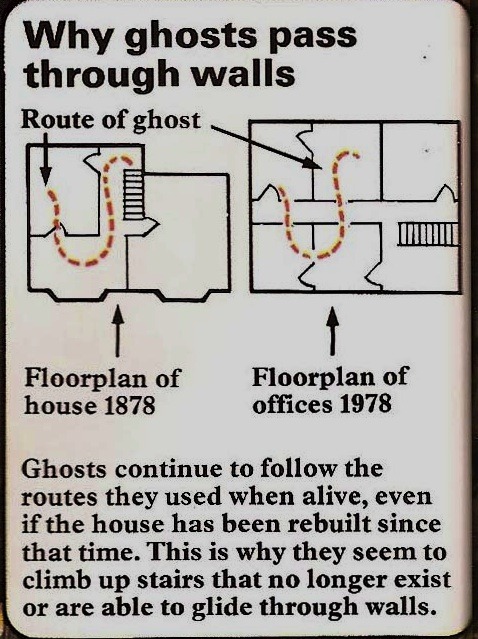
I came to this post, at a blog dedicated to exploring Disneyland's Haunted Mansion ride, through JR's tumblr. The image there has a sort of sweet humor, its text (divorced of whatever context it initially appeared in) seeming beyond (in)sincerity. There's no reason to doubt that these diagrams are anything but in earnest, and yet, who has ever heard of a ghost ascending stairs that don't exist? Flying, certainly, but plodding up a no-longer-existent staircase?

Having never (at least that I can recall) actually been in Disney's Haunted Mansion, I'm not going to contribute to the debate about whether the attraction is more amenable to what HBG2 refers to as the "Spirit Possession paradigm" or the "Parallel World paradigm," but I would like to briefly discuss how these "paradigms" don't quite work, in my view, and again try to advance the way in which I've been prone to thinking about ghost stories for a little while now.
Here are HBG2's working definitions of the two paradigms:
Spirit Possession:
Parallel World:
I've been meaning to write, for a couple of years now, a coherent argument regarding representations of ghosts. The closest I've gotten is almost certainly the final paragraph of my post Unified (Gar)Field Theory; there are fragments in this comment I left here and a lot of this post, from the 14th paragraph until the weird occupy stuff at the bottom, but both of these are very specifically arguing about ways of reading the Haunted House, and so don't so much present a theory of ghosts as elaborate on a theory that I still have yet to present. For the record, my theory basically revolves around a reading of John Carpenter's The Fog, which has always seemed to me to be a film about the ways in which space itself attempts to become linguistic. Obviously this is something that needs a significant amount of explanation, that I'm just not going to be able to provide here.
Back to the two paradigms, though. It is fairly unsurprising when, at the end of the post, HBG2 concludes that, "P[arallel] W[orld] and S[pirit] P[ossession] are not mutually exclusive theories." In the context of the discussion he's intervening in around the Haunted Mansion, this is meant as a way to hold open ambiguities; he, like many interpreters and critics, wants to open up the possibilities of enjoyment of this ride, instead of foreclose them, and having (apparently) competing lenses allows this. To my mind, though, the reason that his two paradigms aren't mutually exclusive is kind of a lot easier -- it's because they're the same thing.
Well, not exactly. The "Parallel Worlds" theory is a lot more appealing to me, for instance, because the "Spirit Possession" theory smacks of that intolerable misunderstanding of ghosts as the products of "unfinished business." There's really no excuse for so direly misinterpreting what it is about ghosts that makes them compelling as that catchphrase does. It makes ghosts nothing but a narrative function, a conflict, a pending resolution, masquerading as an ontology. But the "Parallel Worlds" theory does this too, albeit in a slightly more clever way, reducing ghosts to the psychological or metaphysical. No matter which of the theories you choose, what you ultimately advocate is an understanding of ghosts as presences. Which is all well and fine, I suppose, if you want your frights wrapped in a nice little blanket of affirmation of your belief in immortal souls, or whatever. But that's fucking boring.
As I said in the Garfield post, "ghosts are absences of space, absences within space, that structure the space." The "Structuring Absence" theory of ghosts, I would argue, applies broadly across all ghosts, and touches on what is truly interesting about them. Because the second you start to think of ghosts as presences, and specifically as individualized presences, you lose the way in which they function not as the story, but of it. It is the story which shapes itself around the ghost, not the ghost which is the story -- unless we're talking Casper here, in which case we're just talking about the ghost as a purely aesthetic object.
The further I try to go here in articulating the idea, the more unmanageable this is going to become. So I'll try to just lay out a few ideas, necessarily underdeveloped, that I think are absolutely necessary to support my claim at a very basic level, and leave the heavy shit for later. I'll also try to tie this back into the Haunted Mansion post out of which this whole thing began, if only for my own sake.
It is, for me, impossible to overstate just how important the idea that Ghosts Are Space is. Because, for one thing, this goes very much against most of the received narrative wisdom of ghosts, which argues incessantly that ghosts are dead folks. And so they surely are, but they are dead folks in a very specific way, which is to say in their relation to space. Because ghosts haunt; in ceasing living, they cease to take up space, and instead constitute it. Whether they are rattling teacups or murdering interlopers, whether are motivated by redemption or revenge, what makes them ghosts is that they articulate a space. I actually kind of like "Articulating Absence" as the name for this theory of ghosts. Maybe we'll stick with that one.
That is precisely what ghosts do: they make a space speak, and they provide it with joints. They hinge space. The ghost is that space which fits together in such a way that its parts may move, and which through voice can define itself.
And so, to return at last to the Haunted Mansion. Despite never having been on the ride, it's my contention that the reason that the two proposed paradigms overlap so neatly is that they are both, as are most understandings of ghost stories, theories of the ghost as narrative function (which, to be entirely fair, is HBG2's entire point; I'm not so much arguing against his ideas here, at least I don't think so, as trying to use them as a springboard to talk about something else, as if that weren't obvious enough already). I am proposing, instead, that the psychological and metaphysical readings of ghosts that renders them narrative functions is wrongheaded, in that it doesn't come close to capturing the stuff that makes ghosts interesting beyond the particular narratives in which they are embedded, and that an alternative theory of ghosts is needed, which properly situates ghosts not within the psychological, but within the topological. Simply put: for the Haunted Mansion and for every other ghost story, it is not a question of whether the ghosts "possess" spaces, or whether it is a question of how they view spaces; the ghosts are themselves the spaces, or at least the absences which articulate them.

Having never (at least that I can recall) actually been in Disney's Haunted Mansion, I'm not going to contribute to the debate about whether the attraction is more amenable to what HBG2 refers to as the "Spirit Possession paradigm" or the "Parallel World paradigm," but I would like to briefly discuss how these "paradigms" don't quite work, in my view, and again try to advance the way in which I've been prone to thinking about ghost stories for a little while now.
Here are HBG2's working definitions of the two paradigms:
Spirit Possession:
Quite simply, wicked spirits are out to get you. They want to take possession of your body. Failing that, they'll take an animal or even a building, but they want to move up to humans if they can.
Parallel World:
[G]hosts may continue to inhabit the world that was there, regardless of what is found there now.
I've been meaning to write, for a couple of years now, a coherent argument regarding representations of ghosts. The closest I've gotten is almost certainly the final paragraph of my post Unified (Gar)Field Theory; there are fragments in this comment I left here and a lot of this post, from the 14th paragraph until the weird occupy stuff at the bottom, but both of these are very specifically arguing about ways of reading the Haunted House, and so don't so much present a theory of ghosts as elaborate on a theory that I still have yet to present. For the record, my theory basically revolves around a reading of John Carpenter's The Fog, which has always seemed to me to be a film about the ways in which space itself attempts to become linguistic. Obviously this is something that needs a significant amount of explanation, that I'm just not going to be able to provide here.
Back to the two paradigms, though. It is fairly unsurprising when, at the end of the post, HBG2 concludes that, "P[arallel] W[orld] and S[pirit] P[ossession] are not mutually exclusive theories." In the context of the discussion he's intervening in around the Haunted Mansion, this is meant as a way to hold open ambiguities; he, like many interpreters and critics, wants to open up the possibilities of enjoyment of this ride, instead of foreclose them, and having (apparently) competing lenses allows this. To my mind, though, the reason that his two paradigms aren't mutually exclusive is kind of a lot easier -- it's because they're the same thing.
Well, not exactly. The "Parallel Worlds" theory is a lot more appealing to me, for instance, because the "Spirit Possession" theory smacks of that intolerable misunderstanding of ghosts as the products of "unfinished business." There's really no excuse for so direly misinterpreting what it is about ghosts that makes them compelling as that catchphrase does. It makes ghosts nothing but a narrative function, a conflict, a pending resolution, masquerading as an ontology. But the "Parallel Worlds" theory does this too, albeit in a slightly more clever way, reducing ghosts to the psychological or metaphysical. No matter which of the theories you choose, what you ultimately advocate is an understanding of ghosts as presences. Which is all well and fine, I suppose, if you want your frights wrapped in a nice little blanket of affirmation of your belief in immortal souls, or whatever. But that's fucking boring.
As I said in the Garfield post, "ghosts are absences of space, absences within space, that structure the space." The "Structuring Absence" theory of ghosts, I would argue, applies broadly across all ghosts, and touches on what is truly interesting about them. Because the second you start to think of ghosts as presences, and specifically as individualized presences, you lose the way in which they function not as the story, but of it. It is the story which shapes itself around the ghost, not the ghost which is the story -- unless we're talking Casper here, in which case we're just talking about the ghost as a purely aesthetic object.
The further I try to go here in articulating the idea, the more unmanageable this is going to become. So I'll try to just lay out a few ideas, necessarily underdeveloped, that I think are absolutely necessary to support my claim at a very basic level, and leave the heavy shit for later. I'll also try to tie this back into the Haunted Mansion post out of which this whole thing began, if only for my own sake.
It is, for me, impossible to overstate just how important the idea that Ghosts Are Space is. Because, for one thing, this goes very much against most of the received narrative wisdom of ghosts, which argues incessantly that ghosts are dead folks. And so they surely are, but they are dead folks in a very specific way, which is to say in their relation to space. Because ghosts haunt; in ceasing living, they cease to take up space, and instead constitute it. Whether they are rattling teacups or murdering interlopers, whether are motivated by redemption or revenge, what makes them ghosts is that they articulate a space. I actually kind of like "Articulating Absence" as the name for this theory of ghosts. Maybe we'll stick with that one.
That is precisely what ghosts do: they make a space speak, and they provide it with joints. They hinge space. The ghost is that space which fits together in such a way that its parts may move, and which through voice can define itself.
And so, to return at last to the Haunted Mansion. Despite never having been on the ride, it's my contention that the reason that the two proposed paradigms overlap so neatly is that they are both, as are most understandings of ghost stories, theories of the ghost as narrative function (which, to be entirely fair, is HBG2's entire point; I'm not so much arguing against his ideas here, at least I don't think so, as trying to use them as a springboard to talk about something else, as if that weren't obvious enough already). I am proposing, instead, that the psychological and metaphysical readings of ghosts that renders them narrative functions is wrongheaded, in that it doesn't come close to capturing the stuff that makes ghosts interesting beyond the particular narratives in which they are embedded, and that an alternative theory of ghosts is needed, which properly situates ghosts not within the psychological, but within the topological. Simply put: for the Haunted Mansion and for every other ghost story, it is not a question of whether the ghosts "possess" spaces, or whether it is a question of how they view spaces; the ghosts are themselves the spaces, or at least the absences which articulate them.
Labels:
ghosts
Wednesday, May 23, 2012
Appreciatively, (full text)
[Originally published January 8th, 2015.]
I didn't do a whole lot this year, all things considered. I put out a proper music EP based around samples from the first season of Xena: Warrior Princess, with my band A Truly Blonde Child; I made myself a birthday present, which was the first videogame I've ever made. I started a small videogame blog, which hopefully isn't totally dead. I got published thrice(-ish). And I did 2014 in Shit.
Also I made some strong claims about the canonical movies of film directors and ended up in This Year in Videogame Blogging (whoa). I'm reaching here. So I figured rather than recapping that, I might try to shout out some friends who have been doing cool stuff. That's what this is for. I know cool folks, and they do cool shit, so here's some stuff of theirs I thought was especially cool.
******
I don't actually know who is all part of the aanaaanaaanaaana.net collective, except that my old friend Zan-zan-zawa-veia is somehow involved. It's taken me way too long to listen to their stuff. This is in part their fault; they release stuff semi-frequently, and nearly all of it is in ".it" format. They also only have one album (that I've found) that explains how to listen to this. So here; go to the Schism Tracker site, and choose the version for your Operating System. Then, go download their album goldfinch, unpack the zip, and, in Schism Tracker, point to the folder it's in. Then double click on a song, and hit f5. Once the song has played through to your liking, click f9, load up a new one, and click f5 to start it. It's pretty easy, once you do it, and it's a really interesting way to listen to music. It helps that there are tracks like "darn owl" that completely smash your shit, and tracks like "hell_in_the_club" that will make you laugh out loud, and tracks like "egret" that are just straightforward pretty things that loop before you can make the keypress to start a new one and so you just end up listening to it again and maybe one more time, and again.
If you aren't sold on Zan's music based on this incredible little way of releasing it (you might have different interests than me, in that case), then you can click the link to her older release on Pause Music above, or on the other EP she released this year, Mist Slug. It's about fifteen minutes of intricate, abrasive chiptunes that take inspiration from torch songs and progressive rock. I've always been a little low-key infuriated with Zan, because everything about her music is something I would hate on paper, and it's only very, very occasionally that I can even manage to dislike it. If you buy the album, you also get about 30 extra short sketches of tracks. They're great too.
If there's one thing I can comfortably compare Zan's music to, without intending to draw any parallels in the artistry (only in my reaction to it) (although those parallels aren't necessarily not there, I dunno) it would be World's End Girlfriend. The thing that they share is that every time I sit down and listen to either Zan or WEG, I remember what it is about music that I give a shit about, really, at the most basic level. They're the kind of artists who I can sit there and smile at, whose little choices strike me as being just different from what I would expect, just better, so consistently. And those expectations are produced by the music itself. It might just be because I'm a big unknowledgeable jerk, and they just riff slightly enough; but whatever. I love it. Listen to Zan, and give the weird release type a try. It's not confident music, at least not all of the time, but it is funny. And not just in the "yo skrill drop it hard" samples, but in the way music can be uniquely funny and exciting, building up sounds and undercutting them and using that and churning beautifully.
*****
Joyride! are some of the best folks. Their lead singer, Jenna, has been pretty instrumental in making my time in the Bay Area as good as it's been so far, not least because she put a whole hell of a lot of work in on the Dungeons & Dragons campaign (and its branching off into games like Monsterhearts and Dream Askew) that I GMed for ages. Without her work, I doubt I'd know much of anything about any music scene going in the area, which would mean I would never have found Tender Buttons or Wizard Apprentice or a number of other rad bands and spaces. There's something about knowing that there is a cool, vibrant community nearby, that you can interface with without having to "join" or whatever, that is still remarkable and beautiful to me.
Plus, Jason is a pretty great dude, and I imagine Eugene is too, though I doubt I'll ever really find out one way or another, and that's cool.
Joyride!'s album from this year is called Bodies of Water, and it's good. They're still an upbeat pop punk band who know how to operate comfortably within that formula without devolving into sameness. They play around within the limited structures available to the genre, and they know how to construct an album and a setlist to make those little variances mean something. It helps that Jenna's lyrics are unfailingly smart, in unassuming ways, and that all three of them together have the kind of chemistry that seems to encourage the kind of showmanship that doesn't hog a spotlight.
What makes me particularly excited about this new record, though, is how much these songs have enhanced their live show. I know that doesn't translate to "reading about them on the internet," but, well. The last time or two I've seen them live has marked a serious shift in their performance; where in the past few years they've been very good at playing the songs that they wrote, recently they seem to be much more interested in the set itself as an experience. This mostly comes out in terms of things like extending and blending outros/intros, allowing the time to be filled organically without being wanky. Sometimes it even gets a little metal, which I'm super into.
Standout tracks from the record, at least as far as I'm concerned, are probably Small Talk and Open Curtain. Both are mostly-straightforward pop punk, tinged with something that I'm going to be a jerk and call emotional maturity, even though I barely have any idea what that could possibly mean. There's a seriousness to Joyride!, as a band, that I sometimes (in my head at least) get down on, but Bodies of Water is, I think, their growing into that, and I am excited to see where they go from here. And the only reason I get down on it, I think, is because sometimes I forget how much fun there is in taking shit serious sometimes.
*****
Both Bleubird and Babelfishh are on the short list of artists that I've opened for. It was two different shows, but in both of them I was playing IiIwayne, a weird performance art piece that I have no idea how I feel about anymore. There's video if you must. They're both good dudes for whom I have a lot of respect, and seeing that they had collaborated on a new song for the MISM records tenth anniversary comp had me stoked. Shout out to Papervehicle, who also played the show with Babelfishh and who are also good at what they do.
Money Grinder is one of those songs that I listened to after an extended period of not really listening to music. It happens more and more often these days. It's also one of those songs that reminded me immediately of how much I can fucking love music. Fishh just has the best fucking voice, and the production is droney and abrasive and it's all crashes for rhythm and transitions into whine and squeal. It also has the best fade out-to-hit I've heard in ages.
I'm not really sure why, but the way Bird says "oooh, free beer and pizza!" is incredibly funny to me. Bird's a funny dude. As far as punchlines go it's up there with "that was a setup for a punchline on duct tape," at least as far as I'm concerned. Which is maybe weird for a song that is clearly more interested in, to raise a bullshit binary briefly, the atmospheric potentials of rap rather than the poetic. But then, that's how words are work too, whether wordplay or soundscape.
*****
They didn't release anything but demos, but my ATBC bandmate is in a band that is good and getting better.
*****
Aurist has done a bunch of things over the years; most relevant here is their time spent making noise [dl link] (back when I met them) and their time spent writing (very good) poetry, back before alt lit had a proper name and a (fully developed) toxic culture. In the last couple years they have primarily been producing juke/footwork-inspired beats. I put that qualifying slash in there because I don't really follow that scene or know almost anything about the music, so if I end up sounding like that's the case I apologize in advance.
Early this year, they produced a song for the rapper Chae Buttuh called Doin' My Thang. I don't really know anything about Chae Buttuh except that I've listened to a few tracks and the collaboration with Aurist has happened a couple times. Also that I've liked what I heard.
Doin' My Thang is pretty fucking great. It's the kind of thing that makes me want to say shit like "Aurist has really come into their own" as a producer, even though that's not what I think or mean, given it would imply some sort of finality and I have no idea what they might end up doing next. Better perhaps to say that it is the kind of beat that is enriched by knowing something of the artist's history, even as it stands on its own as a pretty fucking cool piece of production. And it also happens to have a pretty fucking good rapper on top of it who knows how to work it.
*****
Burning is a new project from a friend I've known for a very long time. I still call him AxemRangers, mostly, in the same way that -- well, look, here's the thing, I've been following professional wrestling a lot in the last year, so it's a referent I have now, and I'm going to use it, even though it's super not relevant for this particular discussion -- people still refer to Paul Levesque as Hunter, or the same way that CM Punk accidentally referred to Bryan Danielson as "Dragon" in the podcast. You know someone by their name, or their handle, and it's hard to make a new one stick. Here's that attempt at sticking.
It's weird because, in addition to the handle, AxemRangers was a music project prior to Burning that ended with 2013's The Axem Rangers Drop In. It's a fucking good track. I wrote a whole thing about it. Then I deleted it. Sorry. I forgot it came out in 2013.
The new track is on Allkore's new compilation, SEGA NERDCORE GENERATION. That's nerdcore in the Japanese sense, not the shitty american rap one. It's a fucking rad album. It's got Traffic Jammies and motherfucking DJ Sharpnel on it. Seriously, it's absolutely mindblowing. Buy the album.
Burning's my friend on it, though, so I'll spare you some incoherent ramblings on how Sharpnel moved me through both living at home and drives that were attempts at life that never panned out. He makes kick ass music. Which, in a tenuous way, is relevant; Burning is the dude that showed me Sharpnel, and that showed me the music that allowed me to appreciate Sharpnel in the first place. He's been there since I started messing around with the art thing, and is probably the single most important person in keeping it going. That's largely due to brokering no bullshit from me, in terms of the work. The personal bullshit is a whole other story.
Have goddess on your wings is a really fucking good song. I have an incredibly limited vocabulary for talking about music, but I'm not unconfident in saying that, if you were to try to talk about the song, the operative word would be texture. It flows, and it hits, and it moves, of course, and all the other things, but it's a song that builds, that requires attention to be enjoyed as much as it can be. It establishes a stage, and then removes it, and then rebuilds it while you are listening, adding to it in ways you don't immediately notice. The sort of thing that feels like it engages the whole range of possible sounds, even if it doesn't.
Have goddess on your wings is a song that establishes expectations, that knows how to refuse your desire that it be something different, and that then follows through on them. It's a great single song. And it's on a really fucking cool record.
*****
My friend Toxxi made a bunch of music over a stretch of time. Listen to it.
*****
I feel like I've been waiting to hear anything out of Tachyon Ghetto Blaster for like two years, even though it probably hasn't been that long. I can't even remember where I first heard about it; in all likelihood it was off of Kaigen's facebook. I also can't quite remember how I linked up with Kaigen in the first place; he came through the states a couple years back and I saw him live, and I ended up writing some bio stuff for him around the release of his last album, and we've been sort of in touch since. I still dig the fuck out of Re: bloomer, and was hella excited when the TGB stuff came out for Fake Four Freecember.
Kaigen's still Kaigen, and I love the hell out of him for it. He picks skittery, melodic beats with a hard foundation and walks confidently over them. Listening to him rap is kind of like watching someone knit; the words are grabbed, positioned, and woven over and around each other. The insistent taks are there, are productions of, but lose causality sometimes, seem divorced until you refocus. I mean this all, no matter how strained and (perhaps) unlikely, in the best possible way.
I don't really know Orko Eloheim's work, but I think the best way I can talk about him as the type of rapper that I'm glad exists even though I don't necessarily dig what he does. He's one of those dudes that (at least as best as I can figure it) is more interested in stringing words together by theme (generally in the family of "conspiracy theory," at least in terms of, let's say, mood) than more common techniques like narrative or comedy. If you think Aesop Rock you're not too far off, although from what I've heard of Eloheim he's a lot more focused. MF DOOM is also similarly sort of right. Death Grips has sort of been blowing up this spot for a minute, although I'd probably put Circus as the closest comparison. You could probably loop Warcloud/Holocaust in there, or maybe a couple of Ras Kass' songs. Death Grips(' "Guillotine") aside, to an extent, its some shit that I never really connected with, but that I've often wished I could. There's something about those weird pockets of rap that aren't necessarily in any formal way divergent from the genre but that still point to possibilities within it that aren't very well explored that I really fucking appreciate the existence of. And it helps that Eloheim is one of the better ones at the whole thing, who can channel the feeling of aggressiveness that needs to be there to talk about power and systems as abstractions.That is, as functions of language.
The point, really, is that I think the two of them mesh in a way I was hopeful for but not entirely confident would happen. But they do, and so all this post-hoc analytic rationalization isn't a good look. I'm super looking forward to Tachyon Ghetto Blaster's full length, and continuing to be a fan of Kaigen's future work.
*****
Orem Ochiel was in a book this year, and published this review well worth your time and attention.
*****
Grant is maybe the artist friend of mine who I see myself most in, albeit in different media. It's hard to talk about any single thing he did this last year, at least on the level of a linkable album. Off the top of my head, he's helped organize a poetry reading series, recorded a bunch of his poetry for his youtube channel, messed around on tumblr and ello, and has maintained the kind of twitter presence that made the medium so interesting in years past. If I'm allowed to project for a moment, he's the sort of artist for whom process is the goal, productions merely consequences. On good days, that's how I think of myself, even in a year where those productions ended up being severely lessened. And it's a little unfair to claim that is the case only for Grant; probably it is true, to a certain extent at least, for everyone who does this sort of thing, and especially for people for whom it is not done for a living. And it's not like he hasn't put out a book and a (physical) zine in the past couple years.
Maybe it just comes down to tone. A lot of Grant's art is incredibly funny, at least to me, and it is hard to articulate why that is in the sort of preview you can reasonably give someone before supplying them with a link to a little weird block of linebroken text following an image. It's also the kind of humor that lives in what can at times be dense theoretical/philosophical discussions. For me, again, it's very similar, in how it feels if nothing else, to the kind of humor I love in music; the moment to moment shifts in understanding, in anticipation being dragged out from under you, in the unexpected clash or the overdelivering on expectations. It's playing with the form it then suddenly remembering that there is a larger context to which it is chained. It's the identification of a moment of frustration, abandoned and left within a finished work. It's watching yourself fill in the potholes.
I'll mention, briefly, his recording of his poem "A Racist," if only because I, for whatever reason, ended up remixing it. The poem itself isn't some revelation; it's a goofy transposition, a way of exploring certain political/ethical subjectivities. It's a joke, I guess, that comes from a serious place. It isn't the ideal starting point to engage his work or even particularly exemplary. I just liked it, and especially his cadence in the reading, and that was amenable to chopping it up and squeezing it out into a terrible couple of songs, so I did. And that was fun.
*****
When it was released, I think he was still going by Frank Dodds, which is the name I know him by second best. Nowadays it's Meddlr, and it's hella confusing. Frank's one of those dudes who you sometimes get asked about (in the abstract), in that "I like my friend but I don't really dig their art, how should I handle this" sort of way. Or at least, he was, back in the day. Not that that was even really operative, because back then we were making shitty internet noise for an audience of each other and some hypothetical unfortunates using last.fm's tag radio. The answer, at least from my own past, is to be a complete asshole about it, by the way. I have vague memories of him having a nightmare about me and a friend flying to Australia to troll him, both of us all painted up in full juggalo regalia. I kinda suck.
That's all changed in the last couple years, though, as Frank's moved away from noise and towards beat making. I dig the shit out of most of the stuff he's been doing, and this latest release clinched it for me. There aren't a lot of "instrumentals" type albums I've ever been able to give a shit about, even when they were by folks I liked personally, or producers who I adored. This is one, though. I listened to the whole goddamn thing right through, and did it again another time, and have revisited a couple of the tracks a number of times individually.
It's called fall out. Listen to "frosted" and "tongues" and "slider" if you have to test stuff out or whatever, but really just put it on when you've got some semi-occupied downtime. It's an album you can cook to (in the sense of preparing a meal), if you're making some lowkey shit, or put on when your roommates are home and you're down to hang out but aren't trying to actively encourage it. The kind of shit that bumps without being too invasive, that rewards attention without necessarily demanding (or even warranting) it straight through. Which is I guess to say that it's a fucking instrumental album. But it's fucking good at being one of those, and it isn't the kind of wheel spinning jerkoff bullshit that usually implies. It feels more like a move forward than a bunch of cuts that are worthless as material.
If I dunno shit about music or how to talk about it, then I know even less about how to talk about instrumental hip hop. So this'll have to be good enough. Give it a shot when you're halfheartedly browsing twitter or whatever on your computer, one of these days, and feel like you need a distraction from the distraction. However it goes, I imagine it won't disappoint.
*****
Zareen's music is more than worth paying attention to.
*****
I don't have any associations or history or real knowledge of what goth means, other than that at this point I wouldn't use it in any way other than very emphatically. The Bedroom Witch is goth. She's also, per her bandcamp tags, grave wave. If there's a song to start with, it's Moth Whispers. It's an incredible pop song, better live, but more "natural" recorded. It's hard to talk about her music, as someone whose closest real referent is probably Joy Division (or New Order).
Against that difficulty, of course, is the fact that The Bedroom Witch makes phenomenal music. Probably my actual favorite is Fast Forward or Push Rewind. Her music is the sort of thing that lays foundations; a simple, compelling, static-driven snare that complements a deep bass kick, supplemented by synths that are playful in an alienated, singular way, with a bass throbbing back and forth to round them out. It is, of course, her words that tie the whole thing together. These swim between the hooks that characterized the two songs mentioned and the sung-chanted rites throughout.
Unfortunately, I don't feel confident in talking about the words specifically. So listen.
*****
My friend Tom, in addition to remixing a track from the A Truly Blonde Child EP, released a rap album this year, and I think it's pretty sweet. I still owe him a remix. Sorry about that, Tom.
Tom's probably one of the nicest dudes I know; despite not being directly active in the #spamfm chats of years gone by, he was always supportive of my music and the whole crew. He's gone so far as to feature me on his internet radio show a few times, which has always made me stoked. I mention this because doing the sort of small things that keep any community together is weird and unrecognized and incredibly hard, and there are especially weird extra little things that come when you tack on to the community label something like "creative" and "internet." I think his work there deserves some acknowledgment; certainly more than I can rightly give it. Hopefully some is better than none, though.
His album has been a few years in the making, if I remember correctly, and it shows. The albums strongest material is at the top and the bottom; Strange Things and State of Play in particular hit hard and Tom rhymes over them comfortably. I imagine the way he raps might not be everyone's favorite thing; his subjects tend toward the social as interpreted through the personal, and he isn't shy about filling up a bar or sixteen with syllables. He's also got that rainy fascist island accent if that bothers you.
Even if it does, Tom's more Warcloud than The Streets. And the production he favors hews closer to the more interesting things El-P has done than anything else. It's even got a fucking gay against you beat which is just nuts.
If there's one thing that Tom does really well, as a rapper, in my estimation, it's how well he manages to balance the seriousness of his shit with the playfulness of what he's doing. There's going to be some level of emphasis on playfulness and fun in all of the things here, because I'm talking about people who (mostly) don't do this shit for a living, who are pushing things out because they love to do it and because they have spaces and folks available to them to do so productively. Tom's ace at nabbing vocal samples; another deep cut, Agenda Binary (deep in that it was produced by Ten Thousand Free Men and Their Families), is rapping about computer shit over a chiptune beat with cameo-samples by other folks rapping about computer shit. It's fun.
*****
L.E.'s shirts are fantastic.
*****
It has, apparently, been nearly three years since I last wrote about Sole's music. That post was the most trafficked thing on my blog for the bulk of that time (That Hashtag has since surpassed it, though more recently than you might expect), and this is certainly not going to be on that level. In terms of analysis or of interest to anyone who isn't me. Sole's a good dude, though, and a friend, and has released some fantastic fucking music since then, and done some good work (especially around Occupy).
Back in June, he released his first full length collaboration with DJ Pain 1: Death Drive. It's fucking good. The Janitor's Son is fire; Baghdad Shake is the kind of goofy fuck you seriousness that is my favorite thing about what he does. Maybe it's the sort of thing that if you can't occasionally cringe at it and still enjoy it, you should skip. Fuck around with it, though. Maybe if you aren't hella right about everything all the time, like I'm sure not, and you can start from the position that he's just some asshole, you can get something from it.
The biggest point in that blog post of mine linked above, at least regarding Sole, is that he was, at the time, shifting from a Communist politics to an Anarchist politics, and that is as evident here as it has been for the last few years. I was thinking of it, then, as a shift fundamentally tied to the economics of the rap business, but it was certainly catalyzed by subsequent praxis; there may have been plenty of commies engaging with the camps, but even the ones who were crucial there were more communization than workerist (and the ones who weren't were often the worst). For what it's worth, I think he's made all his best music since that shift, even if we might disagree on some particulars of the ideal outcomes.
The reason, I think -- which I referred to jokingly with the cringing bit above -- is tied to what I've learned to really love about Sole's music since I wrote that post. To put it unnecessarily harshly, what I connect with is that he's kind of a fucking mess. Not that he doesn't have his shit together and isn't living a cool fucking life, or even that he doesn't know what he's doing. Just that if you take what he does less as pronouncing than trying his best to figure shit out, it's a lot more engaging. If that's the rubric, then the periodization switches; instead of Communist to Anarchist, it's a movement from the period where he externalized to one where he is learning to engage. And learning, I think, is the operative word, in the non-derogatory sense.
Here's another way to phrase it, in terms closer to how I actually feel: listen to Death Drive. Unless you think people who make things should know everything, and not be learning alongside you. That might be a problem.
It's maybe a case in point, but I mostly just want to manufacture an excuse to bring it up. There's a line on this record: "I used to rap like what's the meaning of life / like a fucking 19 year old white rapper knows the meaning of life." It's fucking good.
*****
SBSM fucking rules. They're a grindy, noisy punk &c band that puts on really great shows and writes no bullshit songs. My only real complaint is that their work together means Placentaur has gone mostly quiet, but that's just being selfish. Placentaur's hella good though.
The album they put out this year is called Bitter Ends, and it is most of (maybe all) of the songs of theirs I know. It's the sort of album that you will come back to; maybe only after you've forgotten about it for a few months, but you will. There's too much going on in it not to.
Bitter Ends is the sort of album that is driven, from its opening moments, by what is probably called tone or atmosphere. It's the second song, Is This How The Party Ends?, where everything completely snaps together, but from the start you know what you're getting. I'm obviously failing miserably at describing this album.
Listen to Party, and listen to White Man, and listen to Rite to Die. Listen to them all in the context of the album, though. Or see SBSM live, if you get the chance.
Also listen to Scream Queens Radio. Like, whether or not you give a shit about the rest of this. It's a way better way to get a handle on what's happening than this could ever hope to be.
*****
Shareef's the only person in my adult life that I've consistently played chess with. Prior to that, my main experience with it was wrecking the other nerds in my afterschool program when I was like eleven. It turns out the pawn wave opener isn't actually impenetrable.
This year, he released an album called A Place To Remember The Dead. He's a punky folk singer, whose shows are often dude with a guitar (and occasionally a couple regulars backing him up). He's a fucking good songwriter, and a friend who happens to be one of the sweetest people I've ever met, which helps, but I also think his songs are pretty fucking great. Especially live.
If there's one thing to note about his music, it's maybe not a thing that you'd want someone writing about your own shit to lead with. Maybe it's just because I know him, and I have to admit it wasn't something I picked up on immediately, but he has a tendency to overfill some of his lines with syllables. It's usually, I think, early in a chorus, and it's probably the single most endearing thing about his music to me. Which is different from, say, what I most admire about it; that stuff is the storytelling and structuring of the songs, mostly. But there are plenty of motherfuckers I admire (or there have been), and that only sustains my interest for a minute. I'm not much interested in becoming a better musician; I like being bad at it. That's a tangent, though.
I think Shareef's second best song (of all his songs I know) is The Tenderness in Me, and it is kind of the perfect example. This is an album that doesn't need to be listened through consecutively, so go ahead with it. Which isn't to say that it doesn't necessarily work as an album, or anything. But I think you can kind of get it from that. There's a weird, cute, great mix of ability and awkwardness in that song, and I can't speak highly enough of it.
From there, there's options. If you're sold, start from the beginning; the first three are fantastic, with the second a particularly punchy pop-folk song. Or for more, maybe I Want to Kiss Death. If you're one of those Politics folks, and are okay with the idea but aren't sold on the particulars, give Stone's Throw a shot.
If you don't dig any of it, maybe you're just a jerk. That's okay.
*****
Sadists is probably my "album of 2014." Listen to it. You can read more if you have to, I guess.
I've never really listened to Hana's music before. I've, honestly, probably interacted with her more in the last three months than in the years I've known her. I'd like to say that's fine, though, because her release from last year, Soft Drink's Sadists, is just that good. Unfortunately, I can't, because the record's too good, and so oblique to my attempts to get farther into what motivates it, that I actively regret not getting to know her music better.
Here's the thing: it's really pleasant to listen to it. Through laptop speakers, through decent, plugged-in speakers, through headphones. There's layering going on that allows you to pay attention to the whole or any specific part in a way that will gratify your desire to hear neat sounds or their progression. It's great.
But if you opt for the final option. I mean, if you don't, it's still there: "I don't care if it buries me alive," "What's love when your heart is confused / if it isn't, defused." But if you do, if you catch what's mixed in low and sung in that I Have An Hour I Think I'm Alone voice. Well.
If there has to be one, maybe A Void is it. It's neither representative nor the best, but it is maybe the most approachable. It has programmed drums that swing, and a nice little melody, and it works better as a closer than an opener but it's also more hook-driven. They're all, structurally, probably, pop songs, but it feels like one. And I can't really go much farther, because I just really like it and can't do it justice, and hope you listen.
*****
I really like Crabapple. Every time I listen to them, I remember this; whenever I'm not listening to them, it's hard to make it stick. They're fucking great to listen to. Maybe you won't become obsessed with their music. That's fine, I think. It's really great to listen to, though.
At the beginning of this year, they released is it you?, and I don't know that I have much to say about it. I remember seeing them, maybe before this, maybe after, and being impressed for the weirdest reason. I felt like, having seen them a few times before, they were sort of embracing the way that they were, as a band, way closer to surf rock than 90% of the pop punk I had ever heard. Which isn't to say that they are in any way a surf rock band. But that's kind of a really neat genre rubric to encounter, suddenly and briefly, in the middle of an entirely different thing. Which is, I guess, about as coherent as I imagine I will be able to be with regards Crabapple, and I'm kind of okay with that.
It's really great to listen to.
*****
Jason, of Joyride!, put out a thing toward the end of the year. It's Hey Hallways' Absence Makes the Heart Forget. It's well worth your time.
*****
Ceschi Ramos is a dude I met at a Fresno amusement park. It was some kind of label showcase deal, and it went for like ten hours. Ceschi ended up headlining, as one of three artists who were brought in to play. The other two -- Filkoe, whose name I knew from Sole's message board, and Astronautalis, who I had gone there with some friends to see -- were both great. I hadn't heard of Ceschi prior to that, and he fucking blew me away. The man puts on one of the best live shows I've ever seen, every time I see him. We, unfortunately, only got to ride go-karts with Astro and not Ceschi. But these days he's the one that still drops by to hang out whenever I'm at one of his shows.
I've seen Ceschi play a lot of shows since then, from a barn where we had a cake fight for his birthday to a venue in Boston, which is the only thing I did in Boston and the only thing I've ever done there. Plus a number of spots throughout the Bay, of course. The second to most recent time I saw him, he apologized and said he wouldn't be back for a while. That was at a bar where I had overheard the bartender proudly bragging about how he had threatened protesters against the Zimmerman verdict with a knife, to protect some property. I told Ceschi about that and he played Cop Killing Season. The apology, though, was because he was about to be thrown in prison on some completely bullshit drug charges.
Because of that time inside, he didn't end up releasing his usual slew of new work. There were still some gems though. Of what did come out, I'll mention two.
The first is an acoustic song by the name of Say Something, of which a video came out. It's a really nice song, He prefaces the recording by saying he's going to do another one about prison. That's not why it's nice.
The other thing, which will bring this full circle, is a guest verse on Tommy V's Fake Four Freecember release, along with his brother David. I saw David play that night in Boston, and everything I've caught of his recently has made me a bigger and bigger fan. And I will always remember Tommy V as the dude in the amusement park who offered me a smoke. His record as a whole is good, but this track in particular -- Wander -- is really fantastic.
*****
Karen Tei Yamashita is easily the most important professor I've ever had, and she released a book this year. I've only read the titular play, but it goes hard and is amazing.
I didn't do a whole lot this year, all things considered. I put out a proper music EP based around samples from the first season of Xena: Warrior Princess, with my band A Truly Blonde Child; I made myself a birthday present, which was the first videogame I've ever made. I started a small videogame blog, which hopefully isn't totally dead. I got published thrice(-ish). And I did 2014 in Shit.
Also I made some strong claims about the canonical movies of film directors and ended up in This Year in Videogame Blogging (whoa). I'm reaching here. So I figured rather than recapping that, I might try to shout out some friends who have been doing cool stuff. That's what this is for. I know cool folks, and they do cool shit, so here's some stuff of theirs I thought was especially cool.
******
I don't actually know who is all part of the aanaaanaaanaaana.net collective, except that my old friend Zan-zan-zawa-veia is somehow involved. It's taken me way too long to listen to their stuff. This is in part their fault; they release stuff semi-frequently, and nearly all of it is in ".it" format. They also only have one album (that I've found) that explains how to listen to this. So here; go to the Schism Tracker site, and choose the version for your Operating System. Then, go download their album goldfinch, unpack the zip, and, in Schism Tracker, point to the folder it's in. Then double click on a song, and hit f5. Once the song has played through to your liking, click f9, load up a new one, and click f5 to start it. It's pretty easy, once you do it, and it's a really interesting way to listen to music. It helps that there are tracks like "darn owl" that completely smash your shit, and tracks like "hell_in_the_club" that will make you laugh out loud, and tracks like "egret" that are just straightforward pretty things that loop before you can make the keypress to start a new one and so you just end up listening to it again and maybe one more time, and again.
If you aren't sold on Zan's music based on this incredible little way of releasing it (you might have different interests than me, in that case), then you can click the link to her older release on Pause Music above, or on the other EP she released this year, Mist Slug. It's about fifteen minutes of intricate, abrasive chiptunes that take inspiration from torch songs and progressive rock. I've always been a little low-key infuriated with Zan, because everything about her music is something I would hate on paper, and it's only very, very occasionally that I can even manage to dislike it. If you buy the album, you also get about 30 extra short sketches of tracks. They're great too.
If there's one thing I can comfortably compare Zan's music to, without intending to draw any parallels in the artistry (only in my reaction to it) (although those parallels aren't necessarily not there, I dunno) it would be World's End Girlfriend. The thing that they share is that every time I sit down and listen to either Zan or WEG, I remember what it is about music that I give a shit about, really, at the most basic level. They're the kind of artists who I can sit there and smile at, whose little choices strike me as being just different from what I would expect, just better, so consistently. And those expectations are produced by the music itself. It might just be because I'm a big unknowledgeable jerk, and they just riff slightly enough; but whatever. I love it. Listen to Zan, and give the weird release type a try. It's not confident music, at least not all of the time, but it is funny. And not just in the "yo skrill drop it hard" samples, but in the way music can be uniquely funny and exciting, building up sounds and undercutting them and using that and churning beautifully.
*****
Joyride! are some of the best folks. Their lead singer, Jenna, has been pretty instrumental in making my time in the Bay Area as good as it's been so far, not least because she put a whole hell of a lot of work in on the Dungeons & Dragons campaign (and its branching off into games like Monsterhearts and Dream Askew) that I GMed for ages. Without her work, I doubt I'd know much of anything about any music scene going in the area, which would mean I would never have found Tender Buttons or Wizard Apprentice or a number of other rad bands and spaces. There's something about knowing that there is a cool, vibrant community nearby, that you can interface with without having to "join" or whatever, that is still remarkable and beautiful to me.
Plus, Jason is a pretty great dude, and I imagine Eugene is too, though I doubt I'll ever really find out one way or another, and that's cool.
Joyride!'s album from this year is called Bodies of Water, and it's good. They're still an upbeat pop punk band who know how to operate comfortably within that formula without devolving into sameness. They play around within the limited structures available to the genre, and they know how to construct an album and a setlist to make those little variances mean something. It helps that Jenna's lyrics are unfailingly smart, in unassuming ways, and that all three of them together have the kind of chemistry that seems to encourage the kind of showmanship that doesn't hog a spotlight.
What makes me particularly excited about this new record, though, is how much these songs have enhanced their live show. I know that doesn't translate to "reading about them on the internet," but, well. The last time or two I've seen them live has marked a serious shift in their performance; where in the past few years they've been very good at playing the songs that they wrote, recently they seem to be much more interested in the set itself as an experience. This mostly comes out in terms of things like extending and blending outros/intros, allowing the time to be filled organically without being wanky. Sometimes it even gets a little metal, which I'm super into.
Standout tracks from the record, at least as far as I'm concerned, are probably Small Talk and Open Curtain. Both are mostly-straightforward pop punk, tinged with something that I'm going to be a jerk and call emotional maturity, even though I barely have any idea what that could possibly mean. There's a seriousness to Joyride!, as a band, that I sometimes (in my head at least) get down on, but Bodies of Water is, I think, their growing into that, and I am excited to see where they go from here. And the only reason I get down on it, I think, is because sometimes I forget how much fun there is in taking shit serious sometimes.
*****
Both Bleubird and Babelfishh are on the short list of artists that I've opened for. It was two different shows, but in both of them I was playing IiIwayne, a weird performance art piece that I have no idea how I feel about anymore. There's video if you must. They're both good dudes for whom I have a lot of respect, and seeing that they had collaborated on a new song for the MISM records tenth anniversary comp had me stoked. Shout out to Papervehicle, who also played the show with Babelfishh and who are also good at what they do.
Money Grinder is one of those songs that I listened to after an extended period of not really listening to music. It happens more and more often these days. It's also one of those songs that reminded me immediately of how much I can fucking love music. Fishh just has the best fucking voice, and the production is droney and abrasive and it's all crashes for rhythm and transitions into whine and squeal. It also has the best fade out-to-hit I've heard in ages.
I'm not really sure why, but the way Bird says "oooh, free beer and pizza!" is incredibly funny to me. Bird's a funny dude. As far as punchlines go it's up there with "that was a setup for a punchline on duct tape," at least as far as I'm concerned. Which is maybe weird for a song that is clearly more interested in, to raise a bullshit binary briefly, the atmospheric potentials of rap rather than the poetic. But then, that's how words are work too, whether wordplay or soundscape.
*****
They didn't release anything but demos, but my ATBC bandmate is in a band that is good and getting better.
*****
Aurist has done a bunch of things over the years; most relevant here is their time spent making noise [dl link] (back when I met them) and their time spent writing (very good) poetry, back before alt lit had a proper name and a (fully developed) toxic culture. In the last couple years they have primarily been producing juke/footwork-inspired beats. I put that qualifying slash in there because I don't really follow that scene or know almost anything about the music, so if I end up sounding like that's the case I apologize in advance.
Early this year, they produced a song for the rapper Chae Buttuh called Doin' My Thang. I don't really know anything about Chae Buttuh except that I've listened to a few tracks and the collaboration with Aurist has happened a couple times. Also that I've liked what I heard.
Doin' My Thang is pretty fucking great. It's the kind of thing that makes me want to say shit like "Aurist has really come into their own" as a producer, even though that's not what I think or mean, given it would imply some sort of finality and I have no idea what they might end up doing next. Better perhaps to say that it is the kind of beat that is enriched by knowing something of the artist's history, even as it stands on its own as a pretty fucking cool piece of production. And it also happens to have a pretty fucking good rapper on top of it who knows how to work it.
*****
Burning is a new project from a friend I've known for a very long time. I still call him AxemRangers, mostly, in the same way that -- well, look, here's the thing, I've been following professional wrestling a lot in the last year, so it's a referent I have now, and I'm going to use it, even though it's super not relevant for this particular discussion -- people still refer to Paul Levesque as Hunter, or the same way that CM Punk accidentally referred to Bryan Danielson as "Dragon" in the podcast. You know someone by their name, or their handle, and it's hard to make a new one stick. Here's that attempt at sticking.
It's weird because, in addition to the handle, AxemRangers was a music project prior to Burning that ended with 2013's The Axem Rangers Drop In. It's a fucking good track. I wrote a whole thing about it. Then I deleted it. Sorry. I forgot it came out in 2013.
The new track is on Allkore's new compilation, SEGA NERDCORE GENERATION. That's nerdcore in the Japanese sense, not the shitty american rap one. It's a fucking rad album. It's got Traffic Jammies and motherfucking DJ Sharpnel on it. Seriously, it's absolutely mindblowing. Buy the album.
Burning's my friend on it, though, so I'll spare you some incoherent ramblings on how Sharpnel moved me through both living at home and drives that were attempts at life that never panned out. He makes kick ass music. Which, in a tenuous way, is relevant; Burning is the dude that showed me Sharpnel, and that showed me the music that allowed me to appreciate Sharpnel in the first place. He's been there since I started messing around with the art thing, and is probably the single most important person in keeping it going. That's largely due to brokering no bullshit from me, in terms of the work. The personal bullshit is a whole other story.
Have goddess on your wings is a really fucking good song. I have an incredibly limited vocabulary for talking about music, but I'm not unconfident in saying that, if you were to try to talk about the song, the operative word would be texture. It flows, and it hits, and it moves, of course, and all the other things, but it's a song that builds, that requires attention to be enjoyed as much as it can be. It establishes a stage, and then removes it, and then rebuilds it while you are listening, adding to it in ways you don't immediately notice. The sort of thing that feels like it engages the whole range of possible sounds, even if it doesn't.
Have goddess on your wings is a song that establishes expectations, that knows how to refuse your desire that it be something different, and that then follows through on them. It's a great single song. And it's on a really fucking cool record.
*****
My friend Toxxi made a bunch of music over a stretch of time. Listen to it.
*****
I feel like I've been waiting to hear anything out of Tachyon Ghetto Blaster for like two years, even though it probably hasn't been that long. I can't even remember where I first heard about it; in all likelihood it was off of Kaigen's facebook. I also can't quite remember how I linked up with Kaigen in the first place; he came through the states a couple years back and I saw him live, and I ended up writing some bio stuff for him around the release of his last album, and we've been sort of in touch since. I still dig the fuck out of Re: bloomer, and was hella excited when the TGB stuff came out for Fake Four Freecember.
Kaigen's still Kaigen, and I love the hell out of him for it. He picks skittery, melodic beats with a hard foundation and walks confidently over them. Listening to him rap is kind of like watching someone knit; the words are grabbed, positioned, and woven over and around each other. The insistent taks are there, are productions of, but lose causality sometimes, seem divorced until you refocus. I mean this all, no matter how strained and (perhaps) unlikely, in the best possible way.
I don't really know Orko Eloheim's work, but I think the best way I can talk about him as the type of rapper that I'm glad exists even though I don't necessarily dig what he does. He's one of those dudes that (at least as best as I can figure it) is more interested in stringing words together by theme (generally in the family of "conspiracy theory," at least in terms of, let's say, mood) than more common techniques like narrative or comedy. If you think Aesop Rock you're not too far off, although from what I've heard of Eloheim he's a lot more focused. MF DOOM is also similarly sort of right. Death Grips has sort of been blowing up this spot for a minute, although I'd probably put Circus as the closest comparison. You could probably loop Warcloud/Holocaust in there, or maybe a couple of Ras Kass' songs. Death Grips(' "Guillotine") aside, to an extent, its some shit that I never really connected with, but that I've often wished I could. There's something about those weird pockets of rap that aren't necessarily in any formal way divergent from the genre but that still point to possibilities within it that aren't very well explored that I really fucking appreciate the existence of. And it helps that Eloheim is one of the better ones at the whole thing, who can channel the feeling of aggressiveness that needs to be there to talk about power and systems as abstractions.That is, as functions of language.
The point, really, is that I think the two of them mesh in a way I was hopeful for but not entirely confident would happen. But they do, and so all this post-hoc analytic rationalization isn't a good look. I'm super looking forward to Tachyon Ghetto Blaster's full length, and continuing to be a fan of Kaigen's future work.
*****
Orem Ochiel was in a book this year, and published this review well worth your time and attention.
*****
Grant is maybe the artist friend of mine who I see myself most in, albeit in different media. It's hard to talk about any single thing he did this last year, at least on the level of a linkable album. Off the top of my head, he's helped organize a poetry reading series, recorded a bunch of his poetry for his youtube channel, messed around on tumblr and ello, and has maintained the kind of twitter presence that made the medium so interesting in years past. If I'm allowed to project for a moment, he's the sort of artist for whom process is the goal, productions merely consequences. On good days, that's how I think of myself, even in a year where those productions ended up being severely lessened. And it's a little unfair to claim that is the case only for Grant; probably it is true, to a certain extent at least, for everyone who does this sort of thing, and especially for people for whom it is not done for a living. And it's not like he hasn't put out a book and a (physical) zine in the past couple years.
Maybe it just comes down to tone. A lot of Grant's art is incredibly funny, at least to me, and it is hard to articulate why that is in the sort of preview you can reasonably give someone before supplying them with a link to a little weird block of linebroken text following an image. It's also the kind of humor that lives in what can at times be dense theoretical/philosophical discussions. For me, again, it's very similar, in how it feels if nothing else, to the kind of humor I love in music; the moment to moment shifts in understanding, in anticipation being dragged out from under you, in the unexpected clash or the overdelivering on expectations. It's playing with the form it then suddenly remembering that there is a larger context to which it is chained. It's the identification of a moment of frustration, abandoned and left within a finished work. It's watching yourself fill in the potholes.
I'll mention, briefly, his recording of his poem "A Racist," if only because I, for whatever reason, ended up remixing it. The poem itself isn't some revelation; it's a goofy transposition, a way of exploring certain political/ethical subjectivities. It's a joke, I guess, that comes from a serious place. It isn't the ideal starting point to engage his work or even particularly exemplary. I just liked it, and especially his cadence in the reading, and that was amenable to chopping it up and squeezing it out into a terrible couple of songs, so I did. And that was fun.
*****
When it was released, I think he was still going by Frank Dodds, which is the name I know him by second best. Nowadays it's Meddlr, and it's hella confusing. Frank's one of those dudes who you sometimes get asked about (in the abstract), in that "I like my friend but I don't really dig their art, how should I handle this" sort of way. Or at least, he was, back in the day. Not that that was even really operative, because back then we were making shitty internet noise for an audience of each other and some hypothetical unfortunates using last.fm's tag radio. The answer, at least from my own past, is to be a complete asshole about it, by the way. I have vague memories of him having a nightmare about me and a friend flying to Australia to troll him, both of us all painted up in full juggalo regalia. I kinda suck.
That's all changed in the last couple years, though, as Frank's moved away from noise and towards beat making. I dig the shit out of most of the stuff he's been doing, and this latest release clinched it for me. There aren't a lot of "instrumentals" type albums I've ever been able to give a shit about, even when they were by folks I liked personally, or producers who I adored. This is one, though. I listened to the whole goddamn thing right through, and did it again another time, and have revisited a couple of the tracks a number of times individually.
It's called fall out. Listen to "frosted" and "tongues" and "slider" if you have to test stuff out or whatever, but really just put it on when you've got some semi-occupied downtime. It's an album you can cook to (in the sense of preparing a meal), if you're making some lowkey shit, or put on when your roommates are home and you're down to hang out but aren't trying to actively encourage it. The kind of shit that bumps without being too invasive, that rewards attention without necessarily demanding (or even warranting) it straight through. Which is I guess to say that it's a fucking instrumental album. But it's fucking good at being one of those, and it isn't the kind of wheel spinning jerkoff bullshit that usually implies. It feels more like a move forward than a bunch of cuts that are worthless as material.
If I dunno shit about music or how to talk about it, then I know even less about how to talk about instrumental hip hop. So this'll have to be good enough. Give it a shot when you're halfheartedly browsing twitter or whatever on your computer, one of these days, and feel like you need a distraction from the distraction. However it goes, I imagine it won't disappoint.
*****
Zareen's music is more than worth paying attention to.
*****
I don't have any associations or history or real knowledge of what goth means, other than that at this point I wouldn't use it in any way other than very emphatically. The Bedroom Witch is goth. She's also, per her bandcamp tags, grave wave. If there's a song to start with, it's Moth Whispers. It's an incredible pop song, better live, but more "natural" recorded. It's hard to talk about her music, as someone whose closest real referent is probably Joy Division (or New Order).
Against that difficulty, of course, is the fact that The Bedroom Witch makes phenomenal music. Probably my actual favorite is Fast Forward or Push Rewind. Her music is the sort of thing that lays foundations; a simple, compelling, static-driven snare that complements a deep bass kick, supplemented by synths that are playful in an alienated, singular way, with a bass throbbing back and forth to round them out. It is, of course, her words that tie the whole thing together. These swim between the hooks that characterized the two songs mentioned and the sung-chanted rites throughout.
Unfortunately, I don't feel confident in talking about the words specifically. So listen.
*****
My friend Tom, in addition to remixing a track from the A Truly Blonde Child EP, released a rap album this year, and I think it's pretty sweet. I still owe him a remix. Sorry about that, Tom.
Tom's probably one of the nicest dudes I know; despite not being directly active in the #spamfm chats of years gone by, he was always supportive of my music and the whole crew. He's gone so far as to feature me on his internet radio show a few times, which has always made me stoked. I mention this because doing the sort of small things that keep any community together is weird and unrecognized and incredibly hard, and there are especially weird extra little things that come when you tack on to the community label something like "creative" and "internet." I think his work there deserves some acknowledgment; certainly more than I can rightly give it. Hopefully some is better than none, though.
His album has been a few years in the making, if I remember correctly, and it shows. The albums strongest material is at the top and the bottom; Strange Things and State of Play in particular hit hard and Tom rhymes over them comfortably. I imagine the way he raps might not be everyone's favorite thing; his subjects tend toward the social as interpreted through the personal, and he isn't shy about filling up a bar or sixteen with syllables. He's also got that rainy fascist island accent if that bothers you.
Even if it does, Tom's more Warcloud than The Streets. And the production he favors hews closer to the more interesting things El-P has done than anything else. It's even got a fucking gay against you beat which is just nuts.
If there's one thing that Tom does really well, as a rapper, in my estimation, it's how well he manages to balance the seriousness of his shit with the playfulness of what he's doing. There's going to be some level of emphasis on playfulness and fun in all of the things here, because I'm talking about people who (mostly) don't do this shit for a living, who are pushing things out because they love to do it and because they have spaces and folks available to them to do so productively. Tom's ace at nabbing vocal samples; another deep cut, Agenda Binary (deep in that it was produced by Ten Thousand Free Men and Their Families), is rapping about computer shit over a chiptune beat with cameo-samples by other folks rapping about computer shit. It's fun.
*****
L.E.'s shirts are fantastic.
*****
It has, apparently, been nearly three years since I last wrote about Sole's music. That post was the most trafficked thing on my blog for the bulk of that time (That Hashtag has since surpassed it, though more recently than you might expect), and this is certainly not going to be on that level. In terms of analysis or of interest to anyone who isn't me. Sole's a good dude, though, and a friend, and has released some fantastic fucking music since then, and done some good work (especially around Occupy).
Back in June, he released his first full length collaboration with DJ Pain 1: Death Drive. It's fucking good. The Janitor's Son is fire; Baghdad Shake is the kind of goofy fuck you seriousness that is my favorite thing about what he does. Maybe it's the sort of thing that if you can't occasionally cringe at it and still enjoy it, you should skip. Fuck around with it, though. Maybe if you aren't hella right about everything all the time, like I'm sure not, and you can start from the position that he's just some asshole, you can get something from it.
The biggest point in that blog post of mine linked above, at least regarding Sole, is that he was, at the time, shifting from a Communist politics to an Anarchist politics, and that is as evident here as it has been for the last few years. I was thinking of it, then, as a shift fundamentally tied to the economics of the rap business, but it was certainly catalyzed by subsequent praxis; there may have been plenty of commies engaging with the camps, but even the ones who were crucial there were more communization than workerist (and the ones who weren't were often the worst). For what it's worth, I think he's made all his best music since that shift, even if we might disagree on some particulars of the ideal outcomes.
The reason, I think -- which I referred to jokingly with the cringing bit above -- is tied to what I've learned to really love about Sole's music since I wrote that post. To put it unnecessarily harshly, what I connect with is that he's kind of a fucking mess. Not that he doesn't have his shit together and isn't living a cool fucking life, or even that he doesn't know what he's doing. Just that if you take what he does less as pronouncing than trying his best to figure shit out, it's a lot more engaging. If that's the rubric, then the periodization switches; instead of Communist to Anarchist, it's a movement from the period where he externalized to one where he is learning to engage. And learning, I think, is the operative word, in the non-derogatory sense.
Here's another way to phrase it, in terms closer to how I actually feel: listen to Death Drive. Unless you think people who make things should know everything, and not be learning alongside you. That might be a problem.
It's maybe a case in point, but I mostly just want to manufacture an excuse to bring it up. There's a line on this record: "I used to rap like what's the meaning of life / like a fucking 19 year old white rapper knows the meaning of life." It's fucking good.
*****
SBSM fucking rules. They're a grindy, noisy punk &c band that puts on really great shows and writes no bullshit songs. My only real complaint is that their work together means Placentaur has gone mostly quiet, but that's just being selfish. Placentaur's hella good though.
The album they put out this year is called Bitter Ends, and it is most of (maybe all) of the songs of theirs I know. It's the sort of album that you will come back to; maybe only after you've forgotten about it for a few months, but you will. There's too much going on in it not to.
Bitter Ends is the sort of album that is driven, from its opening moments, by what is probably called tone or atmosphere. It's the second song, Is This How The Party Ends?, where everything completely snaps together, but from the start you know what you're getting. I'm obviously failing miserably at describing this album.
Listen to Party, and listen to White Man, and listen to Rite to Die. Listen to them all in the context of the album, though. Or see SBSM live, if you get the chance.
Also listen to Scream Queens Radio. Like, whether or not you give a shit about the rest of this. It's a way better way to get a handle on what's happening than this could ever hope to be.
*****
Shareef's the only person in my adult life that I've consistently played chess with. Prior to that, my main experience with it was wrecking the other nerds in my afterschool program when I was like eleven. It turns out the pawn wave opener isn't actually impenetrable.
This year, he released an album called A Place To Remember The Dead. He's a punky folk singer, whose shows are often dude with a guitar (and occasionally a couple regulars backing him up). He's a fucking good songwriter, and a friend who happens to be one of the sweetest people I've ever met, which helps, but I also think his songs are pretty fucking great. Especially live.
If there's one thing to note about his music, it's maybe not a thing that you'd want someone writing about your own shit to lead with. Maybe it's just because I know him, and I have to admit it wasn't something I picked up on immediately, but he has a tendency to overfill some of his lines with syllables. It's usually, I think, early in a chorus, and it's probably the single most endearing thing about his music to me. Which is different from, say, what I most admire about it; that stuff is the storytelling and structuring of the songs, mostly. But there are plenty of motherfuckers I admire (or there have been), and that only sustains my interest for a minute. I'm not much interested in becoming a better musician; I like being bad at it. That's a tangent, though.
I think Shareef's second best song (of all his songs I know) is The Tenderness in Me, and it is kind of the perfect example. This is an album that doesn't need to be listened through consecutively, so go ahead with it. Which isn't to say that it doesn't necessarily work as an album, or anything. But I think you can kind of get it from that. There's a weird, cute, great mix of ability and awkwardness in that song, and I can't speak highly enough of it.
From there, there's options. If you're sold, start from the beginning; the first three are fantastic, with the second a particularly punchy pop-folk song. Or for more, maybe I Want to Kiss Death. If you're one of those Politics folks, and are okay with the idea but aren't sold on the particulars, give Stone's Throw a shot.
If you don't dig any of it, maybe you're just a jerk. That's okay.
*****
Sadists is probably my "album of 2014." Listen to it. You can read more if you have to, I guess.
I've never really listened to Hana's music before. I've, honestly, probably interacted with her more in the last three months than in the years I've known her. I'd like to say that's fine, though, because her release from last year, Soft Drink's Sadists, is just that good. Unfortunately, I can't, because the record's too good, and so oblique to my attempts to get farther into what motivates it, that I actively regret not getting to know her music better.
Here's the thing: it's really pleasant to listen to it. Through laptop speakers, through decent, plugged-in speakers, through headphones. There's layering going on that allows you to pay attention to the whole or any specific part in a way that will gratify your desire to hear neat sounds or their progression. It's great.
But if you opt for the final option. I mean, if you don't, it's still there: "I don't care if it buries me alive," "What's love when your heart is confused / if it isn't, defused." But if you do, if you catch what's mixed in low and sung in that I Have An Hour I Think I'm Alone voice. Well.
If there has to be one, maybe A Void is it. It's neither representative nor the best, but it is maybe the most approachable. It has programmed drums that swing, and a nice little melody, and it works better as a closer than an opener but it's also more hook-driven. They're all, structurally, probably, pop songs, but it feels like one. And I can't really go much farther, because I just really like it and can't do it justice, and hope you listen.
*****
I really like Crabapple. Every time I listen to them, I remember this; whenever I'm not listening to them, it's hard to make it stick. They're fucking great to listen to. Maybe you won't become obsessed with their music. That's fine, I think. It's really great to listen to, though.
At the beginning of this year, they released is it you?, and I don't know that I have much to say about it. I remember seeing them, maybe before this, maybe after, and being impressed for the weirdest reason. I felt like, having seen them a few times before, they were sort of embracing the way that they were, as a band, way closer to surf rock than 90% of the pop punk I had ever heard. Which isn't to say that they are in any way a surf rock band. But that's kind of a really neat genre rubric to encounter, suddenly and briefly, in the middle of an entirely different thing. Which is, I guess, about as coherent as I imagine I will be able to be with regards Crabapple, and I'm kind of okay with that.
It's really great to listen to.
*****
Jason, of Joyride!, put out a thing toward the end of the year. It's Hey Hallways' Absence Makes the Heart Forget. It's well worth your time.
*****
Ceschi Ramos is a dude I met at a Fresno amusement park. It was some kind of label showcase deal, and it went for like ten hours. Ceschi ended up headlining, as one of three artists who were brought in to play. The other two -- Filkoe, whose name I knew from Sole's message board, and Astronautalis, who I had gone there with some friends to see -- were both great. I hadn't heard of Ceschi prior to that, and he fucking blew me away. The man puts on one of the best live shows I've ever seen, every time I see him. We, unfortunately, only got to ride go-karts with Astro and not Ceschi. But these days he's the one that still drops by to hang out whenever I'm at one of his shows.
I've seen Ceschi play a lot of shows since then, from a barn where we had a cake fight for his birthday to a venue in Boston, which is the only thing I did in Boston and the only thing I've ever done there. Plus a number of spots throughout the Bay, of course. The second to most recent time I saw him, he apologized and said he wouldn't be back for a while. That was at a bar where I had overheard the bartender proudly bragging about how he had threatened protesters against the Zimmerman verdict with a knife, to protect some property. I told Ceschi about that and he played Cop Killing Season. The apology, though, was because he was about to be thrown in prison on some completely bullshit drug charges.
Because of that time inside, he didn't end up releasing his usual slew of new work. There were still some gems though. Of what did come out, I'll mention two.
The first is an acoustic song by the name of Say Something, of which a video came out. It's a really nice song, He prefaces the recording by saying he's going to do another one about prison. That's not why it's nice.
The other thing, which will bring this full circle, is a guest verse on Tommy V's Fake Four Freecember release, along with his brother David. I saw David play that night in Boston, and everything I've caught of his recently has made me a bigger and bigger fan. And I will always remember Tommy V as the dude in the amusement park who offered me a smoke. His record as a whole is good, but this track in particular -- Wander -- is really fantastic.
*****
Karen Tei Yamashita is easily the most important professor I've ever had, and she released a book this year. I've only read the titular play, but it goes hard and is amazing.
Tuesday, April 17, 2012
Tuesday, March 20, 2012
#NoDads Is Our Principal Of Solidarity
To claim as the origin of #NoDads a certain text, or set of texts; an incident or event, a philosophy, is impossible. This simple phrase is a buoy, tossing around in the contrary seas of the universal and the particular, the systemic and the experiential. The stuff that it is made of has seemed, so far, to float, and this is all we know for certain.
The "origin" itself could seem to be an antithetical concept, something necessarily obviated by an embrace of this phrase, a (not so) simple extension of the parental role into the immaterial realm. But origins are never quite that. Their place, in language and in the arts, always finds itself occupied by the texts that find themselves woven of the stuff they're claimed to predate, before they could have known that this is what they were. No origin slips through without precedents, and no precedents content themselves as such; and certainly no text will sit silent and let itself be hermeticized. The relationship can never be father-child, between an origin and that which came of its origination; no, the text is always a virus, its woven cloth catching and unraveling, making all of what pretends to be itself into its own.
In 2006 Teairra Marà was posed to be Rihanna. Unfortunately, Rihanna happened. Marà now holds a semi-faceless presence, a precarious position at the bottom of the charts, being neither as marketable as Rihanna nor possessing her own fan-army, like her recent collaborators Gucci Mane & Soulja Boy. But before she was struck down, she struck out, with a single.
No Daddy is neither origin nor predecessor, neither of nor outside, #NoDads. They meet in the breath of a voice, in the slippage of the syntactic clarity. For where No Daddy structures itself as a revolt against a deterministic reading of the absence of the patriarch, #NoDads is an embracing of that absence's ineluctability. But from one, the other, and from the other, one; and so it is that No Daddy, despite striking long before the iron was hot, makes the right notes ring out, and holds them in suspension that we might see our own strikes before they happen.
And so I offer, here, a close reading of No Daddy, both song and video, in the hopes that things might become clearer. #NoDads is nothing, as yet; a simple phrase, one that finds itself displacing parts and occupying them, mutating certain cells within the whole and metastasizing their meaning. There will be no exegesis, not for now at least, not until the words take hold, the meme reproduced unto death; until then, we have only the power of creation, of adding meaning where it did not yet exist. And it is from within this non-origin, this perfect accident of an antecedent, that the words can be sprung to clear the space that is needed.

The video opens cold, with what is revealed to be a (day)dream sequence, of Teairra Marà confronting her mother about her new stepfather. It is, presumably, a recollection that serves as a prelude to the events of the video, but this is not entirely clear; it could, just as feasibly, be pure fantasy. A reading of the events of the video could be twisted one way or another depending on which stance one takes on this question; I will say, for the record, that I lean towards it being used as a recollection, but that either interpretation can lead comfortably to my reading, I think. The significant difference (barring the wildly boring reading in which the whole video itself is just Marà continuing to fantasize) turns on the gap between an actually pre-existing antagonism and a potential antagonism. In the case of the latter, the individualistic/voluntaristic threads would necessarily be pulled through more firmly, which I think is obviated by the moves toward solidarity and autonomy that the rest of the song/video seems to privilege.
If I might be allowed to skip ahead here, in order to further this argument and also note a certain thread that doesn't become clear immediately and, when it does, no longer seems to have any explicit relevance, another reason to disbelieve the supposition that Marà is idly (day)dreaming, or reacting to a potential antagonism, is the way that the narrative structure of the video incorporates the Dad Figures.
There are only, to my count, three Dads in this video; the stepdad in the opening sequence, the teacher that is introduced immediately afterward, and the Principal. By the time the video really kicks into gear, the Dads are (once again) absent, and the authority figures that are being struggled with are primarily female. Further, of these three Dads, none puts up any sort of fight - the stepdad merely parrots the mother and gets punched, the teacher shouts impotently and is pelted by paper, and the principal immediately succumbs to MarÃ's companion's seduction. If this video - and, I might self-servingly add, #NoDads - was about elevating a potential antagonism and working through it, then it would, presumably, be structured around that antagonism, and resolve with that antagonism. Because it is not the case that No Daddy or #NoDads describes, exclusively, a goal - it is not that an absence of Dad(dy)s is desirable, but that it exists.

The classroom in which she has this dream is in a state of revolt. The teacher gesticulates wildly, screaming at the girls who are throwing wads of paper - or doing their makeup - at him, complaining from his position of authority, stationed in front of a chalkboard covered in rules, that he is being prevented from enacting that authority properly.
The teacher's rant is intercut with shots of Marà dancing in front of another chalkboard, this one covered in lyrics to the song she has not yet begun singing. This seems, fairly obviously, to be a playful inversion of the teacher's authority, in that it places Marà in a similar visual space but with certain key differences; namely, the words on the chalkboard change from rules to exhortations of dispossession & solidarity, and the lack of a podium or classroom remove both the mediation and subject/object relationship out of which authority arises. The juxtaposition of the teacher's wild gesticulations in front of his blackboard against MarÃ's fairly understated dancing also underline the disjunction of this visual metaphor. On top of this, the different demeanors that Marà effects, sitting in the classroom versus dancing in front of the blackboard, the one exasperated and antagonistic, the other self-possessed to the point of taunting, seem to indicate a working knowledge of the influence of both performance and structural positioning in the role of ongoing antagonisms.
That this consciousness of role-playing occurs during the stage-setting period of the video, between the "history" that the (day)dream represents and the insurrection that the video will shortly detail, along with cuts that make explicit where we are (such as the sign that establishes that we are in the "Wainwright School for Girls”) and who we (as viewers who are intimately tied to MarÃ's perspective) are opposing, is no accident; it even further embellishes the ways in which the established authorities of the school are merely actors. It is precisely this dialectical engagement with the arbitrary nature of authority that the video, and #NoDads, revolves around.

So when the teacher ends his rant with an upset, "Miss Thomas," (the biographical Mari's surname) "speak!" there is a bitter irony to his legitimation.
This irony is no hipsterization, however. And neither is it the reduction to the Imaginary, or a deference to the Big Other in some reductive psychologizing Lacanian fantasy. For while it is the case that the hyperbolic figure of authority is called upon to legitimate the voice of dissent, it does so precisely against the backdrop of a telegraphed appropriation of said dissenter for whom the privileges of the hipster or the analysand cannot exist. For both of these subjects come into being only in the presence of certain sets of social, economic, and cultural structures, and are defined by certain modes of reaction towards them. In the case of the hipster, this includes a combination of racial and sexual privilege which are valorized under the sign of social capital according to certain rules of rejection/negation; in the case of the analysand, it is the capacity to enter into the quasi-auto/theocratic environment which rejects/defers the messy circuits of exchange in favor of a purified structure of the mind, which it then works through.

Marà - and let's be clear here, we're talking about the fictional construct of Marà that the text of the song/video presents holistically, despite certain feints the text makes towards opening out onto the biographical subject, because no one believes them and no one is meant to, at least insofar as they gesture toward the cynical position that posits the fractured celebrity as a singular whole - does not occupy either of these positions. The autocracy of the classroom is ironized not as a cynical (and, therefore, universalizable) exemption, but according to the conditions of its reproduction. Which is to say, the exhortation, "speak!" tastes bitter because it is a speech act intended as both accession and curse, and yet we know that it is spat at a subject who both has no prior experience in the reproduction of the social structures that she is being cursed into (through the lyrics of the chorus and the (day)dream sequence) and who (therefore) does not even possess the capacity to reproduce that system properly (through the sequence in which she dances in front of the altered chalkboard).
This first chorus also introduces two important visual elements. The first is the replacement of the chalkboard sequence with a different extra-narrative sequence, in which Marà dances in front of yellow lockers in the hallways of the school with four back-up dancers. The second is the revelation that Marà brought some really rather pretty brass knuckles with her to class.

The first verse, also taking place in the classroom that finds itself in a sort of nascent-revolutionary state, is fairly rote, lyrically; it establishes MarÃ's authenticity, claiming that she has navigated special hardship, that she identifies herself primarily with her stance against authority ("I'm the type who don't give a damn about rules"). Its vague-specificity ("I was forced to survive on the streets / make my own way to eat / gotta do what I gotta do") that serves as a way of opening out doubly, serving either as an invitation for the listener to insert themselves into the the position of the narrator, or for the narrative position to be read biographically, to be followed up on to create the larger mythology of the pop singer. This opening out, however, as I've just stated, operates within the universe of pop music and celebrity. It is not, therefore, a lacuna within the text, but an invitation to overdetermine it however you'd like to. This distinction is crucial because, well, broadly, if you fail to grasp it then you are likely to wind up with an incredibly stupid reading of pop music, but specifically because it operates in the context of this video as a strong argument for avoiding the aforementioned reading in which the whole thing is a "mere" fantasy. Because the specific form this invitation to overdetermination takes is one in which the songs vagueness is asked to be read as being linked to determinate forms of struggle which it itself refuses to provide.
The verse, of course, does more than this, however. Its return to the extra-narrative space of the chalkboard dance sequence, in conjunction with its emphasis (while in the classroom) on foregrounding MarÃ's brass knuckles signifies that this is the moment in which it sets the terms of antagonism. MarÃ's singing "Been through so much" and "I'm the type that don't give a damn about rules" in front of the chalkboard might be read as a sort of stump speech, campaign promises from a candidate equipped (as we see within the narrative) for revolutionary violence. But these vagaries are, ultimately, more empty description than empty promise, and it is a strange fact of the video that, within the classroom, Marà is often decentered, with shots focusing on the girl brushing her hair, or the girl preparing another paper missile to pelt the teacher with.
That this subtle visual decentering takes place over ostensibly personal lyrics is negatively mirrored in the following prechorus; the lyrics shift from her individual story to words of solidarity and advice, while the visuals shift, in the first half, purely to the two extra-narrative spaces in which Marà dominates, and in the second half to Marà getting ejected from the classroom.
If these first four sections of the video, from the teacher's rant to the first prechorus, maintain the visual continuity of the classroom, then it could be said that this ends the first movement of the video. MarÃ's ejection thus completes the stage-setting portion of the video as the lyrics move for the first time from the individual narrative that they have so far made their focus to something less personal. But first, something must be said about that second extra-narrative space.


The sequence in which Marà dances in front of the yellow lockers prefigures scenes which we have not yet seen in this video, assuming we are taking it in in a linear fashion. Because, unlike the sequence in which Marà dances alone in front of the chalkboard, the set used in this dance sequence is recycled for the sequence in which the students at the Wainwright School for Girls take to the streets, so to speak; there are going, shortly, to be lots of semi-anonymous feet sprinting past these lockers, not just Marà and her dancers. But this sequence is still extra-narrative; even after the girls have begun running past these same lockers, this coordinated dance sequence still surfaces. That is, even after this space becomes subsumed within the narrative, given a particular location with respect to one of the three main staging locations (the classroom, the principal's office, and the cafeteria), it continues to operate as a space that exists outside of the narrative structure of the video.
Aside from being a visual trope, anchoring the space of the video firmly within the pop/R&B music tradition which dominated at the time of the videos release, this sequence functions as a sort of pivot point, by way of its shared space, between the spaces and actions of the video, and its mutilated temporality. There is an argument to be made, I think, that this sequence can be read as a sort of vanguard, as those who act before the time is right in order to guarantee the right time arrives, and also that it can be read as a sort of holdover, as those who continue to act even after the failure/success of the revolutionary moment. This is why it must remain outside of the narrative logic of the video, and also why it must be connected to it. As opposed to the chalkboard sequence, which posits a detourned and dethroned authority, the lockers and back up dancers signify a return to pop, and its degraded universal.

As Marà is kicked out of the classroom, there is an echo of the earlier invocation to speak; here again, this impotent authority figure is given some semblance of his power back, if only in order to facilitate that which was already predetermined to happen. For Marà was never not going to start singing, just as she was never not going to escalate this antagonism. But there is still that vestige, that performed deference, that qualifies and constitutes her actions.

With the second chorus, we finally exit the classroom and return only to the chalkboard. The opening shot, of the ejected girls' feet marching through the hallways of the school, seems a bit strange; it recalls 80s films about high school, when the cruel, popular girls enter the scene. The lyrics that overlay this visual, "I ain't had no daddy around when I was growin' up / That's why I'm wild and I don't give a (Huh)," also create a sort of dissonance. They aren't describing what you would expect to be hearing in that sort of filmic moment, but they aren't entirely divorced from it either; the "mean girls" characters are almost invariably the ones that end up (either sympathetically or humiliatingly, depending on whether the film tends more towards sentiment or cynicism) acting the way they act precisely through the revelation of "Daddy Issues."
The utility of this framing is immediately realized, of course, in the narrative, as the two girls who aren't Pop Stars distract the principal by flirting with him in order that Marà herself might sneak into his office. But, to linger for a moment on that shot, because it bubbles up out of the moments that precede it, and is subsumed by those that follow so elegantly, that it becomes something quite strange.
Those shots, of Marà and company walking through the hallway in formation, draw on the extra-narrative locker sequence with the backers; they draw on the (day)dream sequence with MarÃ's posture that seems so prim as to contain the potentials of an explosive violence; they draw on the performed assumption of power that the chalkboard sequence details. At the same time, they draw on this trope, of the bristling power of potential violence that operates by performing its own restraint that the "popular girls" signify.
This chorus, of course, also shifts the #NoDads content of this video from one in which it is explicitly antagonistic, as in the first chorus, if tacitly legitimated by who it intends to antagonize, to a more autonomous position. That lingering sense that the teacher still maintains some symbolic authority, in that he can act Marà into doing what she will do anyway, and thereby retain at least the position of authority if not uncontestedly enact its powers, is here destroyed. For that symbolic authority to maintain any credibility, in the absence of its ability to assert violence, it must at least be able to negate the possibility of retribution. With MarÃ's sneaking into the Principal's office at the end of the chorus, however, we see that this is precisely what is no longer going to be the case.

This second verse is, I will say it straight, my favorite part. And so I will lay absolutely bare how I see the sequence that it describes.
What is happening is that MarÃ, having seized the means of distribution, makes an announcement in solidarity with sex workers. The result of this, as shown in the shots of the girls in the hallways and classrooms eyeing the PA system approvingly, is an insurrection, in the form, at least initially, of a wildcat strike.
Now, couching it in these terms is obviously leaning in a certain interpretive direction, an indication that the interpreters center of mass is, perhaps, a bit closer to the spleen than the appendix, so to speak. But then, it seems incredibly difficult to disagree that this is, quite literally, what we are watching. No matter the language you choose, there is a stoppage, an exeunt, of those caught up in the moment of the dissolution of the status quo.

And it is here that the spaces of antagonism become articulated, that the particular classrooms in which this message strike home become visual, and so, according to the logic of the spectacle - for this is a music video, we must remember, a condensation and production of the spectacle, a product that is not bought or consumed, never itself exempted from the circuits of exchange because it never unfolds outside of exchange - and so become real. The computer lab, the tennis court, the science lab, the track. These are the four sites in which the seed of rebellion that Marà plants takes root.
The computer lab, where knowledge becomes digitized and commodified; where this school of girls can learn to type quickly, efficiently, can reproduce the pool of secretary. The tennis court, where physical fitness can double as the internalization of modes of social reproduction, where the ungainly accident of observable exhortation can be honed to a minimum of a grunt, while still keeping the physique and mannered form in proper 'shape.' The science lab, with its beakers and microscopes and candy-colored chemicals in dishes, that holds up the dual promise of progress (and all the wealth associated therewith) and a vestigial mysticism, that worst kind of academicism, that lets one peer through microscopes at possibilities, apportion them through eye-droppers, but never get close enough to play in; that give these girls the scent of what might better their situation, but never taste it. And the track, with its lone stretching figure seeming especially symbolic, almost transparently so, just taking a break from running in circles to hear what she needs to hear to sprint somewhere else, towards this new community of solidarity taking shape.

With the third chorus, the wildcat strike begins in earnest. The reintroduction of the chalkboard sequence anchors the scenes of the girls abandoning their posts, sprinting through hallways past lockers, some of which look suspiciously similar to those in which the extra-narrative dance sequence took place. When the chorus winds down, and Marà steps out from behind her seized means of distribution, leading the girls past the blue lockers that seem (according to the shot structure) to be leading toward the yellow lockers that were danced in front of - and the fact has been established that the girls are not just refusing their labor, not just sprinting through the halls, they are actively striking, barricading the teachers into classrooms - then, well, then we have come to the point we've been building to so far, with only one revelation still in the wings.
It is, of course, this spatial convergence that the camera is urging us toward that is itself the final revelation. The final space.
If the visuals that accompanied the previous prechorus articulated the spaces of antagonism, then this chorus is the process of collapsing them into each other. As the objects of the antagonism take flight into a communal space, the spatial alienation resolves itself; no longer are these girls atomized, broken into arbitrary groups of commodified instruction (it would be hard to believe that the “Wainwright School For Girls” was anything other than a private school, but even if it wasn't, well, if you don't believe public schools are in the business of commodified-knowledge-production/distribution, then I'm pretty shocked you've ever heard of me and made it this far), but instead are, again, escalating the antagonism, not by addressing them individually, but instead by converging them all, in space.

If you have guessed, by now, that the final revelation, the collapsing antagonisms into a unified space, that occurs at the end of this bridge, either by my own language so far or by watching the video, is an occupation – specifically a closed or locked-down occupation – then we're on the same page. Here it is, in its full glory; a pop song, about the absence of the patriarch, which tracks a path of rebellion through the wildcat strike, inspired by seizing the means of distribution (the PA system) and making an announcement in solidarity with sex workers, to an occupation of the only means of reproduction that the school possesses – the cafeteria.
Schools are themselves the premiere sites of reproductive labor within contemporary capitalism. They are social factories, as the saying goes, whose nominal goal, the egalitarian dissemination of knowledge, is only of course a cover, or at best an ideal, which provides a moral cover for the real work of socialization which goes on there, the reproduction of systems of class power. #NoDads, of course, has this particular function as its central concern, the father having always been the symbol not of the fact of reproduction, but its labor; this labor is itself almost always relegated to the women, being most often thought of as housework and birth, but it has always been the figure of the father who carries out, primarily, what we might call immaterial reproductive labor. The absence of the dad is the absence of the coercive and exploitative relation of the reproduction of the social.
Insurrection must follow these lines of flight. From the classroom, where the father-teacher rages at his unperformable authority, which crisis we must facilitate; to the hallways, where the atomized might meet in the synchronized, (dis)ordered stomping of feet toward a goal that perhaps none quite yet know; to, finally, the cafeteria, where the real production of reproduction, both the simple fact of eating, sustaining the body, and the complex fact of the network, where the biopolitical administration of class difference can be enacted through self-management, and where, having both experienced and enacted #NoDads, a community of bodies can be created.

The single most important visual component of the third and final prechorus is the reintroduction of the second of the extra-narrative sequences, the dance in front of the lockers. This is where, as I said earlier, it becomes incontestable that this sequence is in fact extra-narrative; the girls sprinting in front of these same lockers do not encroach upon the sequence, even though at one point there is a cut directly from the girls running to the dance sequenced. And as I mentioned before, I believe the importance of this sequence is its status as a pivot point.
As the occupation of the cafeteria begins in earnest during this prechorus, the return of this pivot point is crucial. What makes the two extra-narrative sequences extra-, of course, is a sort of atemporality - they both exist outside the time of the narrative. The chalkboard sequence also exists outside of the space of the narrative, however, which places it more as commentary, a sort of eschatological projection, than the other sequence.
That which occupies the same space, but is disjunct from time; in other words, a tradition. As I've said, this sequence is what anchors No Daddy to the tradition of pop/R&B videos of the particular moment in which it was made. And so it is that the simple juxtaposition that the video revolves around becomes fully realized.

It is the relation of pop, with its insistence on the bodily, on the disruption of the disembodying of taste, to the direct action, with its insistence on disruption, on the immediate embodying of politics, that is being juxtaposed. And it is done so under the sign of absence of the figure of immaterial reproductive labor.
This is the universality of pop, that it is timeless and of space, as though it were itself a tradition, as though it were itself a history. Its space, though, is always constructed, is always a set, is the club that never quite has a referent; it is always an ahistory.
The end of this song, as the beat fades out to the images of the occupied cafeteria and Marà dancing in front of the chalkboard, neither affirms nor denies the potentiality of the moment that Marà has activated with this song, whose time would not even begin to come to pass until over half a decade later. But this is precisely the point; that the pop, whether it divides itself into four fourths or signals the beginning reintegration of the apparently disparate system, is without time, and thus, without ancestry.
The "origin" itself could seem to be an antithetical concept, something necessarily obviated by an embrace of this phrase, a (not so) simple extension of the parental role into the immaterial realm. But origins are never quite that. Their place, in language and in the arts, always finds itself occupied by the texts that find themselves woven of the stuff they're claimed to predate, before they could have known that this is what they were. No origin slips through without precedents, and no precedents content themselves as such; and certainly no text will sit silent and let itself be hermeticized. The relationship can never be father-child, between an origin and that which came of its origination; no, the text is always a virus, its woven cloth catching and unraveling, making all of what pretends to be itself into its own.
In 2006 Teairra Marà was posed to be Rihanna. Unfortunately, Rihanna happened. Marà now holds a semi-faceless presence, a precarious position at the bottom of the charts, being neither as marketable as Rihanna nor possessing her own fan-army, like her recent collaborators Gucci Mane & Soulja Boy. But before she was struck down, she struck out, with a single.
No Daddy is neither origin nor predecessor, neither of nor outside, #NoDads. They meet in the breath of a voice, in the slippage of the syntactic clarity. For where No Daddy structures itself as a revolt against a deterministic reading of the absence of the patriarch, #NoDads is an embracing of that absence's ineluctability. But from one, the other, and from the other, one; and so it is that No Daddy, despite striking long before the iron was hot, makes the right notes ring out, and holds them in suspension that we might see our own strikes before they happen.
And so I offer, here, a close reading of No Daddy, both song and video, in the hopes that things might become clearer. #NoDads is nothing, as yet; a simple phrase, one that finds itself displacing parts and occupying them, mutating certain cells within the whole and metastasizing their meaning. There will be no exegesis, not for now at least, not until the words take hold, the meme reproduced unto death; until then, we have only the power of creation, of adding meaning where it did not yet exist. And it is from within this non-origin, this perfect accident of an antecedent, that the words can be sprung to clear the space that is needed.

The video opens cold, with what is revealed to be a (day)dream sequence, of Teairra Marà confronting her mother about her new stepfather. It is, presumably, a recollection that serves as a prelude to the events of the video, but this is not entirely clear; it could, just as feasibly, be pure fantasy. A reading of the events of the video could be twisted one way or another depending on which stance one takes on this question; I will say, for the record, that I lean towards it being used as a recollection, but that either interpretation can lead comfortably to my reading, I think. The significant difference (barring the wildly boring reading in which the whole video itself is just Marà continuing to fantasize) turns on the gap between an actually pre-existing antagonism and a potential antagonism. In the case of the latter, the individualistic/voluntaristic threads would necessarily be pulled through more firmly, which I think is obviated by the moves toward solidarity and autonomy that the rest of the song/video seems to privilege.
If I might be allowed to skip ahead here, in order to further this argument and also note a certain thread that doesn't become clear immediately and, when it does, no longer seems to have any explicit relevance, another reason to disbelieve the supposition that Marà is idly (day)dreaming, or reacting to a potential antagonism, is the way that the narrative structure of the video incorporates the Dad Figures.
There are only, to my count, three Dads in this video; the stepdad in the opening sequence, the teacher that is introduced immediately afterward, and the Principal. By the time the video really kicks into gear, the Dads are (once again) absent, and the authority figures that are being struggled with are primarily female. Further, of these three Dads, none puts up any sort of fight - the stepdad merely parrots the mother and gets punched, the teacher shouts impotently and is pelted by paper, and the principal immediately succumbs to MarÃ's companion's seduction. If this video - and, I might self-servingly add, #NoDads - was about elevating a potential antagonism and working through it, then it would, presumably, be structured around that antagonism, and resolve with that antagonism. Because it is not the case that No Daddy or #NoDads describes, exclusively, a goal - it is not that an absence of Dad(dy)s is desirable, but that it exists.

The classroom in which she has this dream is in a state of revolt. The teacher gesticulates wildly, screaming at the girls who are throwing wads of paper - or doing their makeup - at him, complaining from his position of authority, stationed in front of a chalkboard covered in rules, that he is being prevented from enacting that authority properly.
The teacher's rant is intercut with shots of Marà dancing in front of another chalkboard, this one covered in lyrics to the song she has not yet begun singing. This seems, fairly obviously, to be a playful inversion of the teacher's authority, in that it places Marà in a similar visual space but with certain key differences; namely, the words on the chalkboard change from rules to exhortations of dispossession & solidarity, and the lack of a podium or classroom remove both the mediation and subject/object relationship out of which authority arises. The juxtaposition of the teacher's wild gesticulations in front of his blackboard against MarÃ's fairly understated dancing also underline the disjunction of this visual metaphor. On top of this, the different demeanors that Marà effects, sitting in the classroom versus dancing in front of the blackboard, the one exasperated and antagonistic, the other self-possessed to the point of taunting, seem to indicate a working knowledge of the influence of both performance and structural positioning in the role of ongoing antagonisms.
That this consciousness of role-playing occurs during the stage-setting period of the video, between the "history" that the (day)dream represents and the insurrection that the video will shortly detail, along with cuts that make explicit where we are (such as the sign that establishes that we are in the "Wainwright School for Girls”) and who we (as viewers who are intimately tied to MarÃ's perspective) are opposing, is no accident; it even further embellishes the ways in which the established authorities of the school are merely actors. It is precisely this dialectical engagement with the arbitrary nature of authority that the video, and #NoDads, revolves around.

So when the teacher ends his rant with an upset, "Miss Thomas," (the biographical Mari's surname) "speak!" there is a bitter irony to his legitimation.
This irony is no hipsterization, however. And neither is it the reduction to the Imaginary, or a deference to the Big Other in some reductive psychologizing Lacanian fantasy. For while it is the case that the hyperbolic figure of authority is called upon to legitimate the voice of dissent, it does so precisely against the backdrop of a telegraphed appropriation of said dissenter for whom the privileges of the hipster or the analysand cannot exist. For both of these subjects come into being only in the presence of certain sets of social, economic, and cultural structures, and are defined by certain modes of reaction towards them. In the case of the hipster, this includes a combination of racial and sexual privilege which are valorized under the sign of social capital according to certain rules of rejection/negation; in the case of the analysand, it is the capacity to enter into the quasi-auto/theocratic environment which rejects/defers the messy circuits of exchange in favor of a purified structure of the mind, which it then works through.

Marà - and let's be clear here, we're talking about the fictional construct of Marà that the text of the song/video presents holistically, despite certain feints the text makes towards opening out onto the biographical subject, because no one believes them and no one is meant to, at least insofar as they gesture toward the cynical position that posits the fractured celebrity as a singular whole - does not occupy either of these positions. The autocracy of the classroom is ironized not as a cynical (and, therefore, universalizable) exemption, but according to the conditions of its reproduction. Which is to say, the exhortation, "speak!" tastes bitter because it is a speech act intended as both accession and curse, and yet we know that it is spat at a subject who both has no prior experience in the reproduction of the social structures that she is being cursed into (through the lyrics of the chorus and the (day)dream sequence) and who (therefore) does not even possess the capacity to reproduce that system properly (through the sequence in which she dances in front of the altered chalkboard).
This first chorus also introduces two important visual elements. The first is the replacement of the chalkboard sequence with a different extra-narrative sequence, in which Marà dances in front of yellow lockers in the hallways of the school with four back-up dancers. The second is the revelation that Marà brought some really rather pretty brass knuckles with her to class.

The first verse, also taking place in the classroom that finds itself in a sort of nascent-revolutionary state, is fairly rote, lyrically; it establishes MarÃ's authenticity, claiming that she has navigated special hardship, that she identifies herself primarily with her stance against authority ("I'm the type who don't give a damn about rules"). Its vague-specificity ("I was forced to survive on the streets / make my own way to eat / gotta do what I gotta do") that serves as a way of opening out doubly, serving either as an invitation for the listener to insert themselves into the the position of the narrator, or for the narrative position to be read biographically, to be followed up on to create the larger mythology of the pop singer. This opening out, however, as I've just stated, operates within the universe of pop music and celebrity. It is not, therefore, a lacuna within the text, but an invitation to overdetermine it however you'd like to. This distinction is crucial because, well, broadly, if you fail to grasp it then you are likely to wind up with an incredibly stupid reading of pop music, but specifically because it operates in the context of this video as a strong argument for avoiding the aforementioned reading in which the whole thing is a "mere" fantasy. Because the specific form this invitation to overdetermination takes is one in which the songs vagueness is asked to be read as being linked to determinate forms of struggle which it itself refuses to provide.
The verse, of course, does more than this, however. Its return to the extra-narrative space of the chalkboard dance sequence, in conjunction with its emphasis (while in the classroom) on foregrounding MarÃ's brass knuckles signifies that this is the moment in which it sets the terms of antagonism. MarÃ's singing "Been through so much" and "I'm the type that don't give a damn about rules" in front of the chalkboard might be read as a sort of stump speech, campaign promises from a candidate equipped (as we see within the narrative) for revolutionary violence. But these vagaries are, ultimately, more empty description than empty promise, and it is a strange fact of the video that, within the classroom, Marà is often decentered, with shots focusing on the girl brushing her hair, or the girl preparing another paper missile to pelt the teacher with.
That this subtle visual decentering takes place over ostensibly personal lyrics is negatively mirrored in the following prechorus; the lyrics shift from her individual story to words of solidarity and advice, while the visuals shift, in the first half, purely to the two extra-narrative spaces in which Marà dominates, and in the second half to Marà getting ejected from the classroom.
If these first four sections of the video, from the teacher's rant to the first prechorus, maintain the visual continuity of the classroom, then it could be said that this ends the first movement of the video. MarÃ's ejection thus completes the stage-setting portion of the video as the lyrics move for the first time from the individual narrative that they have so far made their focus to something less personal. But first, something must be said about that second extra-narrative space.


The sequence in which Marà dances in front of the yellow lockers prefigures scenes which we have not yet seen in this video, assuming we are taking it in in a linear fashion. Because, unlike the sequence in which Marà dances alone in front of the chalkboard, the set used in this dance sequence is recycled for the sequence in which the students at the Wainwright School for Girls take to the streets, so to speak; there are going, shortly, to be lots of semi-anonymous feet sprinting past these lockers, not just Marà and her dancers. But this sequence is still extra-narrative; even after the girls have begun running past these same lockers, this coordinated dance sequence still surfaces. That is, even after this space becomes subsumed within the narrative, given a particular location with respect to one of the three main staging locations (the classroom, the principal's office, and the cafeteria), it continues to operate as a space that exists outside of the narrative structure of the video.
Aside from being a visual trope, anchoring the space of the video firmly within the pop/R&B music tradition which dominated at the time of the videos release, this sequence functions as a sort of pivot point, by way of its shared space, between the spaces and actions of the video, and its mutilated temporality. There is an argument to be made, I think, that this sequence can be read as a sort of vanguard, as those who act before the time is right in order to guarantee the right time arrives, and also that it can be read as a sort of holdover, as those who continue to act even after the failure/success of the revolutionary moment. This is why it must remain outside of the narrative logic of the video, and also why it must be connected to it. As opposed to the chalkboard sequence, which posits a detourned and dethroned authority, the lockers and back up dancers signify a return to pop, and its degraded universal.

As Marà is kicked out of the classroom, there is an echo of the earlier invocation to speak; here again, this impotent authority figure is given some semblance of his power back, if only in order to facilitate that which was already predetermined to happen. For Marà was never not going to start singing, just as she was never not going to escalate this antagonism. But there is still that vestige, that performed deference, that qualifies and constitutes her actions.

With the second chorus, we finally exit the classroom and return only to the chalkboard. The opening shot, of the ejected girls' feet marching through the hallways of the school, seems a bit strange; it recalls 80s films about high school, when the cruel, popular girls enter the scene. The lyrics that overlay this visual, "I ain't had no daddy around when I was growin' up / That's why I'm wild and I don't give a (Huh)," also create a sort of dissonance. They aren't describing what you would expect to be hearing in that sort of filmic moment, but they aren't entirely divorced from it either; the "mean girls" characters are almost invariably the ones that end up (either sympathetically or humiliatingly, depending on whether the film tends more towards sentiment or cynicism) acting the way they act precisely through the revelation of "Daddy Issues."
The utility of this framing is immediately realized, of course, in the narrative, as the two girls who aren't Pop Stars distract the principal by flirting with him in order that Marà herself might sneak into his office. But, to linger for a moment on that shot, because it bubbles up out of the moments that precede it, and is subsumed by those that follow so elegantly, that it becomes something quite strange.
Those shots, of Marà and company walking through the hallway in formation, draw on the extra-narrative locker sequence with the backers; they draw on the (day)dream sequence with MarÃ's posture that seems so prim as to contain the potentials of an explosive violence; they draw on the performed assumption of power that the chalkboard sequence details. At the same time, they draw on this trope, of the bristling power of potential violence that operates by performing its own restraint that the "popular girls" signify.
This chorus, of course, also shifts the #NoDads content of this video from one in which it is explicitly antagonistic, as in the first chorus, if tacitly legitimated by who it intends to antagonize, to a more autonomous position. That lingering sense that the teacher still maintains some symbolic authority, in that he can act Marà into doing what she will do anyway, and thereby retain at least the position of authority if not uncontestedly enact its powers, is here destroyed. For that symbolic authority to maintain any credibility, in the absence of its ability to assert violence, it must at least be able to negate the possibility of retribution. With MarÃ's sneaking into the Principal's office at the end of the chorus, however, we see that this is precisely what is no longer going to be the case.

This second verse is, I will say it straight, my favorite part. And so I will lay absolutely bare how I see the sequence that it describes.
What is happening is that MarÃ, having seized the means of distribution, makes an announcement in solidarity with sex workers. The result of this, as shown in the shots of the girls in the hallways and classrooms eyeing the PA system approvingly, is an insurrection, in the form, at least initially, of a wildcat strike.
Now, couching it in these terms is obviously leaning in a certain interpretive direction, an indication that the interpreters center of mass is, perhaps, a bit closer to the spleen than the appendix, so to speak. But then, it seems incredibly difficult to disagree that this is, quite literally, what we are watching. No matter the language you choose, there is a stoppage, an exeunt, of those caught up in the moment of the dissolution of the status quo.

And it is here that the spaces of antagonism become articulated, that the particular classrooms in which this message strike home become visual, and so, according to the logic of the spectacle - for this is a music video, we must remember, a condensation and production of the spectacle, a product that is not bought or consumed, never itself exempted from the circuits of exchange because it never unfolds outside of exchange - and so become real. The computer lab, the tennis court, the science lab, the track. These are the four sites in which the seed of rebellion that Marà plants takes root.
The computer lab, where knowledge becomes digitized and commodified; where this school of girls can learn to type quickly, efficiently, can reproduce the pool of secretary. The tennis court, where physical fitness can double as the internalization of modes of social reproduction, where the ungainly accident of observable exhortation can be honed to a minimum of a grunt, while still keeping the physique and mannered form in proper 'shape.' The science lab, with its beakers and microscopes and candy-colored chemicals in dishes, that holds up the dual promise of progress (and all the wealth associated therewith) and a vestigial mysticism, that worst kind of academicism, that lets one peer through microscopes at possibilities, apportion them through eye-droppers, but never get close enough to play in; that give these girls the scent of what might better their situation, but never taste it. And the track, with its lone stretching figure seeming especially symbolic, almost transparently so, just taking a break from running in circles to hear what she needs to hear to sprint somewhere else, towards this new community of solidarity taking shape.

With the third chorus, the wildcat strike begins in earnest. The reintroduction of the chalkboard sequence anchors the scenes of the girls abandoning their posts, sprinting through hallways past lockers, some of which look suspiciously similar to those in which the extra-narrative dance sequence took place. When the chorus winds down, and Marà steps out from behind her seized means of distribution, leading the girls past the blue lockers that seem (according to the shot structure) to be leading toward the yellow lockers that were danced in front of - and the fact has been established that the girls are not just refusing their labor, not just sprinting through the halls, they are actively striking, barricading the teachers into classrooms - then, well, then we have come to the point we've been building to so far, with only one revelation still in the wings.
It is, of course, this spatial convergence that the camera is urging us toward that is itself the final revelation. The final space.
If the visuals that accompanied the previous prechorus articulated the spaces of antagonism, then this chorus is the process of collapsing them into each other. As the objects of the antagonism take flight into a communal space, the spatial alienation resolves itself; no longer are these girls atomized, broken into arbitrary groups of commodified instruction (it would be hard to believe that the “Wainwright School For Girls” was anything other than a private school, but even if it wasn't, well, if you don't believe public schools are in the business of commodified-knowledge-production/distribution, then I'm pretty shocked you've ever heard of me and made it this far), but instead are, again, escalating the antagonism, not by addressing them individually, but instead by converging them all, in space.

If you have guessed, by now, that the final revelation, the collapsing antagonisms into a unified space, that occurs at the end of this bridge, either by my own language so far or by watching the video, is an occupation – specifically a closed or locked-down occupation – then we're on the same page. Here it is, in its full glory; a pop song, about the absence of the patriarch, which tracks a path of rebellion through the wildcat strike, inspired by seizing the means of distribution (the PA system) and making an announcement in solidarity with sex workers, to an occupation of the only means of reproduction that the school possesses – the cafeteria.
Schools are themselves the premiere sites of reproductive labor within contemporary capitalism. They are social factories, as the saying goes, whose nominal goal, the egalitarian dissemination of knowledge, is only of course a cover, or at best an ideal, which provides a moral cover for the real work of socialization which goes on there, the reproduction of systems of class power. #NoDads, of course, has this particular function as its central concern, the father having always been the symbol not of the fact of reproduction, but its labor; this labor is itself almost always relegated to the women, being most often thought of as housework and birth, but it has always been the figure of the father who carries out, primarily, what we might call immaterial reproductive labor. The absence of the dad is the absence of the coercive and exploitative relation of the reproduction of the social.
Insurrection must follow these lines of flight. From the classroom, where the father-teacher rages at his unperformable authority, which crisis we must facilitate; to the hallways, where the atomized might meet in the synchronized, (dis)ordered stomping of feet toward a goal that perhaps none quite yet know; to, finally, the cafeteria, where the real production of reproduction, both the simple fact of eating, sustaining the body, and the complex fact of the network, where the biopolitical administration of class difference can be enacted through self-management, and where, having both experienced and enacted #NoDads, a community of bodies can be created.

The single most important visual component of the third and final prechorus is the reintroduction of the second of the extra-narrative sequences, the dance in front of the lockers. This is where, as I said earlier, it becomes incontestable that this sequence is in fact extra-narrative; the girls sprinting in front of these same lockers do not encroach upon the sequence, even though at one point there is a cut directly from the girls running to the dance sequenced. And as I mentioned before, I believe the importance of this sequence is its status as a pivot point.
As the occupation of the cafeteria begins in earnest during this prechorus, the return of this pivot point is crucial. What makes the two extra-narrative sequences extra-, of course, is a sort of atemporality - they both exist outside the time of the narrative. The chalkboard sequence also exists outside of the space of the narrative, however, which places it more as commentary, a sort of eschatological projection, than the other sequence.
That which occupies the same space, but is disjunct from time; in other words, a tradition. As I've said, this sequence is what anchors No Daddy to the tradition of pop/R&B videos of the particular moment in which it was made. And so it is that the simple juxtaposition that the video revolves around becomes fully realized.

It is the relation of pop, with its insistence on the bodily, on the disruption of the disembodying of taste, to the direct action, with its insistence on disruption, on the immediate embodying of politics, that is being juxtaposed. And it is done so under the sign of absence of the figure of immaterial reproductive labor.
This is the universality of pop, that it is timeless and of space, as though it were itself a tradition, as though it were itself a history. Its space, though, is always constructed, is always a set, is the club that never quite has a referent; it is always an ahistory.
The end of this song, as the beat fades out to the images of the occupied cafeteria and Marà dancing in front of the chalkboard, neither affirms nor denies the potentiality of the moment that Marà has activated with this song, whose time would not even begin to come to pass until over half a decade later. But this is precisely the point; that the pop, whether it divides itself into four fourths or signals the beginning reintegration of the apparently disparate system, is without time, and thus, without ancestry.
Labels:
pop music
Saturday, February 18, 2012
Unified (Gar)Field Theory
(at garfield.com, starting here, with a hat tip to Grant for sharing it)
The clear implication, at the end of the bizarre arc from October 23rd to the 28th, 1989, is that the entirety of the Garfield comic strip is, in some way, an elaborate hallucination, a paranoid delusion, or an extended meditation on a stage of grief. The comic itself is utterly explicit about this, and, strangely, doesn't even bother to shoot a snide sideways grin; there's no wink at the end, nothing but the tiny "End" insert to indicate that what has happened is at all out of the ordinary in the universe of the strip. And of course that it is there is important. But the final panel itself is strange; it takes the tone of a moral, that part of the fiction which tells you that the fiction is being exceeded, that there is a remainder here that you are supposed to recognize and use. The problem, though, is that what it actually says is totally fucking incoherent as a moral; it's, really, just a description of the preceding comic. Which means, I take it, that the arc itself is the didactic footnote to the fable of the comic.
Which, of course, means that Garfield itself is the story of a cat who does not exist, fantasizing about a life which is not real. And if Garfield is an absence, then he is an absence that dreams in a particular, dilapidated house.
Two days after the end of that arc, came this comic
Which is, of course, exactly your ordinary Garfield comic strip. It happens to be the Halloween edition, so there's a bit of a prepackaged theme to the joke. But, coming as it does just so soon after the arc, and especially the comic from the 27th, where we watch Garfield's delusions dematerialize and see the truth of his surroundings, there's something extra eery about this comic from the 30th of October, 1989. Because Garfield is no longer just a sort of apathetic, sardonic cat - he is in fact the absence of a cat, a nocat, subjected to time. Garfield becomes the structuring principle, the ability to imagine of that which is absent. And the truth of his absence, what makes it comprehensible, is, of course, the dissipation of his dream-world; and what signifies that dissipation is the dilapidated house.
The Garfield Minus Garfield webcomic actually gets Garfield, then, both totally right, and totally wrong. Garfield is, apparently, by its own admission, the comic depiction of loneliness and denial that Garfield Minus Garfield supposedly detourns it into. The way that Garfield Minus Garfield could be said to get Garfield exactly right, though, is that, as that arc showed us, Garfield himself is an absence - "But that means I haven't lived here for years." But it seems to assume that because he is an absence, he is erasable, whereas this seems to be the exact opposite of the truth. Because his absence is a structuring absence, not a simple lack of presence. Jon and Odie are, and perhaps always been, mere projections of this absence, figures formed to fill up space.
Garfield is a ghost. And a real ghost, not some bullshit about a lingering soul trying to finish up his business. Ghosts are space. They are, particularly, a becoming-consciousness of space. Ghosts are not embodied, or if they are, it is a function of narrative and not ghost-ness; ghosts are absences of space, absences within space, that structure the space. And so, apparently, is Garfield.
Wednesday, February 8, 2012
David Banner Vs. Lil B: The Collapsing Into Each Other of Swag Rap and Radio Rap
(This post is going to be a bit top-heavy with the embedded youtubes (or, if you prefer, a bit bottom-heavy with text). I thought about distributing them more evenly but fuck it.)
So, for all you out there who don't follow swag rap, here's the deal. David Banner made this song, Swag, dissing the trend, taking aim specifically at Lil B.
You might recognize David Banner as the rapper who did that 2-bit (but still pretty fantastic) Ying Yang Twinz rip off, Play
Taking aim at swag rap does seem to be the new trend among rappers who no one really gives a shit about anymore. You might remember The Game teaming up with Tyler, The Creator (and sampling Lil Wayne, all "featuring Otis Redding," Watch The Throne style) for that really abominable sub-sub-Eminem track, Martians Vs. Goblins
(Lil B's response to which, is, by the way, fantastic:
and then Lil B released his I Forgive You mixtape, which doesn't actually explicitly reference The Game, but hell if that isn't the funniest way to respond to a diss)
But anyway, that's all sort of beside the point. Lil B's response to David Banner, in which he jacks the beat for Swag and turns it into I Own Swag.
Now, I'm going to be entirely honest here: before I started writing this, I was under the impression that I hadn't heard hardly any David Banner songs. But as I'm writing, I'm looking him up on youtube, and realizing something kind of strange; David Banner has, apparently, been behind every song on the radio for the last decade or so that occupies that exact 'radio space' - where you enjoy it when it comes on, and it inspires no interest beyond that. I don't think I'd ever really known that I was listening to a David Banner song before Swag, and yet I keep finding these songs that I know most of the lyrics to on his VEVO channel. Like, honestly, somehow David Banner even managed to make a song featuring Akon, Weezy, and Snoop fall completely under the radar. That's pretty remarkable.
But I'm not here to talk shit about David Banner. Because I actually kind of like the song Swag. I think the criticisms he's leveling at swag rap are fucking laughable, obviously - especially the shit about "They won't spit the truth / These niggas been scared / Call my flow the puddin' / The proofs in there / I say the shit they say I shouldn't / I ain't never cared." David Banner isn't exactly a fucking conscious emcee - which is a good thing, fuck "conscious hip hop" and all that shit - and, as far as I can tell, he's never said a controversial thing in a major song, ever.* And then, even, it seems like he's almost taking subliminal shots at himself when he says shit like, "Is anybody on the next level, with me / I'm hearin' niggas dissin' god, y'all think it's witty / I ain't laughin', we don't play in Mississippi" (emphasis mine).
It does seem a bit weird to identify who in particular he's targeting. Lil B is definitely the main one, and V-Nasty is pretty fucking explicit in the chorus; but then, Banner did a song with A$AP ROCKY recently, he of Purple Swag fame. It leaves me wondering how Banner feels about, say, Danny Brown, or Lex Luger. Or if the first half of the chorus is intended as a diss at Brick Squad.
Swag is produced by Swiff D, whose beats sound to me basically like really conservative attempts at swag rap beats, like if Clams Casino were constantly worried about how A&Rs would react to their beats. Or, to be a bit more dickish, like how you'd imagine the Fruity Loops-wielding producer for a really unremarkable Southern California rap crew would sound.
The thing about all this, though, is that I think both David Banner and Swiff D actually excel way beyond everything else of theirs I've heard on Swag. The song might be intended as a parody, but if you listen to it as a pastiche, it is, or at least I think it is, pretty interesting, and not a bad example of the form.
And I mean, Banner definitely intended it as a parody, but listen to some of his other songs; he's a pastiche artist. He's almost as bad as The Game, in terms of biting the style of whichever other rapper is on a song with him. The reason The Game's diss at Lil B didn't come out interesting is because his pastiche never reached out far enough; he just copied Tyler, the Creator (and not even all of Tyler, just the part of Tyler that is heavily influenced by Eminem).
The difference between parody and pastiche, being, here, to take from Henry Louis Gates, Jr.'s introduction to The Signifying Monkey, that pastiche is different from parody insofar as pastiche possesses an "absence of the negative critique." (xxvi) That is, pastiche takes previous texts just as parody does, and both rework them, and effect them; but pastiche does so not under the rubric of the critical, or particularly the negative critique, as does parody. Instead of being "about the clearing of a space of narration," pastiche "seems to be intent on underscoring the relation of [the] text ... in a joyous proclamation of antecedent and descendant texts." (xxvii)
Now, if you're following me here, and you've listened to Swag, and paid even the slightest attention, you're probably about ready to tell me to fuck off. The song's about as explicitly a diss song, which might be also called a song of negative critique, if we were kind of poncy, as a song can be, short of Banner including some "Fuck you Lil B" punch-in somewhere.
But then, the way that the song plays out is kind of strange. The way that the diss is constructed is definitely not along the lines of your ordinary rap beef; Banner says very little that is directly insulting, instead jacking Lil B's flow, and his ad libs, and some of his memes, and just incorporating them whole. There are moments, lines about how disappointed in the state of hip hop that he is, that sort of shit. And some weird implication that, like, Lil B is the reason that people didn't care about Oscar Grant's death or something. I'm not really sure.
The point being, though, that as much as David Banner wants to decry this new aesthetic turn in rap, he can't do it in the traditional, parodic way; Banner can't simply come at swag rap the way BDP could come at the Juice Crew, presenting criticisms in order to clear a space for narration. He, instead, has to position himself within the aesthetic, in the hopes that doing so will be understood to be subversive of it. His gambit, though, relies so heavily on the critique remaining implicit, that it's actually not that hard to just willfully ignore it, and listen to the song as though it was a swag rap song by a new convert.
Part of the fun in taking the song this way, for me, is how it reframes Lil B's shot back. Not only because Lil B is actually a lot more explicitly taking shots at David Banner (in that he says his name), but because of how Lil B's response is itself also, then, more pastiche than parody.
Again, even though Lil B's song takes the form of the diss, and seems to mark itself clearly with the intentions of the negative critique, it doesn't really serve the purpose of clearing out a space. The comparison I made earlier, to the Bridge Wars, is an example of diss tracks that do precisely this; these crews attack each other, throwing into question the other's authenticity, claims to veracity, and so on, precisely in order to assert their own narrative into and over the tradition. With Tupac Vs. Notorious B.I.G., the disses were, again, attempts at a geographical dominance over the tradition, only coastal instead of inter-borough. Banner might rep Mississippi, but he's made his share of hyphy-biting tracks; and Lil B might rep the Bay, but he's made no secret of his debt to southern rap like Lil Wayne. The only real sense one could make of Lil B vs David Banner, in geographical terms, is actually meta; Banner being the representative of regional hip hops, Lil B being representative of post-geographical, Internet hip hop. Which might be an interesting lead to follow up on, but I'm not going to do so here.
I Own Swag is not, for the most part, your ordinary Lil B song. Unlike, say, Nas Vs. Jay-Z, where the diss tracks are designed to show off the emcee in his element, his flow perfected, Lil B reaches out for a style that he very rarely employs and is, frankly, not very good at, technically. He sounds more like David Banner than he ever has before, for the most part, except in those moments where he breaks the flow, and reinserts the swag into the song.
When, for instance, Lil B breaks his flow to sing "You know I'm more famous than you," or when he suddenly says, "Obama BasedGod," and seems so pleased with what he's just said that he stops and repeats it. And, to a lesser extent, how the whole second half of the song doesn't have any raps over it at all. It is in those moments that the song steps up out of the parodic mode, I think, and takes the moments that would have been read as parodic before that with it.
What I'm trying to say here, in perhaps a bit too roundabout of a way, is that this beef seems to me to be less battle and more dialogue. A sort of discursive instant within the development of swag rap, the moment this new genres maw opens up to consume and internalize certain thematic and technical content that it has up to this point not had access to.
***********************
I've claimed before that "To be Based is to reach a state at which one's very essence becomes communicable." If Based is still, at this point, and I think it unquestionably is, the most advanced theorization and mystification of swag rap that so far exists, and if my description of Based is accurate, which I have seen nothing to indicate that it isn't, then what is going on in this David Banner Vs. Lil B beef is a further reorganization of rap music along the lines of the Based philosophy/meme.
One of the biggest absences that Swag Rap hasn't really contended with so far, in its ascent from a subgenre to a contender for synonymity with the genre as a whole, is the question of its reterritorializing the mainstream rap tradition. Without anything resembling a program or manifesto, aside from the explicit non-thought of Based, but an open enjoyment of appropriation and certain aesthetic and memetic threads that constitute an ostensive & mutable unity, the (potential) "becoming rap" of Swag Rap means that that which is currently just "rap" will be displaced, and made to reconstitute itself along some other lines.
The point that I made at the beginning, that David Banner is the perfect example of a rapper who occupies the 'radio space,' is precisely what I mean by this. It's not quite "pop rap," not quite "southern rap," not quite anything that we can identify when it is presented to us as it normally is. This isn't to say that Banner's music doesn't come out of these (and other) material traditions, that it doesn't have its own work done to it and that it does, and so on. It is just to say that it is a perfect example of that specific set of hegemonic principles that allow something to be just simply rap, the sort of privileged invisibility of nonspecificity that record label money allows.
If the work of pastiche is the insertion of a text into a tradition, joyously or not, as opposed to the clearing of narrative space to create a tradition (parody), and if David Banner and Lil B's "disses" at each other are really more pastiche than they are parody, then, I'm claiming, what we have here is this exemplar of "rap," in Banner, absorbing and being absorbed by Swag Rap, in the form of its head theorist/mystic, Lil B. And in I Own Swag, I think, we see in embryonic form what could very well be known soon as a simple, unqualified, "rap."
*For real, I mean, this video just came out, but if you can show me one David Banner song that has anything near the political content of Lil B's verse on this I would be very, very fucking surprised:
So, for all you out there who don't follow swag rap, here's the deal. David Banner made this song, Swag, dissing the trend, taking aim specifically at Lil B.
You might recognize David Banner as the rapper who did that 2-bit (but still pretty fantastic) Ying Yang Twinz rip off, Play
Taking aim at swag rap does seem to be the new trend among rappers who no one really gives a shit about anymore. You might remember The Game teaming up with Tyler, The Creator (and sampling Lil Wayne, all "featuring Otis Redding," Watch The Throne style) for that really abominable sub-sub-Eminem track, Martians Vs. Goblins
(Lil B's response to which, is, by the way, fantastic:
and then Lil B released his I Forgive You mixtape, which doesn't actually explicitly reference The Game, but hell if that isn't the funniest way to respond to a diss)
But anyway, that's all sort of beside the point. Lil B's response to David Banner, in which he jacks the beat for Swag and turns it into I Own Swag.
Now, I'm going to be entirely honest here: before I started writing this, I was under the impression that I hadn't heard hardly any David Banner songs. But as I'm writing, I'm looking him up on youtube, and realizing something kind of strange; David Banner has, apparently, been behind every song on the radio for the last decade or so that occupies that exact 'radio space' - where you enjoy it when it comes on, and it inspires no interest beyond that. I don't think I'd ever really known that I was listening to a David Banner song before Swag, and yet I keep finding these songs that I know most of the lyrics to on his VEVO channel. Like, honestly, somehow David Banner even managed to make a song featuring Akon, Weezy, and Snoop fall completely under the radar. That's pretty remarkable.
But I'm not here to talk shit about David Banner. Because I actually kind of like the song Swag. I think the criticisms he's leveling at swag rap are fucking laughable, obviously - especially the shit about "They won't spit the truth / These niggas been scared / Call my flow the puddin' / The proofs in there / I say the shit they say I shouldn't / I ain't never cared." David Banner isn't exactly a fucking conscious emcee - which is a good thing, fuck "conscious hip hop" and all that shit - and, as far as I can tell, he's never said a controversial thing in a major song, ever.* And then, even, it seems like he's almost taking subliminal shots at himself when he says shit like, "Is anybody on the next level, with me / I'm hearin' niggas dissin' god, y'all think it's witty / I ain't laughin', we don't play in Mississippi" (emphasis mine).
It does seem a bit weird to identify who in particular he's targeting. Lil B is definitely the main one, and V-Nasty is pretty fucking explicit in the chorus; but then, Banner did a song with A$AP ROCKY recently, he of Purple Swag fame. It leaves me wondering how Banner feels about, say, Danny Brown, or Lex Luger. Or if the first half of the chorus is intended as a diss at Brick Squad.
Swag is produced by Swiff D, whose beats sound to me basically like really conservative attempts at swag rap beats, like if Clams Casino were constantly worried about how A&Rs would react to their beats. Or, to be a bit more dickish, like how you'd imagine the Fruity Loops-wielding producer for a really unremarkable Southern California rap crew would sound.
The thing about all this, though, is that I think both David Banner and Swiff D actually excel way beyond everything else of theirs I've heard on Swag. The song might be intended as a parody, but if you listen to it as a pastiche, it is, or at least I think it is, pretty interesting, and not a bad example of the form.
And I mean, Banner definitely intended it as a parody, but listen to some of his other songs; he's a pastiche artist. He's almost as bad as The Game, in terms of biting the style of whichever other rapper is on a song with him. The reason The Game's diss at Lil B didn't come out interesting is because his pastiche never reached out far enough; he just copied Tyler, the Creator (and not even all of Tyler, just the part of Tyler that is heavily influenced by Eminem).
The difference between parody and pastiche, being, here, to take from Henry Louis Gates, Jr.'s introduction to The Signifying Monkey, that pastiche is different from parody insofar as pastiche possesses an "absence of the negative critique." (xxvi) That is, pastiche takes previous texts just as parody does, and both rework them, and effect them; but pastiche does so not under the rubric of the critical, or particularly the negative critique, as does parody. Instead of being "about the clearing of a space of narration," pastiche "seems to be intent on underscoring the relation of [the] text ... in a joyous proclamation of antecedent and descendant texts." (xxvii)
Now, if you're following me here, and you've listened to Swag, and paid even the slightest attention, you're probably about ready to tell me to fuck off. The song's about as explicitly a diss song, which might be also called a song of negative critique, if we were kind of poncy, as a song can be, short of Banner including some "Fuck you Lil B" punch-in somewhere.
But then, the way that the song plays out is kind of strange. The way that the diss is constructed is definitely not along the lines of your ordinary rap beef; Banner says very little that is directly insulting, instead jacking Lil B's flow, and his ad libs, and some of his memes, and just incorporating them whole. There are moments, lines about how disappointed in the state of hip hop that he is, that sort of shit. And some weird implication that, like, Lil B is the reason that people didn't care about Oscar Grant's death or something. I'm not really sure.
The point being, though, that as much as David Banner wants to decry this new aesthetic turn in rap, he can't do it in the traditional, parodic way; Banner can't simply come at swag rap the way BDP could come at the Juice Crew, presenting criticisms in order to clear a space for narration. He, instead, has to position himself within the aesthetic, in the hopes that doing so will be understood to be subversive of it. His gambit, though, relies so heavily on the critique remaining implicit, that it's actually not that hard to just willfully ignore it, and listen to the song as though it was a swag rap song by a new convert.
Part of the fun in taking the song this way, for me, is how it reframes Lil B's shot back. Not only because Lil B is actually a lot more explicitly taking shots at David Banner (in that he says his name), but because of how Lil B's response is itself also, then, more pastiche than parody.
Again, even though Lil B's song takes the form of the diss, and seems to mark itself clearly with the intentions of the negative critique, it doesn't really serve the purpose of clearing out a space. The comparison I made earlier, to the Bridge Wars, is an example of diss tracks that do precisely this; these crews attack each other, throwing into question the other's authenticity, claims to veracity, and so on, precisely in order to assert their own narrative into and over the tradition. With Tupac Vs. Notorious B.I.G., the disses were, again, attempts at a geographical dominance over the tradition, only coastal instead of inter-borough. Banner might rep Mississippi, but he's made his share of hyphy-biting tracks; and Lil B might rep the Bay, but he's made no secret of his debt to southern rap like Lil Wayne. The only real sense one could make of Lil B vs David Banner, in geographical terms, is actually meta; Banner being the representative of regional hip hops, Lil B being representative of post-geographical, Internet hip hop. Which might be an interesting lead to follow up on, but I'm not going to do so here.
I Own Swag is not, for the most part, your ordinary Lil B song. Unlike, say, Nas Vs. Jay-Z, where the diss tracks are designed to show off the emcee in his element, his flow perfected, Lil B reaches out for a style that he very rarely employs and is, frankly, not very good at, technically. He sounds more like David Banner than he ever has before, for the most part, except in those moments where he breaks the flow, and reinserts the swag into the song.
When, for instance, Lil B breaks his flow to sing "You know I'm more famous than you," or when he suddenly says, "Obama BasedGod," and seems so pleased with what he's just said that he stops and repeats it. And, to a lesser extent, how the whole second half of the song doesn't have any raps over it at all. It is in those moments that the song steps up out of the parodic mode, I think, and takes the moments that would have been read as parodic before that with it.
What I'm trying to say here, in perhaps a bit too roundabout of a way, is that this beef seems to me to be less battle and more dialogue. A sort of discursive instant within the development of swag rap, the moment this new genres maw opens up to consume and internalize certain thematic and technical content that it has up to this point not had access to.
***********************
I've claimed before that "To be Based is to reach a state at which one's very essence becomes communicable." If Based is still, at this point, and I think it unquestionably is, the most advanced theorization and mystification of swag rap that so far exists, and if my description of Based is accurate, which I have seen nothing to indicate that it isn't, then what is going on in this David Banner Vs. Lil B beef is a further reorganization of rap music along the lines of the Based philosophy/meme.
One of the biggest absences that Swag Rap hasn't really contended with so far, in its ascent from a subgenre to a contender for synonymity with the genre as a whole, is the question of its reterritorializing the mainstream rap tradition. Without anything resembling a program or manifesto, aside from the explicit non-thought of Based, but an open enjoyment of appropriation and certain aesthetic and memetic threads that constitute an ostensive & mutable unity, the (potential) "becoming rap" of Swag Rap means that that which is currently just "rap" will be displaced, and made to reconstitute itself along some other lines.
The point that I made at the beginning, that David Banner is the perfect example of a rapper who occupies the 'radio space,' is precisely what I mean by this. It's not quite "pop rap," not quite "southern rap," not quite anything that we can identify when it is presented to us as it normally is. This isn't to say that Banner's music doesn't come out of these (and other) material traditions, that it doesn't have its own work done to it and that it does, and so on. It is just to say that it is a perfect example of that specific set of hegemonic principles that allow something to be just simply rap, the sort of privileged invisibility of nonspecificity that record label money allows.
If the work of pastiche is the insertion of a text into a tradition, joyously or not, as opposed to the clearing of narrative space to create a tradition (parody), and if David Banner and Lil B's "disses" at each other are really more pastiche than they are parody, then, I'm claiming, what we have here is this exemplar of "rap," in Banner, absorbing and being absorbed by Swag Rap, in the form of its head theorist/mystic, Lil B. And in I Own Swag, I think, we see in embryonic form what could very well be known soon as a simple, unqualified, "rap."
*For real, I mean, this video just came out, but if you can show me one David Banner song that has anything near the political content of Lil B's verse on this I would be very, very fucking surprised:
Labels:
rap
Subscribe to:
Posts (Atom)
Labels
- #CainePrize (5)
- #NoDads (2)
- #readingsthrough/(personal) canon(s) (5)
- 2012infilm (18)
- 2014 in Shit (23)
- 2016 was... (8)
- 2017 top tens (12)
- 2018 top tens (6)
- 2019 in Shit (2)
- 5 thoughts (2)
- a/functional definition (12)
- animation (4)
- anime (6)
- annual international cyber poncho peligroso week (1)
- Buzzing Off (2)
- comedy (5)
- comics (5)
- cooking (1)
- country (6)
- cyberpunk (2)
- cycles of violence (6)
- Easter Egg (2)
- fantastical materialism (4)
- film (18)
- games (20)
- ghosts (11)
- Hello Kitty Everything (9)
- houses (5)
- lovecraft (3)
- music (16)
- open letter (1)
- Patreon (4)
- photoessay (1)
- podcasts (12)
- pop music (10)
- professional wrestling (2)
- rap (15)
- reproductive labor (7)
- review (93)
- salvagepunk (2)
- Short on Games (12)
- speculative fiction (42)
- television (14)
- trans (1)
- trolling (1)
- TV (1)
- video games (21)
- visual arts (2)
- Year in Shit (83)
- zine (1)