Showing posts with label houses. Show all posts

Monday, January 14, 2019

Top 10 TV Shows of 2018

The title's a bit of a lie. The rest of these lists are going to be genuine top 10s. This one is a bit fudged. Because, well, I watched ten TV shows this year. And a lot of Pretty Little Liars, but that's not from this year. So this is less a best of and more a year in review for me. That's why, for instance, GLOW made it on here. You'll see what I mean. Anyway, enjoy!

#10 GLOW (s2)


The first season of GLOW had a slow ramp-up and a pretty wonderful ending. By the last two or three episodes, it became a show that seemed to genuinely appreciate professional wrestling not just as a spectacle, but as a storytelling medium. As someone who has been a fan of the actual stuff, it felt like something that was incredibly obvious finally being done for the first time. A scripted show that respects wrestling! That realizes it for the multi-faceted art form it is, despite its many problems! And it's about women! I cheered.

GLOW's second season said: what about fuck all of that. What if we just reduced wrestling to a spectacle again. Take everything out that even hints that it might be telling a story on its own; revert all of that back to the control of the shitty scenes between the blonde lady and the brunette. Except: pull back on that story too, even though it's way less interesting than anything else going on with any of the wrestlers. Why don't we pull back on the whole ladies thing, too.

GLOW's second season is a brutally boring ten hour long attempt to make Marc Maron's shitty dad character relatable. Fuck this show.

#9 The Haunting of Hill House (s1)


Here are two reviews. The first is me having watched through the whole series. The second is me halfway through the series.

First. I'm sorry to all my friends who I love and respect that y'all loved this show. I'm sorry that y'all got tricked into watching a ten hour Wes Anderson movie that has a couple of shitty ghosts in it. And then second:

The Haunting of Hill House has two things.

One of the two is: every flashback is motivated in the most annoying way possible. A clock turns into a watch in the past. A low-angle shot of someone walking in heels transitions into that same person walking down a hallway from the same angle. A ghost turns into a ghost.

The second is: the laziest Freud. Everything that happens to you at seven is entirely who you will become in the future. All the seeds are there, and there's nothing that happens between your preteen years and your late-20s/late-30s that can change that.

On the positive end: despite looking terrible (Netflix is worse than HBO in terms of house style at this point) and being shot in the most condescending way possible, it does sometimes have a genuine rhythm of addiction that works. And it's nice to see parents being genuine with their children.

Here's the secret third review: I adore haunted houses that are actually about the house, because 2008 happened. Houses fucking eat people. This show takes three of the central pieces of fiction in that genre (Jackson's original, the '63 The Haunting and the '99 The Haunting, all of which I adore) and fucks them into a mess about how to properly set up a match cut and how to revolve a camera in a way to strike a set for scares and how to dissolve the systemic issues with houses into a story of a petit-bourgeois family who goes through strife in order to reproduce families. Fucking oh my god fuck this show.

#8 Devilman Crybaby (s1)


I think I can fairly confidently say that Devilman Crybaby is the worst thing Masaaki Yuasa has ever made. Mind Game is one of my favorite films of all time; Lu Over the Wall and The Night is Short, Walk on Girl both made my top ten movies list last year. Tatami Galaxy and Ping Pong are both excellent, and I know I liked Kaiba well enough, despite not remembering many specifics. He's easily one of my favorite working directors. And that's despite having real issues with a lot of his work. Specifically with his main characters, and how they're often one month on the wrong forum away from becoming MRAs. Which is what I expected to continue to have a problem with here, and instead got the opposite.

Devilman Crybaby is Evangelion with a Netflix budget, which means it's Eva without any of the loose ends that make that show so compelling. On top of that, it's Eva with entirely too much credulous use of Christianity. It's even an Eva that trades "I mustn't run away" with "I must run a relay."

The way that it's the most Eva, though, is the way that Eva is the worst; it's a show that has collectivity boiling underneath its surface, and which instead sides with its most individualist impulses. It's so boring. And it doesn't even look that good.

#7 Aggretsuko (s1)


Sanrio - and all purveyors of corporate kawaii - has always been in the business of commodifying minor movements of revolt. Which is why it makes sense that they would team up with Netflix, a company that seems hell bent on doing for television (and, to a lesser extent nowadays, movies) what streaming services like Spotify have done for music: providing a simple, legal alternative to the internet's grey market in such a way as to fuck artists over just as bad, but make huge amounts of money for a major corporation. Our beautiful technological present is reterritorialization, the same way that kawaii aesthetics were born out of the writing of school girls that was done in such a way as to obfuscate messages from their teachers and other administrators. More about kawaii later, however!

Aggretsuko, as a character and a TV show, is basically the distillation of that commodification. Which is why she's great. As a character, she's the feminist invocation to speak out, and the subcultural aesthetics of death metal coupled cleanly with lean-in corporate culture. As a TV show she's feminist Office Space, when at least the elements of care work are still relevant to a generation lost in the gig economy. It's all capital capture all the way down, and that's one of the reasons I like Sanrio so much.

On the other hand, it's a nice show about solidarity between working women - though not to the point of disrupting the flow of capital, of course. It's about where that solidarity breaks down as well, as embodied in the chatty, gossip-spreading co-worker, the fly-by-the-seat-of-her-pants friend who promises a job and doesn't deliver, and the surveillance of search history by the boss.

More than anything it's about what kinds of solidarity you'll seek out and be drawn to when doing reproductive labor. Who will help you pick up the pieces after an exhausting day so that you can make it back. And who, like Retsuko's short-lived boyfriend, won't. They get dumped. Work goes on, you pay the man at the karaoke place for a private place to scream, and you get drunk and do it all again. The pig boss keeps being sexist, HR gives him the slightest talking to, and nothing happens, because capital's got to keep flowing.

It's pretty fun, but not super impactful, honestly. The Christmas episode is kinda lame too.

#6 The Chilling Adventures of Sabrina (s1)


The Chilling Adventures of Sabrina is at its best when it's most reminiscent of Xena: Warrior Princess. It doesn't have enough meat in the central cast - or a desire to explore their friendships in serious ways that don't center Sabrina - to live up to the best moments of Riverdale. It's also entirely too Netflix-produced to be fun and willing to abandon itself to its whims to live up to Xena. Which puts it in a bit of a weird spot; some great tossed-off episodes, barely any character development that amounts to anything, and the fact that nearly every character is assigned a motivation that doesn't at all, well, motivate their actions.

Take the demon that takes over the teacher early on in the season, who we learn at the end (spoilers I guess) is Lilith, Adam's first wife and mother of all demons. It's established fairly early on that her entire purpose is to get Sabrina to sign the book of the devil, and that she is doing so on Satan's command. We also establish, through scenes with the Satanist priest, that she wants to do so by "womenly wiles" or whatever. In other words, through social and emotional manipulation rather than force. In secret rather than out in the open. If I liked this show enough to watch it a second time, I'd have straight-up GIFs here, because the vast majority of this stuff is said explicitly. Here's what she does in the show: saves Sabrina and her family from a nightmare demon; maybe show Sabrina's friends visions?; help Sabrina start a feminist reading group; and summon 13 witches to burn down Greendale so that Sabrina is forced to sign the book to stop them.

You might think to yourself: that doesn't seem so much like an escalating plan as it does one thing that works after a bunch of things that clearly wouldn't work. And I might agree with you. Because, like most of the other people in this show, she definitely doesn't do anything according to the motivations that are loudly proclaimed about her throughout the show's run time. This isn't a thing I hate. It's just really weird how consistent it is. Or, more specifically, if there's anything about it I hate it's how long the show spends proclaiming what each character is doing, when it could have been a much tighter thing that plays in a darker, witchier space and worked well because of it.

On the other hand: the show does some really interesting stuff with the Weird Sisters, especially. Ambrose Spellman works surprisingly well. I'm curious enough about Susie and Roz to be a little worried. All of which is to say that despite having bogus ass motivations, the interpersonal character work is fairly strong, and that's mostly what I want from something like this.

#5 Channel Zero: The Dream Door


The second of two seasons of SyFy's creepypasta adaptation show in 2018 is probably better than the other one that was released, but it didn't do quite as much for me. The basic premise: a newly-married couple move into the man's house, only to find a door in the basement where there wasn't one prior. Opened, it leads to another door, behind which is the woman's childhood imaginary friend. The clown-faced contortionist Pretzel Jack is her protector, in a way that can be a little overprotective. A little less than the back half of the six episode season is dedicated to a new neighbor who turns out to have similar powers, and the creepy obsession he develops with her.

I think the discussion on this episode of Waypoints does more justice to the show than I can, so if you want a (mostly non-spoilery, as I recall) explanation, head there. For my part, I think the themes that resonated with Danielle Riendeau hit me in a similar way, but not as hard. It's a mostly smart look at the way trauma, internalized, plays out in relationships. That podcast also makes a good case for the ways in which the racial politics succeed and don't.

One thing that sticks with me is the chemistry between the three leads. They did a pretty great job with the casting, and developing those sparks in weird, uncomfortable ways.

#4 Laid Back Camp


The things that Laid Back Camp do well seem, on their face, to be fairly easy. This 12-episode anime about a group of high school girls who go camping during one winter season has sprezzatura, you might say. One girl loves solo camping, and runs into another who biked a long way to see Mt. Fuji only to fall asleep before she got there. This girl has just moved and entered the same girl as the first, where she finds a couple more girls who have an Outdoor Activities Club. A drunk lady who subs in for a teacher on maternity leave and a friend of the first girl rounds out the main cast, when they all end up going camping on Christmas. How could you fuck that up?

The answer, of course, is: in a million different ways. Kitsch walks a thin line. And a show that runs twelve episodes with just over twenty minutes of content (skipping the opening and closing songs) is still going to run you over four hours, which is longer than most very long movies. It needs to have something compelling to hold that length. Especially when three quarters of the "action" is basically watching characters cook and eat things outdoors. The other quarter keeps that action compelling, though.

Shima Rin is the girl who likes solo camping in winter, and Nadeshiko Kagamihara is the girl who wants to see Mt. Fuji. Their friendship is incredibly sweet, based on respecting each other's boundaries but also pushing each other to try new things. It gives Shima an arc that's pretty comfortable; she goes from being someone who only wants to camp alone, to being someone who loves camping alone but is okay with camping with her friends sometimes too. She doesn't have to obliterate herself for the social, but she doesn't have to alienate herself from it either. It's just nice.

#3 Riverdale (s2)


I burned through the first two seasons of Riverdale in less than a week, and that was pretty early on in the year, so my memory of precisely what took place is a bit rough. I definitely wrote about two thousand words on it, but as far as I can tell those are lost forever. Back your shit up in a place you can find it, friends. I also haven't seen any of season three yet.

My main memory of my initial impressions, at this far of a remove, are basically that the first season of the show did an incredible job of threading the main characters' relationships together. It knew when to pull out of Archie's storyline and weave in Veronica's, or Betty, or Jughead's. And it did so in a way that lead to genuinely great interactions between women; Veronica and Betty specifically, but secondary characters as well. The second season - the one under consideration here, I guess - did a much worse job at this. It blew the scope way up, and in doing so lost some of that ability to characterize and develop interpersonal relationships. On the other hand, it did give us the brilliant version of Cheryl Blossom that now exists, so it wasn't all a loss on that front.

To quickly go over that difference in scale: Season one of Riverdale was more or less the first season of Twin Peaks, with a little less mysticism and empathy. A small town suffers a death, and the season revolves around resolving the who and the why. Along the way some people hook up or break up, some come and go, and mostly we're interested in the texture of the town. Season 2 is what the second season of Twin Peaks was probably trying to do; with the central mystery resolved, it's all about how that central trauma warps that kind of small town. Instead of pageants and camping trips, though, it's all histories of genocide and betrayal and present-day local governmental manipulations and riots.

The stuff of season two is, frankly, way better than the first season. People aren't just individuals, they're players in a social space, fighting collectively for what they want and need. Tensions among groups bubble and explode and are manipulated in particular directions by the rich to meet their own ends. Shameful secrets produce generational consequences. It's a show with one eye staring hard at how real life works. The individual components, and the interpersonal relationships that worked so well in the first season, are backdropped for the best possible reason. It's still kind of a bummer, though.

Especially because when it does get personal again, as with the reveal of the Black Hood stuff that plagues the first half of the season, it's simply not as good. Season one is so incredibly adept at not just pacing the character growth, but literally cutting between it. The relatively few episodes are cut together so well that I almost never felt like I was getting too much of any one plot line or character. Everyone felt represented, not because the show needed them to be, but because it was worked best at every moment. The second season feels way more uneven; Archie's little fascist neighborhood watch is overwhelming one moment and forgotten the next. Jughead's investigative journalism then itself becomes overwhelming. The worst thing, though, is how little time Betty and Veronica are given together. They have incredible chemistry in the first season, and how they get along drives so much interest. Second go around, they're basically strangers to each other. It's a goddamn shame.

But then, even with that issue. And for a show whose racial politics are pretty busted. And all the other bits and pieces. It's a show that ends in a beautiful, comprehensive riot and that gave us Cheryl Blossom, and that's pretty sweet.

#2 Sanrio Boys


Like most things Sanrio, Sanrio Boys is a stilted, awkward attempt to suss out the nicest story of consumptive production, specifically in regards to gender. This time around, we follow a boy who has a deep love of Pompompurin, based around its association with his grandmother, which is buried under the dual traumas of his being bullied over that love as a kid and his grandmother passing away soon after, which didn't allow him to grow past his transference (in the psychoanalytic sense) of that bullying into anger at her. The show itself follows his induction into a group of self-described Sanrio Boys, and the trials and tribulations that result.

The very basic breakdown: Sanrio Boys is basically two six-episode seasons of television mashed into one. The first introduces Kouta as the protagonist, and revolves around the assembly of the five boys. A soccer player, a flirt, a class president, and a young English boy who is often mistaken for a girl are the friends. The second half of the season sees them assembled and walks through the creation of a theatrical play they put together, which also serves as a framing device for the show. Which is weird in a way I'll get into in a moment.

The first half of the season works surprisingly well. The boys have fairly reasonable conflicts and resolutions, and it moves along. What it's doing, more or less, is positing the possibility of homosocial reproduction through kawaii aesthetics. Boys can be produced through their gendered consumption of Sanrio characters, albeit in ways distinct from how girls are. They have to overcome stereotypes of perversity, instrumentalized femininity, and arrested development, for instance. None of these things are dealt with in any robust way, though, because the goal is to show that overcoming these obstacles is a way to cement the homosocial even more firmly.

This isn't going to be an essay by the way. It's basically bullet points in paragraph form. Call it 7 theses on Sanrio Boys.

The two-seasons-in-one structure is most pronounced, and kind of at its worst, in the character arc of Kouta. In the first half he's a troubled kid, incredibly fixated on that Freudian moment of losing his toy and his grandma, but he's fundamentally about being the glue. The boys assemblage is possible because he is able to see past their various masculine performances, assess what's actually eating at them, and say the things that will help them move past it. His traumatic moment grounds him and makes him good with people. The second half unmoors this character. Kouta no longer has to make impromptu speeches about trusting others. So the second half of the show basically devolves into his psyche, and not in a "final two episodes of Evangelion" kind of way. He simply shifts from someone who gets other people to someone who is in his own head about why he's the only one who doesn't "sparkle." It's boring.

Ryo, the underclassman, is basically a genderswapped version of Mana Fujisaki from Onegai My Melody (which is a much better show than either of the Sanrio anime from this year). More importantly, he's the season's focal point as far as gendered production is concerned. His character goes from a mysterious hanger-on who ogles the class president (Seiichiro) at archery practice to a boy-who-is-mistaken-as-a-girl and who hates being pampered with cute things to a, well, basically the same but a little more accepting of himself, by the end. Ryo's more "unstable" gender is allowed to persist more or less unchanged throughout, which on its face is a fairly good thing. This show being what it is, though, it's a little more complicated than that. Because this show is about friendship.

Sanrio's marketing materials have always heavily implicated the idea that their primary function is to facilitate friendship. Small gift, big smile has been their tagline for ages; for further information, check their corporate about page. Their success as a company is almost entirely reliant on their ability to insert themselves into social situations that require exchanging low-price items. They brand them in order to produce that "big smile;" from recognition or from appreciating cuteness. The more friendship exists, in other words, the bigger the market for Sanrio goods (as long as there exists in those friendships the need to exchange gifts. Which there always is). That means Ryo's not being forced into one or another gendered position has less to do, at the base level, with him learning to accept himself, and more to do with the production of the market of the goods being sold. It's about the consumptive production of gender, in other words.

There's not a lot to say about the play, really, but I did want to return to it. Because it's just such a weird framing device, in that the play is basically a recap of the show (but mostly the first half) that runs over the first episode's opening credits and the last episode's closing credits. Or, it's a three-act version of the three-act structure of the show. It's an artifice that doesn't so much expose the artifice of what preceded as it does smile blankly back at it. I kinda loved it.

#1 Channel Zero: Butcher's Block


It's been long enough since I watched Butcher's Block, the third season of Channel Zero (discussed earlier) and the first that came out in 2018, that I don't know that I can do justice to this weird neat thing. Or rather, the way I want to do it justice is to say: maaaan. Maaaaaan. This fucking thing. This Fucking Thing. And repeat variations on that until people who like the weird, particular shit that I like watch it. I don't know those people though.

Butcher's Block is based on a series of (quite good) creepypasta about forest services individuals, most of which are unified by a few threads of strangeness that they encounter. Most famously, there are the stairs leading up out of the woods, and ending in a door. This season takes that image - one among a handful in the original stories - and runs with it. The protagonists aren't rangers, but two young women who move to a new town to start a new life. They find out what's at the top of those staircases. They are tempted by what's up their to fix their brain chemistry - specifically their genetic predisposition to schizophrenia - at a terrible cost.

It's full of big open shots of fields with a plantation in the background, of painfully literalized psychoses, of angry old gods. It's a season about eating; people eating people, gods eating people, people eating things, society eating people. It's all so on the nose and such a joy. I feel like I should go rewatch it? I'm probably not going to. But I kind of want to.
Saturday, January 14, 2017

Top 10 Games of 2016

10. Final Fantasy XV by Square Enix

I played maybe just under a dozen hours of Final Fantasy XV at the top of this new year, under conditions of being at my old house and using my friend's PS4. So basically I tried to run through as much of it as I could as quickly as possible, which didn't feel like how I wanted to play it at all. I didn't understand the combat at all, I did almost no side missions, and I didn't even get very far. I still thought it was pretty great.

Mostly what I thought about, because it was still the Big News at the time, was the storytelling. Twitter and publications and podcasts let me know that I would understand nothing about nothing if I hadn't seen the movie and watched the anime, and I'd done neither. Around a half dozen hours in, my friend explained the plot in full to me, having beat the game. My reaction was largely that the game did a good job of conveying everything he'd said, excepting a bunch of bullshit fantasy names of people, places, and trinkets. My suspicions are that people didn't get it because they didn't want to, mostly, or maybe that they're big rude jerks.

Anyway, someone send me a PS4 and this game please.

9. Virginia by Variable State

The thing about Virginia is its use of jump cuts. You could, I suppose, enjoy it as a Twin Peaks/X-Files inspired narrative, but I don't think it uses its material particularly well. You could also dismiss it as an overwrought Thirty Flights of Loving (which, to be fair, I hadn't played until after I played Virginia), but there's a fundamental difference in scope that makes that comparison untenable.

As far as medium-to-large budget walking simulators go, I think Virginia is probably the best of this year; even though its lack of speech is mostly a crutch and the low-poly style isn't particularly well executed, the environmental design is incredibly strong and the movement -- including cuts -- works pretty perfectly. I also really appreciate that they frame the game as a DVD, which is a more intentional choice than I think they got credit for, and a very good one.

8. Pokémon Moon by Game Freaks

The first Pokémon game I played since, I don't know, Gold, maybe? is good as heck.

7. Let it Die by Grasshopper Manufacture

Let it Die would likely be much higher on this list if I'd had more time with it, but I opted to spend my limited PS4 time trying out The Last Guardian (which seemed good but it kind of confirmed that there's a reason I've never gone out of my way to play Ico, as much as I adore Shadow of the Colossus) and getting through about half of Final Fantasy XV. Let it Die is so good though.

As a defender of late pre-GungHo Grasshopper Manufacture, though (Liberation Maiden especially, but also Sine Mora and Killer is Dead to different extents), maybe that's not surprising. In some ways, I expected to kind of hate Let it Die; I've never played either No More Heroes game or Shadows of the Damned or Lollipop Chainsaw; Killer is Dead is the only game-ass game of Grasshopper's I've actually played, and I like that game a lot more for the colors than anything else. I do love messy, shitty third-person action games -- Snowblind Studios is probably my favorite developer and I only say "shitty" because I don't want to yell for a thousand words -- at the same time, but the only roguelike I didn't immediately bounce off of was Dungeon Crawl: Stone Soup (and that took me over a year to get into in tiny fits and starts). In other words: I have no idea what I'm talking about, or what I really expected.

What I got with Let it Die was exactly the kind of game I actually want to play; something that has enough cool shit around the edges to dive into if I feel like it, something that has combat that feels good but also is kind of mindless, and a structure that allows for repetitive play that can be done with multiple levels of (dis)interest. This is actually the game I want you to send me a PS4 for.

6. Stardew Valley by ConcernedApe

I spent more time playing Stardew Valley this year than anything else -- well over a hundred hours -- and I really would prefer that there were better things to put on this list. It's the kind of game that I immediately disliked when I started playing it, seeing it as so obsessed with the proliferation of #content that it failed to deliver on anything. I eventually got over that when I started using it as a vehicle to listen to music with and trying to find my own fun, and that worked for a while. But then it just worked too well to listen to music to, and so I racked up those hundred plus hours doing menial bullshit with garbage balance. I still haven't finished the museum because I guess one of the artifacts that's supposed to have a 4% drop rate just doesn't spawn in some towns or something.

Which, even if we assume that's a glitch, isn't so much a problem in itself as it is a thing that (re)illuminates what kind of sucks about Stardew Valley to begin with. The repetitive busy-work aspect is great, but the focus on #content is the killer. Whatever. It's pretty good.

5. Thumper by Drool

I've never been good at rhythm games, and Thumper is no exception. I really love them though.

Mostly, Thumper is on this list because level 1-13 might be the best single level of a rhythm game I've ever played. I feel up and down about the rest of the game as a whole, and largely stopped playing it within a week or so of getting it, but god fucking damn that level.

4. Overwatch by Blizzard Entertainment

Overwatch is a pretty good game, y'all.

3. Tap My Katamari by Bandai Namco

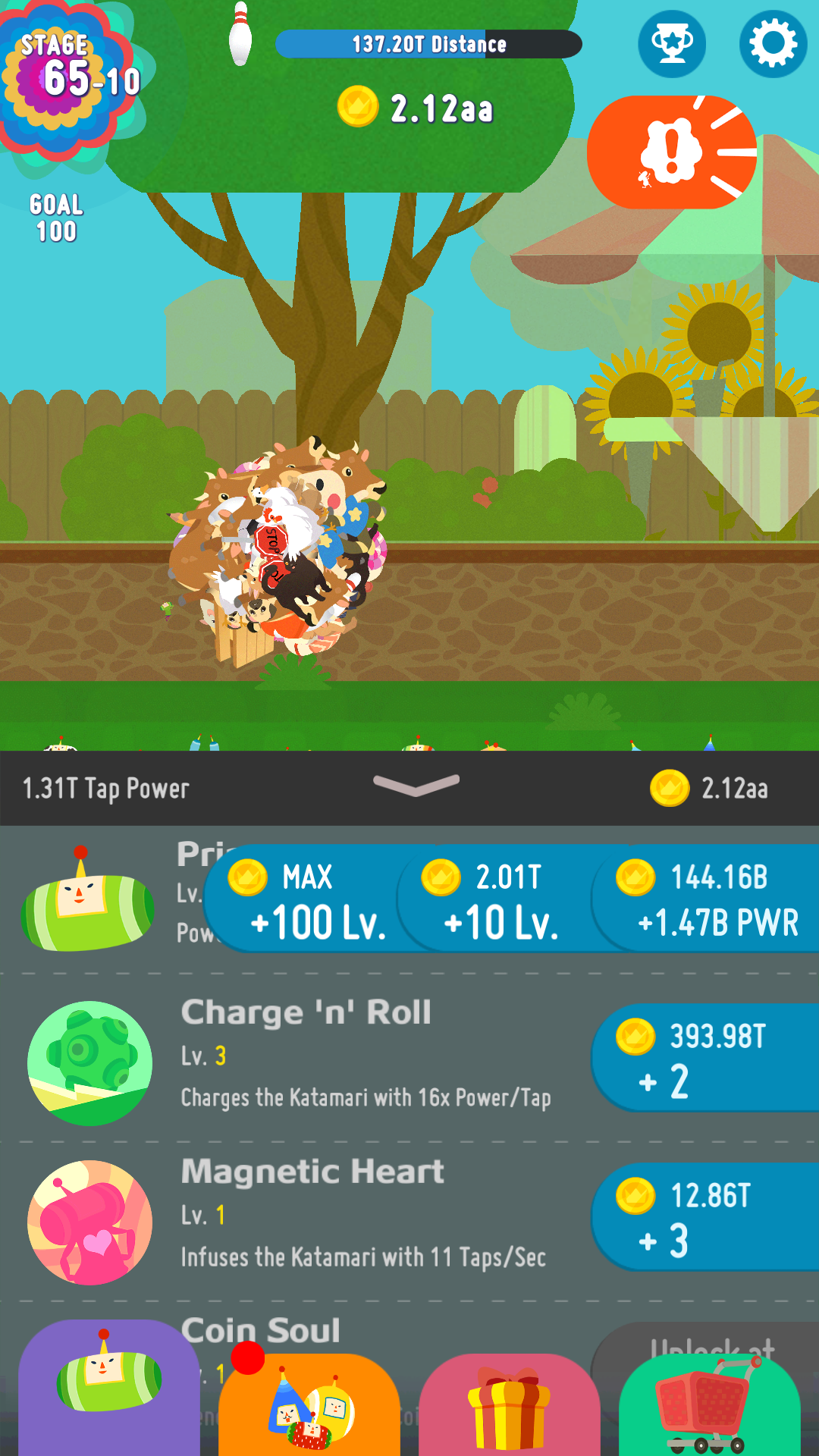
I only really played the original version of Tap My Katamari, the one that was soft-launched on the New Zealand app store at the beginning of the year. I spent a few minutes with the full version a few months after release, and it was in many ways a different game, but the core of it was still there.

When I wrote about Tap My Katamari in February, it was with a special emphasis on the fact that I had played the game sufficiently to fear I was developing an RSI. Alongside the ways that Katamari Damacy was initially interpreted and intended as a critique of consumerism -- and my own feeling that such critiques are fundamentally useless at best -- Tap My Katamari came to me to be a sort of practice. I said then that "[t]here is no phenomenology of film that can make you aware of just how often your wrists are required in daily life," and how "[t]his demand -- that the body mutate to the desires of the software -- is still not an analysis, but it is at least a reflection that does not demand a moralism. If the consumer society is unique, then it is unique in its demands on bodies; not to produce, but to watch the numbers keep going up."

If Katamari Damacy stems from a moral stance on consumerism, in other words, Tap My Katamari is a repudiation of that stance. In the ways that make it a hypocritical object, sure, but more importantly in ways that it forces the player to live in the world the way that they do live in the world, not the way that they should.

2. Final Fantasy Brave Exvius by gumi, inc.

Final Fantasy Brave Exvius is a free-to-play mobile JRPG, and it is both of these things in full. 'Active' turn-based battles bleed into energy hooks bleed into level grind bleeds into card-game cannibalization mechanics bleeds into melodramatic story bleeds into server reimbursement garbage bleeds into one of the most holistic critiques of capitalism as a social order available in a medium that literally can't be anything else.

To call Final Fantasy Brave Exvius strategic in its failures would ascribe it an intention I have no interest in, but that is very much how it feels. Most notably in the ways it fails to replicate the energy structure of a Candy Crush or a Puzzles & Dragons, instead opting for what feels like a straight asymptote; the early game is easily played to your hearts content, the late game impossible to progress reasonably through. As a kid who played JRPGs largely by burning through them until I got burned out (which is to say largely never finishing them, including Final Fantasy VII (which I sometimes call my favorite game of all time still) until year and years later), this feels less like a predatory action in itself and more like an externalization or systematization of the affect of playing these kinds of games. As does the cruft of free-to-play mechanics, from cannibalizing units for experience to the use of gems to the constant, incomprehensible special event being run.

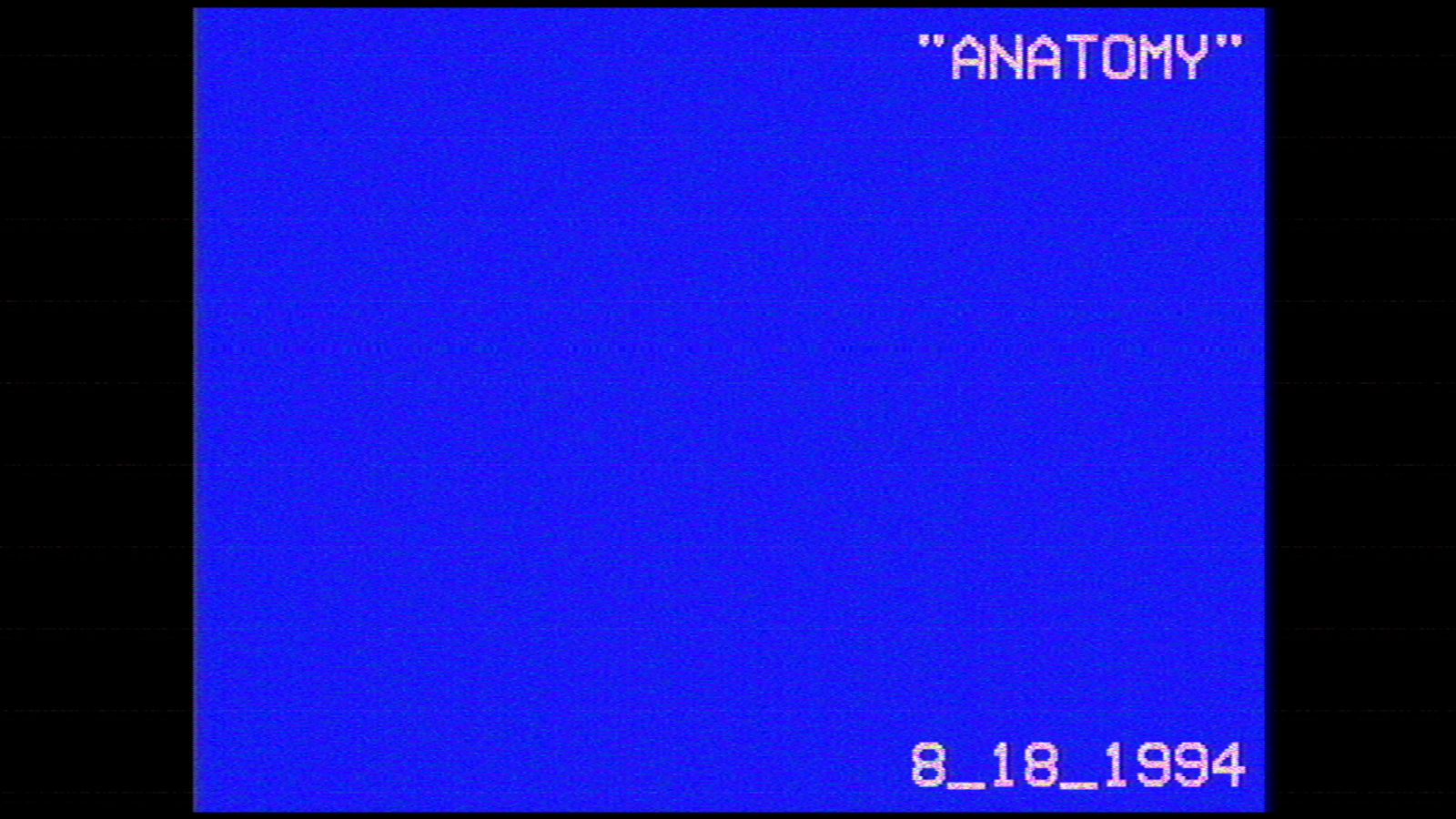
1. Anatomy by Kitty Horrorshow

It wasn't long after playing Anatomy that I kind of burned out on smaller games, and became mostly interested in playing things that would simply allow me to listen to music while performing repetitive actions. Part of that was because of my starting work on QROCC; part of it was because Anatomy hit me in a way that was exactly what I wanted from these kinds of games.

Anything I try to write about Anatomy will likely just be a retread of the piece I wrote at the beginning of the year, and while it could use some edits, I'm not in a spot to do that. The gist of it is that Anatomy is a horror game that uses not only the game but the executable itself to create horror; it is a game that crystallizes and rewards familiarity with Kitty Horrorshow's work to this point, which is some of the most vital work happening in games, and; it is a brilliant, brilliant, brilliant haunted house.

Tuesday, February 23, 2016

Short on Games: January/February 2016

Tap My Katamari


TapMyKatamari


I've never been a huge fan of the "Katamari is an indictment of consumerism" crowd, even if it does include Keita Takahashi, the series' creator. Any critique of "consumerism" is likely to set my eyes rolling, because it never amounts to much more than moralizing. Imagine my surprise, then, when the latest installment – coming long after Takahashi divested himself of the series – presented the most compelling form and rhetoric of that criticism yet, and has so become one of my favorite Katamari games ever. The form is of a tapper, or clicker, or idle or incremental game; the genre is still confused enough to not have a unified name. The rhetoric is physical. The game's argument takes place in your wrist, and it was compelling enough that I spent the week of Global Game Jam in a wrist guard, fearing the onset of an RSI.

The form of the idle game is important because in it is an embedded critique. The story goes like this: Ian Bogost, having been subject to a speech by Zynga's president at the Game Developer's Choice Award, decided to make a critique of the then-dominant genre of social games that Zynga had made a fortune with on Facebook. Bogost deconstructed these with a game called Cow Clicker, in which the player clicked a cow once every six hours to accrue currency. The game's popularity made it more than an academic exercise, and the ultimate consequence was the popularization of the idler genre. In these games, the player rarely does more than click (or tap) to accrue currency. This currency is, generally, used to purchase upgrades that have two purposes: allow the player to click less, and accrue currency faster. As Jeff Gerstmann is fond of saying, the appeal is simple: "The numbers just keep going up."

Gerstmann, who is possibly (Bogost included) the foremost critical authority on idle games, is not making an idle observation. The numbers going up is one of the more visible aspects of videogames design practices. It surfaces just how reliant videogames are on the reward loop, over and above its ostensible function as only a motivator for execution or skill. From its origin as a critique of predatory practices and poor design that turned out to be uniquely compelling to its current status as a genre-without-a-name, the idle game is uniquely suited to be a critical vehicle with teeth.

The year before Bogost sat through the Zynga president's presentation, Keita Takahashi told attendees of the Game Developer's Conference that, "I think I successfully expressed my cynical stance towards the consumption society by making Katamari - but still I felt empty when the objects were gone." In the six years between Katamari Damacy's release and Takahashi's talk, I remember hearing people float that theory around, between jokes about How High Would You Have To Be To Make This, and finding it uncompelling. Beyond even the formal category of games of complicity – your Spec Ops: The Lines and Trains and The Beginner's Guides and so on – which attempt to clarify a reading of engagement or interactivity along a moral line, reading Katamari Damacy as a polemic against consumerism makes it, at best, along the lines of the arguments that situate JRPGs as nothing more than capitalist productivity simulators with even less of a leg to stand on. Takahashi's own affective response to his game is striking, but as analysis it suggests no path other than a tired Louis CK or Jonathan Franzen bit. We live in a fallen society, it claims, and the blame lies on its inhabitants, not its architects.

* * * * *


If videogames are unique, then they are unique insofar as they can ruin your hands. The zenith of 'interactivity' is Mew2King refusing to see a doctor as his career slowly implodes. "Passive entertainment" can't compete with that. There is no phenomenology of film that can make you aware of just how often your wrists are required in daily life.

Tap My Katamari – Endless Cosmic Clicker's mechanics are simple. You tap to roll the katamari a specific distance, and every amount of that distance holds an object which it rolls up. These objects also spit out coins; one at first, and eventually more. With coins, you can buy upgrades to the Prince, or cousins who will roll the katamari without your input. Every tenth object is a gating mechanism, a "Time Attack Challenge," after which you advance to the next level. After certain levels you gain a Star Token, which can be used to buy Presents. These are functionally permanent powerups, as opposed to everything else which gets lost when you turn your katamari into a star, which requires upgrading the Prince to level 600. The strategy, roughly, is to play the game for a couple of hours until the cousins are powerful enough to generate sufficient coins to keep the whole thing going at a clip, and then check in every few hours. You do this less and less until you get to the point where you need more presents, and start it all again.

The most economical way to get coins, of course, involves tapping as fast as possible for a brief period of time. Whether you get this by the King of All Cosmos gifting you with the Royal Touch (for the nominal fee of watching an ad) or through the Coin Soul powerup that refreshes once an hour, rapid tapping becomes central to overcoming the stickier gates. The most effective way is to place both hands to either side of your phone and tap with each finger consecutively on both hands; doing this requires a very odd angle of your wrists.

This demand – that the body mutate to the desires of the software – is still not an analysis, but it is at least a reflection that does not demand a moralism. If the consumer society is unique, then it is unique in its demands on bodies; not to produce, but to watch the numbers keep going up.

Anatomy


Anatomy


The influences that Anatomy wears on its sleeve range from Videodrome to Gone Home, The Haunting of Hill House to House of Leaves. Its tension is created by rifling through a very dark house, but its horror is pure theory. Anatomy is a modest Cyclonopedia with as much, if not more, to offer.

Anatomy begins with the player in a house, which she wanders through. Doors either open or rattle when clicked, until the player finds a tape and player. When played, someone who gives the vibe of a clinical psychologist begins speaking of a theory of houses. At each segment's end, a bit of text informs the player of the location of the next tape in the house. After finding a number of tapes, and hearing the elaboration of the theory of the house as metaphorical organism, the game quits itself out.

At this point, the rattling is worth noting. As much as it is the darkness that produces the tension, and eventually the narration that develops the horror, it is the doors that don't open that develop the creepiness. The sound is a doorknob rattling in a way that is pitch perfect for someone trying to escape or break in, except it only occurs when you intentionally interact with a door. It is creepy not just because of its associations and possibilities, but because it requires a return to the fundamental question of your place within this world. As cliché as it sounds, the simple sound effect is making it clear that what's to be afraid of isn't a monster closet bursting out and spooking you, but the possibility that you are the monster in the closet from the start. In the unzipped folder that hosts Anatomy's .exe is a text file titled "SPOILERS - PLAY BEFORE READING." It is the obvious next step after the game quits, as there's hardly anything to spoil; you may wonder if there's not more game in here, or at least an explication of some kind. Read, the spoiler is simple: relaunch the game. It takes multiple playthroughs to experience in full.

It takes a couple more launches and automatic quits for the player to experience a Kitty Horrorshow environment, and its inclusion is deeply weird. The worlds of Dust City and Chyrza and Rain, House, Eternity are powerful in part because of their decontextualization. Situated explicitly as an outside, what should by all accounts be very familiar in its weird, unsettling imagery becomes, well, defamiliarized. That's a strange thing to say!

Before we get to the house itself, some words about how the game incorporates quitting and launching as a mechanic. It is a historical peculiarity of games that any state which signifies an end to progress – especially a temporary end, from which it is possible to return nearly immediately – is elided into the concept of death. While Anatomy never makes this elision explicit, it is felt. Incorporating paratextual elements into the text has been a signature of Horrorshow's since at least Dust City, and the way Anatomy does this is both recognizable and innovative. Innovative in the sense that it subtly engages with critiques of the walking simulator, especially those that claim to be about gamey credentials but are really fixated on the absence of fail states. Failing – dying – is integral to the experience of Anatomy, and not in a narrative way; but, more importantly, not in the sense of an arbitrary skill check, either. Your floating camera dies without dying, allowing the house, which already exhibits its own agency, to rearrange itself in relation to you.

Which brings us to the most important part, and what makes Anatomy possibly my favorite game made by one of my favorite game makers currently going. Because Anatomy understands that the horror of the house is not the things it hides, or what it represents, or (least of all) how it may be breached, but the theory of the house itself. Because the house is both material and symbolic in absolutely immediate ways, any attempt at taking either of these aspects alone will inevitably get mired in the other's absence.

I've been beating this drum for years, but: ghosts are space. Particularly its becoming-linguistic. And Anatomy, more than possibly anything else I have ever encountered, gets that. What's to fear aren't historical events but the deformations that they leave on a place, and the possibility that the accumulation of those deformations might make it such that the place itself learns to speak. And in learning to speak, it would learn to negate. Anatomy's finale is literally a narration of that. It is incredible.

The theory of houses espoused in Anatomy is of the house as body. The tapes tell the story of living room as heart, bathroom as digestive tract, bedroom as mind, and basement as subconscious. The metaphors are questioned even as they are stated, though; both visually and audibly. The tape that tells the story of the bedroom as mind is in a master bedroom on whose walls are many pictures of teeth. The house as body is only a half-step to the game's ultimate conclusion: that, given enough time, the whole house might become a mouth. The visceral terror there is of the teeth that grind. The horror is of the tongue that lulls, that tells you its theories and asks you for favors, that misdirects and negates. Because dying is just part of the vernacular, so trivial as to be named when it has consequence. But when the space can speak, the space that is the image of the family, of the site of reproduction, of capital and its bubbles; even if it only speaks to tell you that it has a mouth, that is horror.

Saturday, July 5, 2014

Shachipanda: Episode 2?

Update: One of my favorite authors offered translations of the dialogue, which I've included below with links to the tweets.

My preliminary thoughts are that this is an indication that the current is the final state of Shachipanda. I'm still incredibly curious about that t-shirt and what the date is, as well as just generally hoping someone who is more narratively inclined wants to put this together in a way that is satisfying both to the current design and in terms of the previous, but the big hole is now filled, and I am pretty incredibly happy about that.


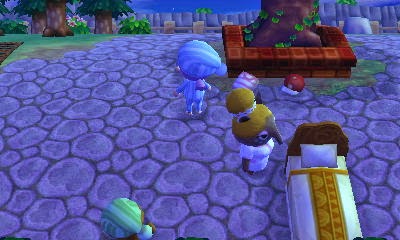
Above is the minimap for the town of Shachipanda, one of the more famous of the (non-Aika) nightmare suites available in Animal Crossing: New Leaf through the Dream Suite. I'm back into New Leaf for the first time in over half a year, and I wanted to revisit some of these "Horror Towns." I did get to go to the original Shachipanda, but I didn't take any screengrabs of it; there are plenty of annotated walkthroughs available.

The short version of the previous Shachipanda is that there is a man, whose identifying dress you wear, who runs some sort of antique shop that's a front for a drug operation. He murdered a girl and her mother, and was possibly the husband/father of them. Another girl, dressed as a rabbit, fell or was pushed off a cliff, and died. Her ghost in the initial town says that her little sister was angry; the other dead girl is the owner of the final house and it seems to be some sort of composite of her memories. There is also a wanted poster of the man, and some police tape around his house.

The current version of Shachipanda seems to be a continuation of this story, although, without knowing Japanese, I can't really piece it together completely.


1


Plugged into Google Translate, this gives "I wondering I must observe the rules"

"Follow the rules while you wander"


Main


Basement


2nd Floor


2

The second house is the house of the murderer from the previous; much of it is the same, except that now he has bedhead and a halo.


Google Translate again: "You're going to have no hesitation."

"You didn't hesitate at all, did you?"

Main


Back Room


Basement


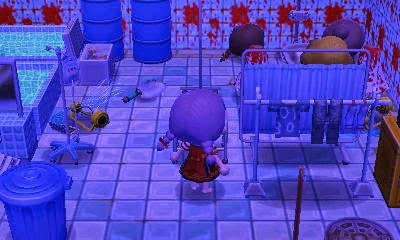
The following, is, as far as I can tell, the only change from the previous version of this room (aside from the placement in the houses); the shirt that's hanging, rather than being bloody, has what looks like some sort of date pattern on it. I couldn't find this pattern anywhere else, though it looks to say 2014 / 30, which, given that the previous town had the date of the girl's murder marked in 2013, seems to be some sort of continuity.


2nd Floor

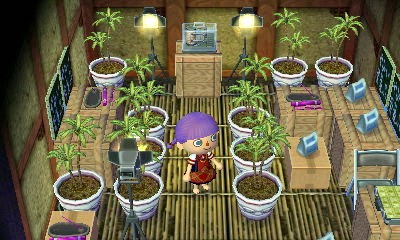
This is the biggest departure from the previous iteration of the town; where this area used to be closed off (with police tape) and include only the wetsuit and a trash can, it now has some more stuff and is accessible.


The words on this pattern are, as best I can figure, "Yamii's Garden;" Yamii being the name of the owner of the next house.


3


Last Google Translate: "And to dream and probably even a nice dream."

"Nice dream, wasn't it? Because it was a dream!"

Main Room


Back Room


Right Room


Left Room


Basement

These pictures aren't going to do them justice at all, but the basement is maybe the single best laid-out room I've ever seen in Animal Crossing; it is some sort of café/sushi bar run by anatomical models.


2nd Floor

This area is too, as it somehow wraps together the titular panda and the voyeurist themes of the previous town.


Other Stuff

Replacement for the wanted poster.


Various


The cleaned up scene of the rabbit's death, with the death- & drug-dealer's ghost.

Blog Archive