10. Like for Likes (dir. Park Hyeon-Jin)
Like for Likes is a South Korean romantic comedy about old people using Facebook and I thought it was pretty alright? Which is a strong enough recommendation for me I think.
9. The Boy (dir. William Brent Bell)
As someone who has no love for doll horror (with the exception of mannequins in giallo, maybe), The Boy looked like a real boring shitshow. And having finally watched (at least some of) James Wan's Dead Silence this year, I was especially primed to be completely uninterested in this movie; if someone as good as Wan was unable to even give me an example of this genre that really worked, who the hell is William Brent Bell to do it? The answer, as it turns out, is that he's nobody I particularly care about, and this movie didn't change my predilections at all. What it does do is have a really dope house, and a really stupid conclusion that I really liked.
The basic premise is that a couple hires a woman to nanny for them, but the boy she's nannying is a doll. But the doll seems like it's alive. But then, spoilers, it isn't. This is the only possible good twist for a movie with this plot, which is points. The real appeal, though, is the pretty darkness within the frame (literal; the color palette looks nice) and the way that the movie refuses to half-step. It's nowhere near the final shot of [rec], but it's close enough to mention that movie, if that makes sense. Not necessarily in terms of visual effects but in terms of turning a relatively dull genre film with a good eye into something genuinely memorable and exciting to have watched.
8. The Mermaid (dir. Stephen Chow)
I hope you know who Stephen Chow is, and I hope you've seen The Mermaid. It's not the best movie ever, and it hardly sticks (with me at least). But come on. This fucking movie.
7. A Violent Prosecutor (dir. Lee Il-Hyung)
Lee Il-Hyung's directorial debut is mostly a tight political thriller about the justice system, from the perspective of a wronged asshole prosecutor who gets put in prison. The broad strokes of the film, and the way in which they are played out, are pretty good, albeit not all that memorable or exciting.
The thing that puts A Violent Prosecutor on this list is the inciting event; a protest against development of, as Wikipedia puts it, "ecologically significant land." The way the whole movie hinges on the events of a few protestors squatting on some land that capital wants to develop is a pretty fucking cool hinge, and how that minor, failed action radiates through politics at the level of the criminal justice system and the electoral system is super fascinating, if in a somewhat utopian way.
6. Phantom Detective (dir. Jo Sung-Hee)
Phantom Detective is a movie whose main character is the Korean Robin Hood (Hong Gil-Dong; a different story but one with similarities) that does So Much. It does entirely too much, really; it feels like it runs five hours and contains a half dozen discrete films, and doesn't bother to glue them together in a way that feels holistic. It's a complete shitshow, in other words, and I can't possibly recommend watching it. Except it's also the best.
5. SORI: Voice from the Heart (dir. Lee Ho-Jae)
SORI: Voice from the Heart is a film about an artificially intelligent satellite that crash lands onto Earth, and a man who lost his daughter a decade ago who forms a relationship to the robot when it offers to help him find her. It's a film about American imperialism and how it manifests both in endless war and the flexing of soft power, and about grief and bonds in ways that leverage sentimentality without concluding within it.
SORI is Lee Ho-Jae's first film since 2009's The Scam, which itself was a movie about day traders at a hell of a time to make a movie about the stock market. It's maybe a stretch to call either movie out and out leftist -- both are mostly concerned with individuals and their own paths of redemption, primarily -- but not out of the realm of possibility, which is nice.
To be completely honest, SORI is a movie that I thought at the time had neat moments but was largely unremarkable; it's only in the months since I watched it that it has made a real impression on me. What I thought would be the stuff that washed out the rest ended up ebbing itself, leaving only the moments of strong visuals and the exciting turns that moved it away from its own liberalism. I don't know that it's a great movie to watch, but I think it's a great movie to have seen, which I value a lot.
4. Dongju: The Portrait of a Poet (dir. Lee Joon-Ik)
Dongju: The Portrait of a Poet is a black and white biopic about Yun Dong-ju, a leftist poet from Korea who went to university in Japan and was locked up there -- and died -- before his work was published. The film largely concerns the poet and his friend, who is more directly involved in leftist resistance against the Imperial Japanese Army and capitalism, and their attempts to live within those acts of resistance. It is a beautiful film, full of contemplative moments and petty ones, and it uses the lack of color well.
Mostly, though, it is beautiful in its serious consideration of a life of resistance.
3. Green Room (dir. Jeremy Saulnier)
The scene where the young punks play "Nazi Punks Fuck Off" to a room full of Nazis somehow manages to be poignant and energizing, rather than as cringe-worthy as I assumed it would be going in. Add to that little miracle the tight camera work, Patrick Stewart, dead Nazis, and some pleasing kitsch about punks and you've got a pretty fucking cool movie.
2. The Handmaiden (dir. Park Chan-Wook)
The Handmaiden is, and I suppose you'll know this if you're familiar at all with the film, a movie about sex. It is about sex as intimacy and transformative power, and it is about sex as control and prurient fantasy. It is parts of Salò and parts of Teorema in one movie, brought together well.
From the perspective of a Park Chan-Wook film, it is more Stoker than Vengeance trilogy, but with hints of I'm A Cyborg, but That's OK. And that's not to say it's without a feeling of continuity from Lady Vengeance, specifically. It is, in other words, a continuation of the style he has been developing for some time now, and that he is very, very good at.
The Handmaiden is, I think, one of Park Chan-Wook's most accomplished films. I think it's also something I'm not in love with, or at least wasn't after seeing it once. It might well gain only on further viewings. And starting at one of the strongest films from one of the best contemporary directors, that should feel impossible.
1. Spirits' Homecoming (dir. Cho Jung-Rae)
Spirits' Homecoming is a film about comfort women. It is one that ranges between near-explicit depictions of the systematized abduction and rapes they experienced, and a sentimentality and melodrama about their lives that puts it in the realm of a very well-funded and well made Hallmark Channel or Lifetime film. It is also couched in a frame narrative about ghosts that works, at least in my memory, extraordinarily well. It's the kind of ghost/spirit story that is in many ways a very transparent, hokey narrative device, but that invests itself with such seriousness and materiality that it pushes through those things to become something truly remarkable.
Showing posts with label ghosts. Show all posts
Showing posts with label ghosts. Show all posts
Thursday, January 12, 2017
Tuesday, February 23, 2016
Short on Games: January/February 2016
Tap My Katamari

I've never been a huge fan of the "Katamari is an indictment of consumerism" crowd, even if it does include Keita Takahashi, the series' creator. Any critique of "consumerism" is likely to set my eyes rolling, because it never amounts to much more than moralizing. Imagine my surprise, then, when the latest installment – coming long after Takahashi divested himself of the series – presented the most compelling form and rhetoric of that criticism yet, and has so become one of my favorite Katamari games ever. The form is of a tapper, or clicker, or idle or incremental game; the genre is still confused enough to not have a unified name. The rhetoric is physical. The game's argument takes place in your wrist, and it was compelling enough that I spent the week of Global Game Jam in a wrist guard, fearing the onset of an RSI.
The form of the idle game is important because in it is an embedded critique. The story goes like this: Ian Bogost, having been subject to a speech by Zynga's president at the Game Developer's Choice Award, decided to make a critique of the then-dominant genre of social games that Zynga had made a fortune with on Facebook. Bogost deconstructed these with a game called Cow Clicker, in which the player clicked a cow once every six hours to accrue currency. The game's popularity made it more than an academic exercise, and the ultimate consequence was the popularization of the idler genre. In these games, the player rarely does more than click (or tap) to accrue currency. This currency is, generally, used to purchase upgrades that have two purposes: allow the player to click less, and accrue currency faster. As Jeff Gerstmann is fond of saying, the appeal is simple: "The numbers just keep going up."
Gerstmann, who is possibly (Bogost included) the foremost critical authority on idle games, is not making an idle observation. The numbers going up is one of the more visible aspects of videogames design practices. It surfaces just how reliant videogames are on the reward loop, over and above its ostensible function as only a motivator for execution or skill. From its origin as a critique of predatory practices and poor design that turned out to be uniquely compelling to its current status as a genre-without-a-name, the idle game is uniquely suited to be a critical vehicle with teeth.
The year before Bogost sat through the Zynga president's presentation, Keita Takahashi told attendees of the Game Developer's Conference that, "I think I successfully expressed my cynical stance towards the consumption society by making Katamari - but still I felt empty when the objects were gone." In the six years between Katamari Damacy's release and Takahashi's talk, I remember hearing people float that theory around, between jokes about How High Would You Have To Be To Make This, and finding it uncompelling. Beyond even the formal category of games of complicity – your Spec Ops: The Lines and Trains and The Beginner's Guides and so on – which attempt to clarify a reading of engagement or interactivity along a moral line, reading Katamari Damacy as a polemic against consumerism makes it, at best, along the lines of the arguments that situate JRPGs as nothing more than capitalist productivity simulators with even less of a leg to stand on. Takahashi's own affective response to his game is striking, but as analysis it suggests no path other than a tired Louis CK or Jonathan Franzen bit. We live in a fallen society, it claims, and the blame lies on its inhabitants, not its architects.
* * * * *
If videogames are unique, then they are unique insofar as they can ruin your hands. The zenith of 'interactivity' is Mew2King refusing to see a doctor as his career slowly implodes. "Passive entertainment" can't compete with that. There is no phenomenology of film that can make you aware of just how often your wrists are required in daily life.
Tap My Katamari – Endless Cosmic Clicker's mechanics are simple. You tap to roll the katamari a specific distance, and every amount of that distance holds an object which it rolls up. These objects also spit out coins; one at first, and eventually more. With coins, you can buy upgrades to the Prince, or cousins who will roll the katamari without your input. Every tenth object is a gating mechanism, a "Time Attack Challenge," after which you advance to the next level. After certain levels you gain a Star Token, which can be used to buy Presents. These are functionally permanent powerups, as opposed to everything else which gets lost when you turn your katamari into a star, which requires upgrading the Prince to level 600. The strategy, roughly, is to play the game for a couple of hours until the cousins are powerful enough to generate sufficient coins to keep the whole thing going at a clip, and then check in every few hours. You do this less and less until you get to the point where you need more presents, and start it all again.
The most economical way to get coins, of course, involves tapping as fast as possible for a brief period of time. Whether you get this by the King of All Cosmos gifting you with the Royal Touch (for the nominal fee of watching an ad) or through the Coin Soul powerup that refreshes once an hour, rapid tapping becomes central to overcoming the stickier gates. The most effective way is to place both hands to either side of your phone and tap with each finger consecutively on both hands; doing this requires a very odd angle of your wrists.
This demand – that the body mutate to the desires of the software – is still not an analysis, but it is at least a reflection that does not demand a moralism. If the consumer society is unique, then it is unique in its demands on bodies; not to produce, but to watch the numbers keep going up.
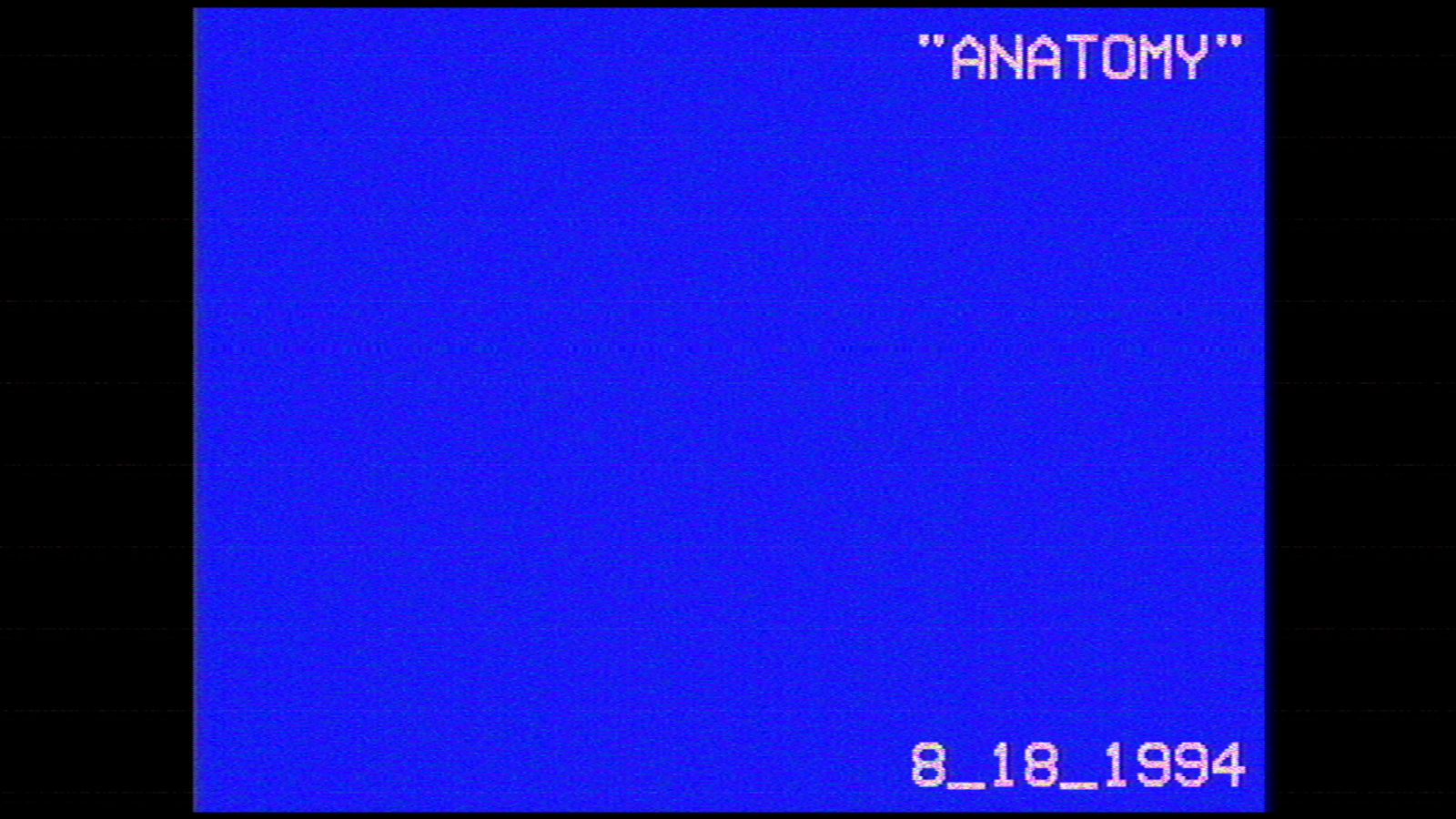
The influences that Anatomy wears on its sleeve range from Videodrome to Gone Home, The Haunting of Hill House to House of Leaves. Its tension is created by rifling through a very dark house, but its horror is pure theory. Anatomy is a modest Cyclonopedia with as much, if not more, to offer.
Anatomy begins with the player in a house, which she wanders through. Doors either open or rattle when clicked, until the player finds a tape and player. When played, someone who gives the vibe of a clinical psychologist begins speaking of a theory of houses. At each segment's end, a bit of text informs the player of the location of the next tape in the house. After finding a number of tapes, and hearing the elaboration of the theory of the house as metaphorical organism, the game quits itself out.
At this point, the rattling is worth noting. As much as it is the darkness that produces the tension, and eventually the narration that develops the horror, it is the doors that don't open that develop the creepiness. The sound is a doorknob rattling in a way that is pitch perfect for someone trying to escape or break in, except it only occurs when you intentionally interact with a door. It is creepy not just because of its associations and possibilities, but because it requires a return to the fundamental question of your place within this world. As cliché as it sounds, the simple sound effect is making it clear that what's to be afraid of isn't a monster closet bursting out and spooking you, but the possibility that you are the monster in the closet from the start. In the unzipped folder that hosts Anatomy's .exe is a text file titled "SPOILERS - PLAY BEFORE READING." It is the obvious next step after the game quits, as there's hardly anything to spoil; you may wonder if there's not more game in here, or at least an explication of some kind. Read, the spoiler is simple: relaunch the game. It takes multiple playthroughs to experience in full.
It takes a couple more launches and automatic quits for the player to experience a Kitty Horrorshow environment, and its inclusion is deeply weird. The worlds of Dust City and Chyrza and Rain, House, Eternity are powerful in part because of their decontextualization. Situated explicitly as an outside, what should by all accounts be very familiar in its weird, unsettling imagery becomes, well, defamiliarized. That's a strange thing to say!
Before we get to the house itself, some words about how the game incorporates quitting and launching as a mechanic. It is a historical peculiarity of games that any state which signifies an end to progress – especially a temporary end, from which it is possible to return nearly immediately – is elided into the concept of death. While Anatomy never makes this elision explicit, it is felt. Incorporating paratextual elements into the text has been a signature of Horrorshow's since at least Dust City, and the way Anatomy does this is both recognizable and innovative. Innovative in the sense that it subtly engages with critiques of the walking simulator, especially those that claim to be about gamey credentials but are really fixated on the absence of fail states. Failing – dying – is integral to the experience of Anatomy, and not in a narrative way; but, more importantly, not in the sense of an arbitrary skill check, either. Your floating camera dies without dying, allowing the house, which already exhibits its own agency, to rearrange itself in relation to you.
Which brings us to the most important part, and what makes Anatomy possibly my favorite game made by one of my favorite game makers currently going. Because Anatomy understands that the horror of the house is not the things it hides, or what it represents, or (least of all) how it may be breached, but the theory of the house itself. Because the house is both material and symbolic in absolutely immediate ways, any attempt at taking either of these aspects alone will inevitably get mired in the other's absence.
I've been beating this drum for years, but: ghosts are space. Particularly its becoming-linguistic. And Anatomy, more than possibly anything else I have ever encountered, gets that. What's to fear aren't historical events but the deformations that they leave on a place, and the possibility that the accumulation of those deformations might make it such that the place itself learns to speak. And in learning to speak, it would learn to negate. Anatomy's finale is literally a narration of that. It is incredible.
The theory of houses espoused in Anatomy is of the house as body. The tapes tell the story of living room as heart, bathroom as digestive tract, bedroom as mind, and basement as subconscious. The metaphors are questioned even as they are stated, though; both visually and audibly. The tape that tells the story of the bedroom as mind is in a master bedroom on whose walls are many pictures of teeth. The house as body is only a half-step to the game's ultimate conclusion: that, given enough time, the whole house might become a mouth. The visceral terror there is of the teeth that grind. The horror is of the tongue that lulls, that tells you its theories and asks you for favors, that misdirects and negates. Because dying is just part of the vernacular, so trivial as to be named when it has consequence. But when the space can speak, the space that is the image of the family, of the site of reproduction, of capital and its bubbles; even if it only speaks to tell you that it has a mouth, that is horror.
Tuesday, December 31, 2013
2013 in Shit (BONUS): Hello Kitty's Fashion Music Wonderland & Here We Go!
In 2013, Viz Media started a line of comics licensed by Sanrio. Each of them tells a series of short, wordless stories about Kitty and her friends.
For ComicCon this year, a sort of pre-series comic was released, called Hello Kitty's Fashion Music Wonderland. In October, the first of the actual series came out: Hello Kitty: Here We Go!. I had Fashion Music Wonderland long before I started this series, but had kind of forgotten about it; I only recently got Here We Go!. They're both kind of great, as a person who likes Hello Kitty a lot. So I decided that, even though I read no other comics, they were worth talking about.

It seems like it's been ages since I've discussed any specific piece of Hello Kitty visual art; after I initally wrote about Jason Han's "I Haz Mouth," I had kind of planned to talk at length about some of the other paintings or sculptures from the 35th anniversary, collected in the Three Apples book. I never really got around to it, unfortunately, and I'm certainly not going to be going nearly as in depth here, but it'll be a fun little thing to do.
The first image, above, is from the arc in Fashion Music Wonderland in which Kitty White becomes a famous pop star; it specifically is the panel where she receives the gift of a Rock Band-like system from Dear Daniel, her old friend/boyfriend/husband, or something, depending on the line I guess.
It's a weird image, kind of very reminiscent of "I Haz Mouth" in its replication of Kitty's face. Except this time her "primary" face is actually entirely absent; her back is turned, but the speech bubble has her full face inside of it, and there is a "pixelated" version of it on the screen of the television. Plus there is Dear Daniel, whose face is also Kitty's face.
But then, it's also even more complex in its way; the exclamation point this time is not just in the speech bubble, it is dotted with Kitty's face, and surrounded by the Bang!-like color that also goes around the Kitty-whose-"talking"'s self. And instead of mirror Kitty (or Mimmy, but probably not) there's Dear Daniel looking like a smug-ass dad, which just, I don't even know how to.
In the short narrative, this gift leads to the formation of a band, who go to a talent show and win a record deal, and Kitty goes off to travel the world, even as she pines for Dear Daniel back home. The final panel of the arc mirrors this one, as Dear Daniel is lead to retrieve his gift which turns out to be Kitty herself; given the bizarre way in which Kitty is refracted throughout the objects and expressions here, from linguistically to technologically mediated, her own return as a unified individual gift is, well, really really interesting.
Of course, the whole point of Hello Kitty is that she is meant to be a gift, whether for another or to oneself, so this moment is shot through with that knowledge as well. I've not got a ton to say there, although it should remain an open topic, I think.
More immediately relevant is that, if, like I've been endlessly repeating, ghosts are about a becoming-linguistic of space, then this panel suggests a certain ghostliness to Kitty herself, if in no other way than in her persistent refusal to become-linguistic. I've covered this better in the essays linked above, but her tendency to occupy non-linguistic representative spaces through signifiers of language is pretty well established at this point. Here though, there is the addition, in the form of the "pixelated" face, of the sort of necessary abstraction of language as well as its refusal. It's a real neat panel.

It's not until the main story arc of Fashion Music Wonderland, where Kitty stars in a sorta Alice in Wonderland, that we see ghosts again. There's the Cheshire Cat, of course, but there's also this weird moment, where Kitty is chasing after that cat, and runs through this intersection populated by quasi-human forms that, again, seem to be somewhat digitized. In a weird way, it could almost be a scene out of Serial Experiments Lain, Internet ghosts and all.
Kitty is chasing the Cheshire Cat because Dear Daniel, here in the role of the very late rabbit, has asked her about his gloves and top hat, which the Cat is wearing. She entered Wonderland by way of thoughtlessly wandering into an open manhole, where she transformed into Fashion Music Kitty; it's all pretty adorable. This in Wonderland ends at the tea party, where the Red Queen shows up and looks very intimidating but ultimately invites Kitty in, and they all enjoy themselves. Which is all just to say that this scene is not really even remotely important to the story; it's a pure action sequence, devoid of narrative weight or responsibility, an unnecessary conveyance of how she gets from point A to point B. It is, in other words, a sort of visualization of what's usually left in the gutter.
Of course, these are more obviously ghostly than the reaction shot to Kitty's gift, even if it also obvious that they are not meant to be read as ghosts insofar as ghosts are associated with horror. They are, rather, instantiations or embodiments of space; a crosswalk doesn't make sense without both vehicular and pedestrian traffic, but it can only really project the former sufficiently. So it speaks its form through these quasidigital objects.

The "Deep Clean" short of Hello Kitty: Here We Go! has, incidentally, a panel that almost directly quotes the latter one from Fashion Music Wonderland. In this, Kitty is engaged in spring cleaning when she gets sucked into a deep underground civilization made up of people made of stone who eat gems and drink and smoke lava. As she enters the town, following her new friend, the panel above shows her wonderment and the friendliness of her newfound city's inhabitants.
In this case, the way that the inhabitants function as expressions of the landscape itself; that deep, the folks are made of rocks, of course. There's no crosswalk, because there's probably not a whole lot of need for vehicular travel; the roads are still very much designed for them, though. Here We Go! is very much, as the name suggests, a comic about Kitty's travels; she is depicted variously as a secret agent, an explorer, and a safari-goer throughout the collection. There are a number of vehicles that she drives or rides in, which makes the absence of them here, if not especially pronounced, at least interesting.
This too is why the stone folks inhabitants of this space is interesting on the level of space itself's becoming-linguistic. In conjunction with the quotation of the digitalish ghosts from the earlier collection of stories, here we are dealing with embodiment through possibility; rather, though, than the expression of space through slightly-estranged normative bodies, its through bodies themselves that are expressions of (in that they consist of the same stuff as, abstracted anthropomorphically,) the space. Which again recalls the first pictured panel; when Kitty becomes linguistic, or at least decidedly fails to, its generally through a form of expression which only ever appears as a simple representation of the stuff of which she is made. Her face.
Speaking of Kitty with the gendered pronoun obscures the point here significantly. That is: she herself is not a character. She precedes narrative. Kitty White is neither character nor stuff; she only exists as stuff, but on its periphery, or as a structuring force. Kitty is, that is to say, the way that stuff enters into the realm of representation, that it becomes-linguistic. She is, I suppose, a brand, although I hold some reservations about using that sort of language. Not that it's necessarily wrong, just that I'm not sure it's totally right.
These three panels, across two comics, tell their own story; it's about how Kitty's presence structures the possibility of the stuff which surrounds her. Call it Kitty Correlationism; her worlds are always only epistemological, organizations of being in accordance with the self-image of branded junk without interiority. Without an anchoring subjectivity, space becomes necessarily as expressive as the pseudosubjects which inhabit it. It's the objective correlative writ large; space, in fiction, sure, but mostly in manufactured objects that exist in the world as potentials for exchange-value, is a response to the subjects affective state.

The final image, also from Here We Go!, complicates my tidy little narrative. From one of the one-page shorts with which this title is filled, it is a brief story about Kitty driving around, getting a flat, and using My Melody's unicycle to replace the tire.
The most obvious difference is the style, which is most obviously explicable by way of the little lines that emanate from the characters' eyes. They aren't really expression lines or action lines or anything; they're just kind of there, looking real weird. Especially on My Melo.
But then, here is the vehicle, no longer absent. A car, too, that object which has, perhaps more than any other, totally restructured the way space works in the world for individuals, especially in America. From trucking to suburbs to sprawl, the automobile is sort of the antithesis of the expression of space; it's its silencing, at least in the form of distance. And yet here too is Kitty.
For ComicCon this year, a sort of pre-series comic was released, called Hello Kitty's Fashion Music Wonderland. In October, the first of the actual series came out: Hello Kitty: Here We Go!. I had Fashion Music Wonderland long before I started this series, but had kind of forgotten about it; I only recently got Here We Go!. They're both kind of great, as a person who likes Hello Kitty a lot. So I decided that, even though I read no other comics, they were worth talking about.

It seems like it's been ages since I've discussed any specific piece of Hello Kitty visual art; after I initally wrote about Jason Han's "I Haz Mouth," I had kind of planned to talk at length about some of the other paintings or sculptures from the 35th anniversary, collected in the Three Apples book. I never really got around to it, unfortunately, and I'm certainly not going to be going nearly as in depth here, but it'll be a fun little thing to do.
The first image, above, is from the arc in Fashion Music Wonderland in which Kitty White becomes a famous pop star; it specifically is the panel where she receives the gift of a Rock Band-like system from Dear Daniel, her old friend/boyfriend/husband, or something, depending on the line I guess.
It's a weird image, kind of very reminiscent of "I Haz Mouth" in its replication of Kitty's face. Except this time her "primary" face is actually entirely absent; her back is turned, but the speech bubble has her full face inside of it, and there is a "pixelated" version of it on the screen of the television. Plus there is Dear Daniel, whose face is also Kitty's face.
But then, it's also even more complex in its way; the exclamation point this time is not just in the speech bubble, it is dotted with Kitty's face, and surrounded by the Bang!-like color that also goes around the Kitty-whose-"talking"'s self. And instead of mirror Kitty (or Mimmy, but probably not) there's Dear Daniel looking like a smug-ass dad, which just, I don't even know how to.
In the short narrative, this gift leads to the formation of a band, who go to a talent show and win a record deal, and Kitty goes off to travel the world, even as she pines for Dear Daniel back home. The final panel of the arc mirrors this one, as Dear Daniel is lead to retrieve his gift which turns out to be Kitty herself; given the bizarre way in which Kitty is refracted throughout the objects and expressions here, from linguistically to technologically mediated, her own return as a unified individual gift is, well, really really interesting.
Of course, the whole point of Hello Kitty is that she is meant to be a gift, whether for another or to oneself, so this moment is shot through with that knowledge as well. I've not got a ton to say there, although it should remain an open topic, I think.
More immediately relevant is that, if, like I've been endlessly repeating, ghosts are about a becoming-linguistic of space, then this panel suggests a certain ghostliness to Kitty herself, if in no other way than in her persistent refusal to become-linguistic. I've covered this better in the essays linked above, but her tendency to occupy non-linguistic representative spaces through signifiers of language is pretty well established at this point. Here though, there is the addition, in the form of the "pixelated" face, of the sort of necessary abstraction of language as well as its refusal. It's a real neat panel.

It's not until the main story arc of Fashion Music Wonderland, where Kitty stars in a sorta Alice in Wonderland, that we see ghosts again. There's the Cheshire Cat, of course, but there's also this weird moment, where Kitty is chasing after that cat, and runs through this intersection populated by quasi-human forms that, again, seem to be somewhat digitized. In a weird way, it could almost be a scene out of Serial Experiments Lain, Internet ghosts and all.
Kitty is chasing the Cheshire Cat because Dear Daniel, here in the role of the very late rabbit, has asked her about his gloves and top hat, which the Cat is wearing. She entered Wonderland by way of thoughtlessly wandering into an open manhole, where she transformed into Fashion Music Kitty; it's all pretty adorable. This in Wonderland ends at the tea party, where the Red Queen shows up and looks very intimidating but ultimately invites Kitty in, and they all enjoy themselves. Which is all just to say that this scene is not really even remotely important to the story; it's a pure action sequence, devoid of narrative weight or responsibility, an unnecessary conveyance of how she gets from point A to point B. It is, in other words, a sort of visualization of what's usually left in the gutter.
Of course, these are more obviously ghostly than the reaction shot to Kitty's gift, even if it also obvious that they are not meant to be read as ghosts insofar as ghosts are associated with horror. They are, rather, instantiations or embodiments of space; a crosswalk doesn't make sense without both vehicular and pedestrian traffic, but it can only really project the former sufficiently. So it speaks its form through these quasidigital objects.

The "Deep Clean" short of Hello Kitty: Here We Go! has, incidentally, a panel that almost directly quotes the latter one from Fashion Music Wonderland. In this, Kitty is engaged in spring cleaning when she gets sucked into a deep underground civilization made up of people made of stone who eat gems and drink and smoke lava. As she enters the town, following her new friend, the panel above shows her wonderment and the friendliness of her newfound city's inhabitants.
In this case, the way that the inhabitants function as expressions of the landscape itself; that deep, the folks are made of rocks, of course. There's no crosswalk, because there's probably not a whole lot of need for vehicular travel; the roads are still very much designed for them, though. Here We Go! is very much, as the name suggests, a comic about Kitty's travels; she is depicted variously as a secret agent, an explorer, and a safari-goer throughout the collection. There are a number of vehicles that she drives or rides in, which makes the absence of them here, if not especially pronounced, at least interesting.
This too is why the stone folks inhabitants of this space is interesting on the level of space itself's becoming-linguistic. In conjunction with the quotation of the digitalish ghosts from the earlier collection of stories, here we are dealing with embodiment through possibility; rather, though, than the expression of space through slightly-estranged normative bodies, its through bodies themselves that are expressions of (in that they consist of the same stuff as, abstracted anthropomorphically,) the space. Which again recalls the first pictured panel; when Kitty becomes linguistic, or at least decidedly fails to, its generally through a form of expression which only ever appears as a simple representation of the stuff of which she is made. Her face.
Speaking of Kitty with the gendered pronoun obscures the point here significantly. That is: she herself is not a character. She precedes narrative. Kitty White is neither character nor stuff; she only exists as stuff, but on its periphery, or as a structuring force. Kitty is, that is to say, the way that stuff enters into the realm of representation, that it becomes-linguistic. She is, I suppose, a brand, although I hold some reservations about using that sort of language. Not that it's necessarily wrong, just that I'm not sure it's totally right.
These three panels, across two comics, tell their own story; it's about how Kitty's presence structures the possibility of the stuff which surrounds her. Call it Kitty Correlationism; her worlds are always only epistemological, organizations of being in accordance with the self-image of branded junk without interiority. Without an anchoring subjectivity, space becomes necessarily as expressive as the pseudosubjects which inhabit it. It's the objective correlative writ large; space, in fiction, sure, but mostly in manufactured objects that exist in the world as potentials for exchange-value, is a response to the subjects affective state.

The final image, also from Here We Go!, complicates my tidy little narrative. From one of the one-page shorts with which this title is filled, it is a brief story about Kitty driving around, getting a flat, and using My Melody's unicycle to replace the tire.
The most obvious difference is the style, which is most obviously explicable by way of the little lines that emanate from the characters' eyes. They aren't really expression lines or action lines or anything; they're just kind of there, looking real weird. Especially on My Melo.
But then, here is the vehicle, no longer absent. A car, too, that object which has, perhaps more than any other, totally restructured the way space works in the world for individuals, especially in America. From trucking to suburbs to sprawl, the automobile is sort of the antithesis of the expression of space; it's its silencing, at least in the form of distance. And yet here too is Kitty.
Saturday, December 14, 2013
2013 in Shit: You're Next
This is a movie about an estranged and hostile space, as are all home invasion and haunted house movies; it tells us this from the beginning with its Halloween-patented shaky is-it-the-killer's-POV? cam and its tight angles that refuse space, in how it manufactures that Lynchian moment with the lingering camera at the unopened (closet?) door at once situated and antitopological, in how it tightens the world through that once off reference among the myriad of other images to a kind of visual claustrophobia where a meat-tenderizer can function legibly as a deadly weapon at the same (albeit chronologically different) time as the glass of a window can empty itself into the documentarian's brain as a crossbow bolt. It's a movie about an unknowable mansion in this way, with space mappable but only as action taken in its own negations; this is never more clear than in the brief sequences shot outside as characters run away, as the trails & roads vanish into absolute forest. It seems that even the driveway dissolves itself with the light as the cars vanish into an out-of place to be seen only in total isolation.
It's worth noting that there are only three traps -- a fourth if you count the camera in the basement -- and the only two that seem really premeditated are both at the front door, with the third the discarded nail-bat beneath the window. The piano wire strung up by the invaders functions as a kind of final emphasis that the house itself has inverted, or everted, lost its constitutive claim to being the becoming of the private, lost fully the fantastical resonances of the castle only to find itself in its own malevolent intelligence. And then, hours later, the protagonist's failure to recognize this leads to the Home Alone-style axe trap rigged in that same space, as though we were still operating in under the illusion of objectivity amenable to modification and not a bastard constellation of desire and thing, which reminds in its first failure that this malevolence is organized as much by the porousness of space as by its opaqueness. It isn't just the way halls and doors obscure visibility; its the way that portals themselves, the means of communication -- that make the house in common with itself, that provide it a system of signification -- are high abstractions, signifiers that only function as though they are linked to their signifieds under certain forms of very specific, arbitrary authority. Which is why when the cop catches that trap to the chest it's not only the FTP but the formalist in me that yelps & claps loud in a mostly empty theater. Mostly its the FTP though.
If the home invasion genre is better at performing the haunted house than those films whose generic identity is rooted in the trope, like last year's Silent House, then You're Next's invasion at a distance (as metonymized through the crossbow) ramps it up a notch; the house pops inwards with an objective cause that only ever announces itself after the fact, in wound of flesh or property, in accordance with the creation or curation or dissolution of tension as the case may be, but, in its fidelity to the affect, always presenting an unknowable immanence prior to and premiere over the subsequence, the folding back into the linguistic facticity of the crossbow bolt buried in the jock's shoulder. That is, of course, if my claims about haunted houses bear any weight, as well, which build on my thoughts about ghosts against their characterization and for their formal qualities as a sort of linguistics of place, or the becoming of a subjectivity of space. Your mileage may vary or whatever.
How else to know a house but through the legal abstractions that condition it, through the language whose obfuscation is a condition of its precision (as though there was any other way)? Private property is a cop, and even if its only through the mediation of Home Alone in a constructed medium that jiggles the doorhandle that pulls the string that pendulums the axe, at least it can be mediated at all. Anyway, that's (apparently) the purview of tomorrow's on The Purge; for now know only that when the homes grow tongues and history fucking attacks that you won't get very far complaining about the illegibility of their speech. If the hostile home's a camera flashing's strobe light in a basement's lure to a two-by-four bludgeoning, or an unexploded gas pump leaking at a station surrounded by a chorus of cars, or a bleeding wall of awkwardly allegorized trauma, don't look all shocked or try to pretend the people there had a goddamn thing to do about it. It's the fucking social and it doesn't have your best interests at heart.
Threaded through You're Next (have I already gone too far? Can I not return to it at this point? I will, anyway), too, is a strong critique of survivalism, contemporarily a US libertarian aesthetic, in the form of the ass-kicking lady protagonist of the movie who murders her way out of the situation, becoming a Die Hard-style vessel for accumulated gore. Except also for injury. The movie ends, before the cop gets it, with her final murder, for its own sake (I believe the accompanying dialogue is "Why not?") of her greedy rich professor boyfriend, a cutting of the gordian knot of wealth & happiness or wealth & freedom, a refusal to die presented as a refusal of a refusal to die, which is a pretty accurate description of the extent of her characterization (achieved through meat cleaver and mechanized blender to brain matter murders, for the most part) at all points prior. An Aussie-inflected libertarian who refuses the American Dream (being born well off and inheriting riches)? Of course she's going to kill cops, whether she wants to or not. The meritocratic myth has to die in each of us some way, so why not through the hostile thinking house and the gore of elaborately manufactured "state of nature" scenarios? I'm fucking into it.
It's worth noting that there are only three traps -- a fourth if you count the camera in the basement -- and the only two that seem really premeditated are both at the front door, with the third the discarded nail-bat beneath the window. The piano wire strung up by the invaders functions as a kind of final emphasis that the house itself has inverted, or everted, lost its constitutive claim to being the becoming of the private, lost fully the fantastical resonances of the castle only to find itself in its own malevolent intelligence. And then, hours later, the protagonist's failure to recognize this leads to the Home Alone-style axe trap rigged in that same space, as though we were still operating in under the illusion of objectivity amenable to modification and not a bastard constellation of desire and thing, which reminds in its first failure that this malevolence is organized as much by the porousness of space as by its opaqueness. It isn't just the way halls and doors obscure visibility; its the way that portals themselves, the means of communication -- that make the house in common with itself, that provide it a system of signification -- are high abstractions, signifiers that only function as though they are linked to their signifieds under certain forms of very specific, arbitrary authority. Which is why when the cop catches that trap to the chest it's not only the FTP but the formalist in me that yelps & claps loud in a mostly empty theater. Mostly its the FTP though.
If the home invasion genre is better at performing the haunted house than those films whose generic identity is rooted in the trope, like last year's Silent House, then You're Next's invasion at a distance (as metonymized through the crossbow) ramps it up a notch; the house pops inwards with an objective cause that only ever announces itself after the fact, in wound of flesh or property, in accordance with the creation or curation or dissolution of tension as the case may be, but, in its fidelity to the affect, always presenting an unknowable immanence prior to and premiere over the subsequence, the folding back into the linguistic facticity of the crossbow bolt buried in the jock's shoulder. That is, of course, if my claims about haunted houses bear any weight, as well, which build on my thoughts about ghosts against their characterization and for their formal qualities as a sort of linguistics of place, or the becoming of a subjectivity of space. Your mileage may vary or whatever.
How else to know a house but through the legal abstractions that condition it, through the language whose obfuscation is a condition of its precision (as though there was any other way)? Private property is a cop, and even if its only through the mediation of Home Alone in a constructed medium that jiggles the doorhandle that pulls the string that pendulums the axe, at least it can be mediated at all. Anyway, that's (apparently) the purview of tomorrow's on The Purge; for now know only that when the homes grow tongues and history fucking attacks that you won't get very far complaining about the illegibility of their speech. If the hostile home's a camera flashing's strobe light in a basement's lure to a two-by-four bludgeoning, or an unexploded gas pump leaking at a station surrounded by a chorus of cars, or a bleeding wall of awkwardly allegorized trauma, don't look all shocked or try to pretend the people there had a goddamn thing to do about it. It's the fucking social and it doesn't have your best interests at heart.
Threaded through You're Next (have I already gone too far? Can I not return to it at this point? I will, anyway), too, is a strong critique of survivalism, contemporarily a US libertarian aesthetic, in the form of the ass-kicking lady protagonist of the movie who murders her way out of the situation, becoming a Die Hard-style vessel for accumulated gore. Except also for injury. The movie ends, before the cop gets it, with her final murder, for its own sake (I believe the accompanying dialogue is "Why not?") of her greedy rich professor boyfriend, a cutting of the gordian knot of wealth & happiness or wealth & freedom, a refusal to die presented as a refusal of a refusal to die, which is a pretty accurate description of the extent of her characterization (achieved through meat cleaver and mechanized blender to brain matter murders, for the most part) at all points prior. An Aussie-inflected libertarian who refuses the American Dream (being born well off and inheriting riches)? Of course she's going to kill cops, whether she wants to or not. The meritocratic myth has to die in each of us some way, so why not through the hostile thinking house and the gore of elaborately manufactured "state of nature" scenarios? I'm fucking into it.
Sunday, December 8, 2013
2013 in Shit: Nevada
I wish I had more to say about Nevada, but I don't, really; JR's writeup convinced me to read it, and I am immensely glad that I did. It is a gorgeous novel, full of beautiful and important and difficult things. It is also the sort of novel that forces even someone with inclinations like myself to read it very personally, in a way that I can't even begin to express how much I appreciated but am not even remotely equipped to articulate.
The one small thing I feel like I can add to the discussion is to focus, very briefly, on just how incredible the novel's ability to move through and in space is; it starts in New York City and ends in Reno, and even though the trip between isn't narrated it is felt. It's a simple, if jarring, perspective shift, from Maria to James, that takes us from the East Coast to the titular state, but the way that shift codes the movement through space in time is complex in all the same ways that the extranovelistic act is. Or at least was in my experience, I guess.
It isn't just the absence there, of course, but the way the novel builds a New York City prior to that, the sketches of Maria's bookstore job and apartment and favorite diner and friends' houses conveying at once a deeply personal and nearly geographically social look at that most fictionalized of American cities, with settings that are never quite set, but neither in flux. It's a depth of form achieved through means other than (or, rather, often, in addition to) "mastery," which is another thing I care deeply about as well but have only my bizarre ranting pseudoacademic language to even begin to articulate, and I really don't feel even remotely inclined toward that here, so.
And yes, ghosts, though I know not how.
The one small thing I feel like I can add to the discussion is to focus, very briefly, on just how incredible the novel's ability to move through and in space is; it starts in New York City and ends in Reno, and even though the trip between isn't narrated it is felt. It's a simple, if jarring, perspective shift, from Maria to James, that takes us from the East Coast to the titular state, but the way that shift codes the movement through space in time is complex in all the same ways that the extranovelistic act is. Or at least was in my experience, I guess.
It isn't just the absence there, of course, but the way the novel builds a New York City prior to that, the sketches of Maria's bookstore job and apartment and favorite diner and friends' houses conveying at once a deeply personal and nearly geographically social look at that most fictionalized of American cities, with settings that are never quite set, but neither in flux. It's a depth of form achieved through means other than (or, rather, often, in addition to) "mastery," which is another thing I care deeply about as well but have only my bizarre ranting pseudoacademic language to even begin to articulate, and I really don't feel even remotely inclined toward that here, so.
And yes, ghosts, though I know not how.
Sunday, December 1, 2013
2013 in Shit: Joyland
There's something in the insistence with which Dev, the narrator, remembers every fucking time that someone calls him some variation of "a sweet boy" that really foregrounds, for me at least, the absurdity of the novel told as retrospective; that it goes hand in hand with Dev telling the story of his summer job as a 21 year old from the perspective of a 61 year old, complete with achronal asides on the deaths of every important character, only reinforces the way that the novel as a form requires ridiculous minutiae like conversations remembered verbatim only reproduces how completely full of shit fiction is. Among other things, that’s the wonderful thing about Joyland; it’s so full of shit, and in a way that is attendant to how tiny details function not so much as a patchwork of the real but a contrived preponderance, an elongating for the sake of nothing but the joy of that very lengthening, for the putting together of words into form (& saleable object).
The narrator himself, as a 61 year old, is pretty gross, which probably made me enjoy the book more; when the character the reader is presumably meant to identify with is almost immediately lamenting (complete with "not that I even really care still" asides) that his over-40-years-past girlfriend wouldn't have sex with him, my sympathy's fucking gone and not coming back. Which, given that the strength of this book is very clearly in the way it fixes time and labor into language, is actually ideal; this is not a novel in which language ornaments the core of plot or character, but the opposite. Being a King novel, this is less easily assumed than one would expect -- at least, for me, given my relative lack of familiarity with his writings.
Then again, that is the perpetual feeling with King, isn't it? That you've either read it all or none of it; any other author whose self-considered seven novel magnum opus I had read, I certainly wouldn't consider myself unfamiliar with. But then I also haven't read Carrie or The Shining or etc etc.
While the reviews seem to insist that the joy of language in Joyland exists primarily in King's use (and invention) of period carnival worker jargon, I think that aspect is metonymic at best; that particular focus might be the sort of hook that drives a review, but what really shines in Joyland are Dev's endless paeans to the difficult manual and performative labor that he engaged in. On the one hand there are descriptions of the maintenance of the machines, and on the other the act of wearing “the fur," the hound costume that serves as Joyland’s mascot, and entertaining children, which becomes Dev's de facto role in the theme park; and then, surrounding that, there are Dev's gross forays into misogynistically-defined relationships (including losing his virginity, prior to which, in true Good Guy fashion, he demands confirmation that it is Not A Pity Fuck) and a ghost/serial killer story. Both of these drive the plot and characterization of the novel, irrespectively, and largely serve as excuses (in my reading, at least) to provide progressive, natural recontextualizations of those passages in which King is finally allowed to get back to rhapsodizing about various kinds of labor, including how miserable they can be.
That isn't entirely fair; the ghost story frame (which is handled with enough ambiguity to keep the credence this story places in the supernatural ambiguous) isn't without its interesting moves. The ghost is the final victim of a serial killer who hasn't murdered in years, and she haunts - sort of - the one Horror House ride in Joyland. Her lack of ghostly machinations seems interesting; excepting an anomalous cart movement toward the end of the story, she doesn't so much as say boo, appearing only once or twice and to only the people who are attuned to that sort of thing (whether or not they prefer to be), she is more than just a plot contrivance; her (debatable) existence is mostly used as one of of the communal points de capiton that provide their loose, itinerant group an identity, and even a subjectivity, beyond their shared labor and its history. In this way she shares the function of the carnival workers' collective idiolect and the misogynist organization of past events by the narrating Dev, fixing meaning in certain ways that allows for the basic coherence of the subject as precondition to its entry into the realm of communication.
It’s ghost as myth, basically, but concretized in a strange way; her presence in the Horror House is as demystifying as it is unimaginative. That she doesn't really do anything, despite the presence of a strange piecemeal psychic ability in the world of the novel, and an 11th hour appearance by another ghost who does (this one being a guy, of course), makes her a real absence, the structuring absence that the active revenant so often fails to be.
If you didn't balk at my use of "collective idiolect" above, then shame on you. It's a fun thing to write and one of those doors that opens to what seems like endless possibility but is clearly just a wall painted black. A collective idiolect is, obviously, a dialect; a point de capiton is a Lacanian term for the individual's fixation of meaning in able to be able to communicate, and which does not have a collective counterpart because it is exclusively a function of bringing the subject into the realm of communication, without which a collective is impossible.Don't let me get away with being an asshole like that, come on.
But then I really do believe that much of the importance of the ghost as a figure in culture is a way of centering a becoming-conscious of the collective, of land as an abstraction, and particularly of its becoming-linguistic. Ghosts take the form, generally, of the individual, but almost always speak primarily of and as the history of a place. And their actions, while generally claimed to be some sort of revenge or guidance, are almost always more productively viewed as the linguistic relation of the land to itself, the way the theme park, for instances, fixes in time momentarily the meaning of a particular murder which occurred on its grounds, in order to enter into the discursive world, if only to attempt to articulate itself.
In this way, Joyland's relatively lackluster thriller narrative can be viewed as a regressive anthropomorphizing and centering of human agency, or it can be read through its weakness as an inhuman investigation, which, coupled with the narrator's shittiness, seems much more compelling to me. More than just the “working class realism” for which King is lauded, and which does form the backbone of the novel, Joyland seems to me to insist strongly on the way in which space itself formulates subjectivity.
Is it any surprise that when space becomes subject, it does so as a barred subject? As an entering into the linguistic by way of the signification of absence (or lack), in the form of a ghost? And is it any more of a surprise that when it speaks, it would do so in a way that is paradoxical, composed of signifiers exclusively comprehensible by itself, but an itself constituted by a multiplicity of speaking subjects? Do you buy it yet?
It’s worth thinking through the way in which this agentivity is gendered, although I doubt I could offer much more than a superficial treatment of that here, without the help of someone more intelligent than myself. Given that it seems like every other reviewer thinks Dev is just a swell guy, a real relatable protagonist, I expect my reading is slightly counterintuitive, at least in as much as it is reliant on recognizing misogyny as an undesirable character trait. But since it is Dev who functions not just as the machinic rhapsodist but also the thrust in the moving forward of the thriller, even as he neither discovers nor solves anything, his misogyny seems to me to, in relation to the gendered ghost, cast the subjectivity of the Joyland park into a stark relief.
I realize now that this seems to be divided pretty cleanly into two parts, and I wish I had a cleaner way to synthesize them, but I don’t. But they certainly are; the way that the valorization of labor and its objects feeds into the becoming linguistic of the space in which that labor takes place is a single action, even as I fail to understand how to bridge the gap in my own thinking about these two things. Hopefully this coda is enough, for now.
The narrator himself, as a 61 year old, is pretty gross, which probably made me enjoy the book more; when the character the reader is presumably meant to identify with is almost immediately lamenting (complete with "not that I even really care still" asides) that his over-40-years-past girlfriend wouldn't have sex with him, my sympathy's fucking gone and not coming back. Which, given that the strength of this book is very clearly in the way it fixes time and labor into language, is actually ideal; this is not a novel in which language ornaments the core of plot or character, but the opposite. Being a King novel, this is less easily assumed than one would expect -- at least, for me, given my relative lack of familiarity with his writings.
Then again, that is the perpetual feeling with King, isn't it? That you've either read it all or none of it; any other author whose self-considered seven novel magnum opus I had read, I certainly wouldn't consider myself unfamiliar with. But then I also haven't read Carrie or The Shining or etc etc.
While the reviews seem to insist that the joy of language in Joyland exists primarily in King's use (and invention) of period carnival worker jargon, I think that aspect is metonymic at best; that particular focus might be the sort of hook that drives a review, but what really shines in Joyland are Dev's endless paeans to the difficult manual and performative labor that he engaged in. On the one hand there are descriptions of the maintenance of the machines, and on the other the act of wearing “the fur," the hound costume that serves as Joyland’s mascot, and entertaining children, which becomes Dev's de facto role in the theme park; and then, surrounding that, there are Dev's gross forays into misogynistically-defined relationships (including losing his virginity, prior to which, in true Good Guy fashion, he demands confirmation that it is Not A Pity Fuck) and a ghost/serial killer story. Both of these drive the plot and characterization of the novel, irrespectively, and largely serve as excuses (in my reading, at least) to provide progressive, natural recontextualizations of those passages in which King is finally allowed to get back to rhapsodizing about various kinds of labor, including how miserable they can be.
That isn't entirely fair; the ghost story frame (which is handled with enough ambiguity to keep the credence this story places in the supernatural ambiguous) isn't without its interesting moves. The ghost is the final victim of a serial killer who hasn't murdered in years, and she haunts - sort of - the one Horror House ride in Joyland. Her lack of ghostly machinations seems interesting; excepting an anomalous cart movement toward the end of the story, she doesn't so much as say boo, appearing only once or twice and to only the people who are attuned to that sort of thing (whether or not they prefer to be), she is more than just a plot contrivance; her (debatable) existence is mostly used as one of of the communal points de capiton that provide their loose, itinerant group an identity, and even a subjectivity, beyond their shared labor and its history. In this way she shares the function of the carnival workers' collective idiolect and the misogynist organization of past events by the narrating Dev, fixing meaning in certain ways that allows for the basic coherence of the subject as precondition to its entry into the realm of communication.
It’s ghost as myth, basically, but concretized in a strange way; her presence in the Horror House is as demystifying as it is unimaginative. That she doesn't really do anything, despite the presence of a strange piecemeal psychic ability in the world of the novel, and an 11th hour appearance by another ghost who does (this one being a guy, of course), makes her a real absence, the structuring absence that the active revenant so often fails to be.
If you didn't balk at my use of "collective idiolect" above, then shame on you. It's a fun thing to write and one of those doors that opens to what seems like endless possibility but is clearly just a wall painted black. A collective idiolect is, obviously, a dialect; a point de capiton is a Lacanian term for the individual's fixation of meaning in able to be able to communicate, and which does not have a collective counterpart because it is exclusively a function of bringing the subject into the realm of communication, without which a collective is impossible.Don't let me get away with being an asshole like that, come on.
But then I really do believe that much of the importance of the ghost as a figure in culture is a way of centering a becoming-conscious of the collective, of land as an abstraction, and particularly of its becoming-linguistic. Ghosts take the form, generally, of the individual, but almost always speak primarily of and as the history of a place. And their actions, while generally claimed to be some sort of revenge or guidance, are almost always more productively viewed as the linguistic relation of the land to itself, the way the theme park, for instances, fixes in time momentarily the meaning of a particular murder which occurred on its grounds, in order to enter into the discursive world, if only to attempt to articulate itself.
In this way, Joyland's relatively lackluster thriller narrative can be viewed as a regressive anthropomorphizing and centering of human agency, or it can be read through its weakness as an inhuman investigation, which, coupled with the narrator's shittiness, seems much more compelling to me. More than just the “working class realism” for which King is lauded, and which does form the backbone of the novel, Joyland seems to me to insist strongly on the way in which space itself formulates subjectivity.
Is it any surprise that when space becomes subject, it does so as a barred subject? As an entering into the linguistic by way of the signification of absence (or lack), in the form of a ghost? And is it any more of a surprise that when it speaks, it would do so in a way that is paradoxical, composed of signifiers exclusively comprehensible by itself, but an itself constituted by a multiplicity of speaking subjects? Do you buy it yet?
It’s worth thinking through the way in which this agentivity is gendered, although I doubt I could offer much more than a superficial treatment of that here, without the help of someone more intelligent than myself. Given that it seems like every other reviewer thinks Dev is just a swell guy, a real relatable protagonist, I expect my reading is slightly counterintuitive, at least in as much as it is reliant on recognizing misogyny as an undesirable character trait. But since it is Dev who functions not just as the machinic rhapsodist but also the thrust in the moving forward of the thriller, even as he neither discovers nor solves anything, his misogyny seems to me to, in relation to the gendered ghost, cast the subjectivity of the Joyland park into a stark relief.
I realize now that this seems to be divided pretty cleanly into two parts, and I wish I had a cleaner way to synthesize them, but I don’t. But they certainly are; the way that the valorization of labor and its objects feeds into the becoming linguistic of the space in which that labor takes place is a single action, even as I fail to understand how to bridge the gap in my own thinking about these two things. Hopefully this coda is enough, for now.
Tuesday, July 24, 2012


Tuesday, July 10, 2012
Articulating Absence: Ghosts in Disney Theme Parks
I came to this post, at a blog dedicated to exploring Disneyland's Haunted Mansion ride, through JR's tumblr. The image there has a sort of sweet humor, its text (divorced of whatever context it initially appeared in) seeming beyond (in)sincerity. There's no reason to doubt that these diagrams are anything but in earnest, and yet, who has ever heard of a ghost ascending stairs that don't exist? Flying, certainly, but plodding up a no-longer-existent staircase?
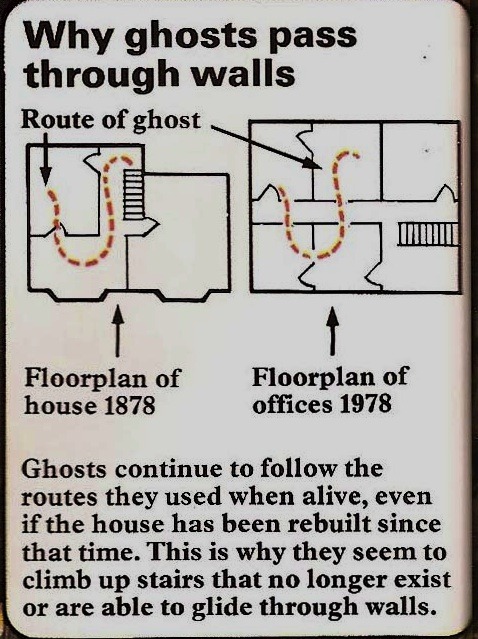
Having never (at least that I can recall) actually been in Disney's Haunted Mansion, I'm not going to contribute to the debate about whether the attraction is more amenable to what HBG2 refers to as the "Spirit Possession paradigm" or the "Parallel World paradigm," but I would like to briefly discuss how these "paradigms" don't quite work, in my view, and again try to advance the way in which I've been prone to thinking about ghost stories for a little while now.
Here are HBG2's working definitions of the two paradigms:
Spirit Possession:
Parallel World:
I've been meaning to write, for a couple of years now, a coherent argument regarding representations of ghosts. The closest I've gotten is almost certainly the final paragraph of my post Unified (Gar)Field Theory; there are fragments in this comment I left here and a lot of this post, from the 14th paragraph until the weird occupy stuff at the bottom, but both of these are very specifically arguing about ways of reading the Haunted House, and so don't so much present a theory of ghosts as elaborate on a theory that I still have yet to present. For the record, my theory basically revolves around a reading of John Carpenter's The Fog, which has always seemed to me to be a film about the ways in which space itself attempts to become linguistic. Obviously this is something that needs a significant amount of explanation, that I'm just not going to be able to provide here.
Back to the two paradigms, though. It is fairly unsurprising when, at the end of the post, HBG2 concludes that, "P[arallel] W[orld] and S[pirit] P[ossession] are not mutually exclusive theories." In the context of the discussion he's intervening in around the Haunted Mansion, this is meant as a way to hold open ambiguities; he, like many interpreters and critics, wants to open up the possibilities of enjoyment of this ride, instead of foreclose them, and having (apparently) competing lenses allows this. To my mind, though, the reason that his two paradigms aren't mutually exclusive is kind of a lot easier -- it's because they're the same thing.
Well, not exactly. The "Parallel Worlds" theory is a lot more appealing to me, for instance, because the "Spirit Possession" theory smacks of that intolerable misunderstanding of ghosts as the products of "unfinished business." There's really no excuse for so direly misinterpreting what it is about ghosts that makes them compelling as that catchphrase does. It makes ghosts nothing but a narrative function, a conflict, a pending resolution, masquerading as an ontology. But the "Parallel Worlds" theory does this too, albeit in a slightly more clever way, reducing ghosts to the psychological or metaphysical. No matter which of the theories you choose, what you ultimately advocate is an understanding of ghosts as presences. Which is all well and fine, I suppose, if you want your frights wrapped in a nice little blanket of affirmation of your belief in immortal souls, or whatever. But that's fucking boring.
As I said in the Garfield post, "ghosts are absences of space, absences within space, that structure the space." The "Structuring Absence" theory of ghosts, I would argue, applies broadly across all ghosts, and touches on what is truly interesting about them. Because the second you start to think of ghosts as presences, and specifically as individualized presences, you lose the way in which they function not as the story, but of it. It is the story which shapes itself around the ghost, not the ghost which is the story -- unless we're talking Casper here, in which case we're just talking about the ghost as a purely aesthetic object.
The further I try to go here in articulating the idea, the more unmanageable this is going to become. So I'll try to just lay out a few ideas, necessarily underdeveloped, that I think are absolutely necessary to support my claim at a very basic level, and leave the heavy shit for later. I'll also try to tie this back into the Haunted Mansion post out of which this whole thing began, if only for my own sake.
It is, for me, impossible to overstate just how important the idea that Ghosts Are Space is. Because, for one thing, this goes very much against most of the received narrative wisdom of ghosts, which argues incessantly that ghosts are dead folks. And so they surely are, but they are dead folks in a very specific way, which is to say in their relation to space. Because ghosts haunt; in ceasing living, they cease to take up space, and instead constitute it. Whether they are rattling teacups or murdering interlopers, whether are motivated by redemption or revenge, what makes them ghosts is that they articulate a space. I actually kind of like "Articulating Absence" as the name for this theory of ghosts. Maybe we'll stick with that one.
That is precisely what ghosts do: they make a space speak, and they provide it with joints. They hinge space. The ghost is that space which fits together in such a way that its parts may move, and which through voice can define itself.
And so, to return at last to the Haunted Mansion. Despite never having been on the ride, it's my contention that the reason that the two proposed paradigms overlap so neatly is that they are both, as are most understandings of ghost stories, theories of the ghost as narrative function (which, to be entirely fair, is HBG2's entire point; I'm not so much arguing against his ideas here, at least I don't think so, as trying to use them as a springboard to talk about something else, as if that weren't obvious enough already). I am proposing, instead, that the psychological and metaphysical readings of ghosts that renders them narrative functions is wrongheaded, in that it doesn't come close to capturing the stuff that makes ghosts interesting beyond the particular narratives in which they are embedded, and that an alternative theory of ghosts is needed, which properly situates ghosts not within the psychological, but within the topological. Simply put: for the Haunted Mansion and for every other ghost story, it is not a question of whether the ghosts "possess" spaces, or whether it is a question of how they view spaces; the ghosts are themselves the spaces, or at least the absences which articulate them.
Having never (at least that I can recall) actually been in Disney's Haunted Mansion, I'm not going to contribute to the debate about whether the attraction is more amenable to what HBG2 refers to as the "Spirit Possession paradigm" or the "Parallel World paradigm," but I would like to briefly discuss how these "paradigms" don't quite work, in my view, and again try to advance the way in which I've been prone to thinking about ghost stories for a little while now.
Here are HBG2's working definitions of the two paradigms:
Spirit Possession:
Quite simply, wicked spirits are out to get you. They want to take possession of your body. Failing that, they'll take an animal or even a building, but they want to move up to humans if they can.
Parallel World:
[G]hosts may continue to inhabit the world that was there, regardless of what is found there now.
I've been meaning to write, for a couple of years now, a coherent argument regarding representations of ghosts. The closest I've gotten is almost certainly the final paragraph of my post Unified (Gar)Field Theory; there are fragments in this comment I left here and a lot of this post, from the 14th paragraph until the weird occupy stuff at the bottom, but both of these are very specifically arguing about ways of reading the Haunted House, and so don't so much present a theory of ghosts as elaborate on a theory that I still have yet to present. For the record, my theory basically revolves around a reading of John Carpenter's The Fog, which has always seemed to me to be a film about the ways in which space itself attempts to become linguistic. Obviously this is something that needs a significant amount of explanation, that I'm just not going to be able to provide here.
Back to the two paradigms, though. It is fairly unsurprising when, at the end of the post, HBG2 concludes that, "P[arallel] W[orld] and S[pirit] P[ossession] are not mutually exclusive theories." In the context of the discussion he's intervening in around the Haunted Mansion, this is meant as a way to hold open ambiguities; he, like many interpreters and critics, wants to open up the possibilities of enjoyment of this ride, instead of foreclose them, and having (apparently) competing lenses allows this. To my mind, though, the reason that his two paradigms aren't mutually exclusive is kind of a lot easier -- it's because they're the same thing.
Well, not exactly. The "Parallel Worlds" theory is a lot more appealing to me, for instance, because the "Spirit Possession" theory smacks of that intolerable misunderstanding of ghosts as the products of "unfinished business." There's really no excuse for so direly misinterpreting what it is about ghosts that makes them compelling as that catchphrase does. It makes ghosts nothing but a narrative function, a conflict, a pending resolution, masquerading as an ontology. But the "Parallel Worlds" theory does this too, albeit in a slightly more clever way, reducing ghosts to the psychological or metaphysical. No matter which of the theories you choose, what you ultimately advocate is an understanding of ghosts as presences. Which is all well and fine, I suppose, if you want your frights wrapped in a nice little blanket of affirmation of your belief in immortal souls, or whatever. But that's fucking boring.
As I said in the Garfield post, "ghosts are absences of space, absences within space, that structure the space." The "Structuring Absence" theory of ghosts, I would argue, applies broadly across all ghosts, and touches on what is truly interesting about them. Because the second you start to think of ghosts as presences, and specifically as individualized presences, you lose the way in which they function not as the story, but of it. It is the story which shapes itself around the ghost, not the ghost which is the story -- unless we're talking Casper here, in which case we're just talking about the ghost as a purely aesthetic object.
The further I try to go here in articulating the idea, the more unmanageable this is going to become. So I'll try to just lay out a few ideas, necessarily underdeveloped, that I think are absolutely necessary to support my claim at a very basic level, and leave the heavy shit for later. I'll also try to tie this back into the Haunted Mansion post out of which this whole thing began, if only for my own sake.
It is, for me, impossible to overstate just how important the idea that Ghosts Are Space is. Because, for one thing, this goes very much against most of the received narrative wisdom of ghosts, which argues incessantly that ghosts are dead folks. And so they surely are, but they are dead folks in a very specific way, which is to say in their relation to space. Because ghosts haunt; in ceasing living, they cease to take up space, and instead constitute it. Whether they are rattling teacups or murdering interlopers, whether are motivated by redemption or revenge, what makes them ghosts is that they articulate a space. I actually kind of like "Articulating Absence" as the name for this theory of ghosts. Maybe we'll stick with that one.
That is precisely what ghosts do: they make a space speak, and they provide it with joints. They hinge space. The ghost is that space which fits together in such a way that its parts may move, and which through voice can define itself.
And so, to return at last to the Haunted Mansion. Despite never having been on the ride, it's my contention that the reason that the two proposed paradigms overlap so neatly is that they are both, as are most understandings of ghost stories, theories of the ghost as narrative function (which, to be entirely fair, is HBG2's entire point; I'm not so much arguing against his ideas here, at least I don't think so, as trying to use them as a springboard to talk about something else, as if that weren't obvious enough already). I am proposing, instead, that the psychological and metaphysical readings of ghosts that renders them narrative functions is wrongheaded, in that it doesn't come close to capturing the stuff that makes ghosts interesting beyond the particular narratives in which they are embedded, and that an alternative theory of ghosts is needed, which properly situates ghosts not within the psychological, but within the topological. Simply put: for the Haunted Mansion and for every other ghost story, it is not a question of whether the ghosts "possess" spaces, or whether it is a question of how they view spaces; the ghosts are themselves the spaces, or at least the absences which articulate them.
Saturday, February 18, 2012
Unified (Gar)Field Theory

(at garfield.com, starting here, with a hat tip to Grant for sharing it)
The clear implication, at the end of the bizarre arc from October 23rd to the 28th, 1989, is that the entirety of the Garfield comic strip is, in some way, an elaborate hallucination, a paranoid delusion, or an extended meditation on a stage of grief. The comic itself is utterly explicit about this, and, strangely, doesn't even bother to shoot a snide sideways grin; there's no wink at the end, nothing but the tiny "End" insert to indicate that what has happened is at all out of the ordinary in the universe of the strip. And of course that it is there is important. But the final panel itself is strange; it takes the tone of a moral, that part of the fiction which tells you that the fiction is being exceeded, that there is a remainder here that you are supposed to recognize and use. The problem, though, is that what it actually says is totally fucking incoherent as a moral; it's, really, just a description of the preceding comic. Which means, I take it, that the arc itself is the didactic footnote to the fable of the comic.
Which, of course, means that Garfield itself is the story of a cat who does not exist, fantasizing about a life which is not real. And if Garfield is an absence, then he is an absence that dreams in a particular, dilapidated house.
Two days after the end of that arc, came this comic

Which is, of course, exactly your ordinary Garfield comic strip. It happens to be the Halloween edition, so there's a bit of a prepackaged theme to the joke. But, coming as it does just so soon after the arc, and especially the comic from the 27th, where we watch Garfield's delusions dematerialize and see the truth of his surroundings, there's something extra eery about this comic from the 30th of October, 1989. Because Garfield is no longer just a sort of apathetic, sardonic cat - he is in fact the absence of a cat, a nocat, subjected to time. Garfield becomes the structuring principle, the ability to imagine of that which is absent. And the truth of his absence, what makes it comprehensible, is, of course, the dissipation of his dream-world; and what signifies that dissipation is the dilapidated house.
The Garfield Minus Garfield webcomic actually gets Garfield, then, both totally right, and totally wrong. Garfield is, apparently, by its own admission, the comic depiction of loneliness and denial that Garfield Minus Garfield supposedly detourns it into. The way that Garfield Minus Garfield could be said to get Garfield exactly right, though, is that, as that arc showed us, Garfield himself is an absence - "But that means I haven't lived here for years." But it seems to assume that because he is an absence, he is erasable, whereas this seems to be the exact opposite of the truth. Because his absence is a structuring absence, not a simple lack of presence. Jon and Odie are, and perhaps always been, mere projections of this absence, figures formed to fill up space.

Garfield is a ghost. And a real ghost, not some bullshit about a lingering soul trying to finish up his business. Ghosts are space. They are, particularly, a becoming-consciousness of space. Ghosts are not embodied, or if they are, it is a function of narrative and not ghost-ness; ghosts are absences of space, absences within space, that structure the space. And so, apparently, is Garfield.
Friday, September 30, 2011
i dont even fucking know
Two (more or less*) adjacent montages from 2004's I Downloaded A Ghost
The first, the moment of defeat, when all hope is lost; having just got her father fired, and her ghost-friend condemned to limbo, Ellen Page enters the lowest point of the film. The narrative arc has bottomed out, and we can tell because... she's putting on makeup and a dress.


But, then! She and her friend find evidence of where the BURMESE FELINE has been taken, and know just what to do. The boy asks: So, who is going to fix this situation? The new Stella, or the old? And she doesn't skip a beat; "the old." So they don smocks and power tools and build a fucking house.


So, I did what I do
*Okay, fine, they're split up by a scene where Carlos Alazraqui does a fucking stand-up comedy routine in the bus he was killed by, to try to learn how to haunt it. Fine. Fuck.
The first, the moment of defeat, when all hope is lost; having just got her father fired, and her ghost-friend condemned to limbo, Ellen Page enters the lowest point of the film. The narrative arc has bottomed out, and we can tell because... she's putting on makeup and a dress.


But, then! She and her friend find evidence of where the BURMESE FELINE has been taken, and know just what to do. The boy asks: So, who is going to fix this situation? The new Stella, or the old? And she doesn't skip a beat; "the old." So they don smocks and power tools and build a fucking house.


So, I did what I do
*Okay, fine, they're split up by a scene where Carlos Alazraqui does a fucking stand-up comedy routine in the bus he was killed by, to try to learn how to haunt it. Fine. Fuck.
Monday, November 29, 2010
Balloons-Bubbles-Diamonds

This is fashioned as a response, of sorts, to a post by Bat, Bean, Beam on Pixar's Up and its relation to the housing crisis. As I personally didn't find Up especially compelling, I'll be returning to it explicitly only through Bat, Bean, Beam's analysis and, most importantly, through the way the picture above can be used to structure my remarks.
"In the very last image before the credits of Up start rolling we discover that the house has landed gently just where Ellie had fantasised as a child. It is a comforting resolution, inevitably so, full of symmetry and sentimental denouement, and yet at the same time unsettling, for it leaves us with the picture of a dream without its dreamer, of an economy without people. It is also therefore, in one final ambiguity, a picture of the crisis."

Brian McCarty, Self-Evident
"[T]he picture of a dream without its dreamer" calls to mind, for me, Brian McCarty's photograph for the Three Apples exhibit, Self-Evident. If you think of it in light of my analysis of Jason Han's I Haz Mouth (painted for the same exhibition), you might be able to see where I'm going with this. The Kitty on the right, in the foreground, in this case however, is not being caught up in an infinite loop of (partial) self-representation; instead, it is the subjectiveless subject. What this picture suggests is the dream whose dreamer is, at the end of the day, a little lump of plastic.
And, importantly, what this piece of affective junk (to use a phrase I keep returning to) dreams is a little girl floating away with a handful of balloons. This is, like any dream, a deeply ambivalent image; it takes only a small step to realize that the "childlike wonder" that this image is supposed to instantiate as an eternal present needs only to be subject to time to become exhilarating terror, worry, and tedium.
In this sense, Kitty's dreams position her in that ambivalent space, either subjective object or objective subject. As we see, it is not simply the fact that objects dream of the things-in-themselves; they also, like Kitty's spoken mouth, are permanently caught up in games of meaning. We might also, to put a Lacanian twist on it, say that Kitty's dreams are the dreams of the other, in this image the little girl, who Kitty knows must long for the freedom of flight and absence, of that transcendent sort of objectification that repeatedly occurs in cries of "look at me, mommy!"
With this, JR's essay Bubble / dreams / forever now comes into play. Gaga who, through her art, her mirroring, and her explicit claims about her project, positions herself as an object to be consumed, and uses this position to advance her bubble dreams. As JR points out, instead of the strict "post-bubble world" utopianism of Capitalist Realism, though, her bubbles diamondize, re-introducing themselves as not just the solution, but also the problem.
With this we have the first of the groups of things that I am trying to apprehend here. One way to put this is to say that the bubble is the medium which allows for the slippage between the balloon and the diamond. This metaphorical relation between the balloon (that ambivalent utopian figure, the dream object that only fulfills dreams after the dreamer has left the picture) and the diamond is conducted through the bubble, that object that is both financial and material.
What, though, exactly, is a diamond, in this sense? The ultimate embodiment of this sort of diamond is, for the moment, Katy Perry. To get there, though, requires a reading against the popular understanding of Perry's project, of which I take Anwyn Crawford's brilliant article Warring Brassieres as the best example. This argument, which posits Gaga's post-feminist, cyborg, utopian weirdness as the leftist version of the counter-revolutionary, reactionary, anti-feminist utopianism of Perry goes toward the truth without ever quite, I think, reaching it. For what is really remarkable about Perry's music is that it, while in the middle of presenting all of these fantasies about becoming consumable, buries deep within itself the vicious pain that this process involves. Think, for instance, of her endless choruses, especially the one in California Gurls, that always end up with Perry basically wailing inarticulately. If it weren't for the massive amounts of work done in post-production, from structural shaping to lathered-on AutoTune, what we would have as the core of this song would be simply Katy Perry screaming.*
This is something that I've tried to approach with my song Internalized Diamonds from my second Valentine's Day EP, but I think a better example is my friend Daniel's youtube video katy perry, embedded above. In the video, a distorted version of Prozzak's Strange Disease plays as a cropped image of Perry in a diamond Hello Kitty outfit spins into and out of a diamond shape.
What this video seems to be identifying, to me, is that Katy Perry's music is an attempt to navigate a world which is truly post-bubble; not just in Friedman's sense of the steady expansion of capital markets with no collapses, but also in the sense of a world which no longer has the capacity to mediate between its dream-balloons and its impossibly hard, sharp diamond-value.
Diamonds, then, could be said to be figures of the pain of unconverted surplus-value, the real promise of profits that will never be realized. The diamond is also, though, a figure of a sort of reductive performativity, the moment when the free shuffling of arbitrary signifiers becomes suddenly refigured as a monstrous destiny instead of a liberating game. This is, I take it, why Perry is so productively represented as the antagonist to Gaga/Rihanna/et al.'s performative protagonist.
In an earlier post on this blog, titled Cobbling, I posited a sort of deconstruction of the (typographical) diamond as both the initial cause and potential solution to the X. The post ends with a link to the video that inspired it in the first place, another by Daniel called Easy Target. This X is the mythological X, the X that both "marks the spot" but also the X that "Xes out," both calling attention to an object and effacing it. The connection, then, between the diamond and the X, can be seen as a sort of Trojan Horse, as the eternal diamond gets internalized as a defense mechanism which only serves to smuggle in the "seek & destroy" protocol of the X. This is, I take it, a sort of summary of the movement that underpins Katy Perry's celebrity-node, and why Internalized Diamonds is about her.**
What we have, now, is the balloon-bubble-diamond structure that identifies the cultural task of commensurating the cultural qualities of the ambivalent utopianism with the hard reality of floating surplus-value by way of both speculative and idealized real bubbles.
It is not quite so simple as all this, though. Because the initial balloons, we must remember, carry a house, and it is the houses that, in a way, are the real subjects of the bubbles.*** Balloons-bubbles-diamonds that well up in the hearts of pop stars are one thing; the ones that buoy houses function in an entirely different way.
In the direction of representing the house as subject, we basically have recourse only to the haunted house. One must only recall the frenzied refrain of the remake of House on Haunted Hill - "the house is alive!" - to see what I mean. Although that movie itself, in the particularities of its representation, tends more towards the Thi13een Ghosts end of the haunted house spectrum, where the house isn't so much "alive" as it is a giant machine, a space constructed to harness spiritual energy and constructive of it.
Closer to a real living house, although it initially seems much further, is something like the Hammer film The House That Bled To Death. In this film, a house that is purported to be haunted is occupied by a family, until a bunch of spooky things force them to vacate. At the end, however, it is revealed that the father of the family is actually (among other things) an actor who has falsified the haunting in order to provide material for a book "based on a true story."
This is an exquisite example of the use of a metafictional technique (what this revelation really reveals is that the director of the film is doubled, as this author's real work has been to direct the film from within) to debunk both the spiritual and psychological narrative (the couple even discusses the possible traumatic effect of the fabrication on their child, only to sort of blithely discount that it could have done any real harm) of the living house. The house is not alive in its ability to magnify spiritual (read: historical) resonances, nor due to the unique makeup of its occupants (as in those films where paranormal phenomenon are being investigated by groups of people who have had a near-death experience), but precisely because the house is revealed, in the final analysis, to be the only concrete subject in play.
Poltergeist, with its explanation of the horror it represents as being a product of the bad bureaucratic decision to move the cemetery and leave the corpses behind (presumably a move by the bureaucrat to inflate the bottom line), is a sort of inversion of this logic. The house as spirit-condenser (although the film attempts to distance itself from this by claiming the invasion is a poltergeist, which is differentiated from a "haunting" in that it is precisely both temporary and not spatial) is thus sort of a way for the house to rebel against its own reduction to being just property. The house is pissed off because of the lack of a level basic human decency in the conditions of its construction.


The real auteur of the living house genre, in this specific sense, is Wes Craven. Although his films never treat themselves in this manner. And this is precisely because he almost categorically rejects the spiritual or psychological reduction that functions as the broadest generic signposts. The only prominent counterexample to this, I think, would be Nightmare on Elm Street which, if you take into account that Craven directed both the first and the final (New Nightmare) iterations of this franchise, then you realize that what results is ultimately almost identical to The House That Bled To Death.****
What Craven does, instead of using these reductive genre motifs, is figure the house as the ultimate space in nearly all of his films. How this almost inevitably pans out is with the climactic chase through the house. The house which - again, almost invariably - has been booby-trapped. What this does is to render the house not just a passive interiority or a disinterested spatial determiner, the navigation of which allows for the creation of tension, but as an, or more precisely the, active intercessor.
The trope of the chase scene is precisely a tool which structurally effects the reduction of all participants to objects, in order to clear space for the tension of mapping interiority onto the landscape. By this I mean that the chase wrenches the subjectivity of, in Craven's films for instance, the chaser by reducing him to an inhuman monster, and the chased by reducing her to abject terror; and in so doing, replaces the processes normally associated with interiority (self-determination, reflexive thought, ability to interpret sensory input) onto the landscape. That the most common form of chase is the "car chase" underlines this, as the car itself already reduces the subject to an object, and the roads become these very externalized thought processes. Thus the house's interior becomes an interiority, and the booby traps a conscious mode of interacting/shaping the trajectories of the (human) objects, as well as determined reactions to sensory stimuli.
This is not all, however. Perhaps the single greatest image of the house as subject comes, paradoxically, in Craven's The Hills Have Eyes, a movie set around a broken down car in an irradiated desert. The films climax sees the kids booby-trapping the trailer to self-destruct, to kill the mutant cannibals they have lured back inside. What this moment offers, more than just another image of a burning house, is a reference to an earlier image in the film; the father, attached to a cross, being burned alive. The house as martyr.
Much more can be said about this (just think, for instance, about the two houses in Scream 3 - the simulacral, film set reconstitution of the house from Scream for "Stab 3," and the director's mansion in which it ends - or the fairy tale of the hidden gold in The People Under The Stairs), but perhaps this is enough to return to the initial argument. It is, I hope, uncontroversial to point out that the 2008 financial collapse was a collapse of the housing markets; it would certainly be insane to suggest that the collapse was triggered by the houses themselves, as though houses across the country and then the world had themselves started to crumble and deteriorate. What was "toxic" were the financial assets; what were "subprime" were the loans; the houses themselves were, quite frankly, incidental, mere incentives, their value only in their unparalleled ability to anchor confidence in the free-flowing capital that soared above them.
What is the point, then, in insisting on this close attention to these fictional houses, these representations capable of consuming the balloon-bubble-diamond, when what they refer to is in reality nothing more than another empty concrete signifier, ready to be shuffled out of the equation as soon as another one can be molded to fit into its place?
The answer to this can, of course, never be entirely fixed. On one level, we might insist on the analysis of the concrete, overdetermined components of this problem, in order to approach a more honest appraisal than that offered by one which only takes into account the abstractions that served as the causal determinations. On another is perhaps the impulse to refuse the free-play of signs, to resist the infinite malleability that conditions the possibility of both creating and salvaging these crises.
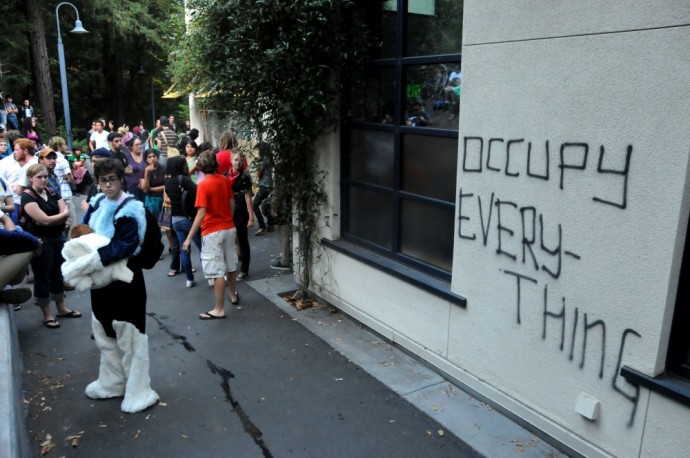
These impulses are shared with, and perhaps engendered by (in me at least), the recent movement toward the direct action tactic of occupations. That word which invokes the spectres of both home-ownership and military occupation, and which refers to the tactical taking over of a factory (or university) by the workers (or students) who perform work within it.
To offer a sort of concluding gesture, then, it might be pointed out that the term "housing bubble" refers not just to the market truth, but also, according to this new schematic, the way in which the "house" itself (under the right subjective conditions) becomes the ferrying mechanism which traverses the gap between balloons and diamonds. This is (or at least I certainly hope it is) more than just another way of making the observation that the house is the ultimate figure of the American Dream, with its dual ideal of speculative advancement and interpersonal mastery. It instead opens up (again, I hope) the possibility that the house, as the highest possible form of affective junk, can be made to operate not simply as a facilitator of capital, but also as a powerful impasse. Like Hello Kitty, standing rigid and plastic on the grass, dreaming without a dreamer of the little girl floating away on her balloons.
*If you've ever listened to an acapella of a Katy Perry song, especially I Kissed A Girl, you'll know what I'm talking about
**To put it in these new terms, one could say that the problem with the dominant analyses of Katy Perry are that they recognize her existence within this world where the diamonds and the balloons have become incommensurable, but focus only on the balloon-aspect of her performance.
***Not the least reason for this is that pop stars/celebrities are always figured as the objects of these bubbles, never the subjects.
****Craven's most recent, My Soul To Take, might also easily be seen to fall into this trap. I get the feeling that it does avoid this, but to explain precisely how it does evades me at this moment.
Subscribe to:
Posts (Atom)