Friday, March 4, 2011

Rap's Coming Insurrection: A Review of mansbestfriend volume 5, an Exegesis of Based, and an Exploration of the Negativity of the Underground

I used to think I was a Communist, a silly dream
It was a lonely place, now everything I do is for me
And I don't like how it sound, but that's the way it go*

In August of 2009, Sole & The Skyrider Band released their second LP, Plastique, on Fake Four Records. The record sees Sole's inner-cyberpunk unleashed and looking for war. The music is a dystopian soundscape, all drums crashing like cars, and the lyrics at points get so caustic that they burn off their own tone. But from an album whose first words are, "To the children of privilege / Taste the pavement / You paid to see an entertainer / But this ain't entertainment," or an artist whose most popular chorus goes:

Cops ain't shit to me
Jobs ain't nothin but free pens and long-distance calls
Thought I had it all, but God got birth control
The white man's the fucking devil
I wanted to be black at age 14
So when they say I don't respect the culture
Truth is, I only rap cuz I ain't smart enough to write a book
I've never paid a parking ticket
It's $20 now and $300 then
You want your money? come and get it
But better bring two hundred guns and a hundred men

what less would you expect?

Over the course of his career, Sole's output (in all its ups and downs) has closely mirrored the best strains of underground hip hop. Both have always had, as their core, a negativity; a fundamental rejection around which a project is built. This is negativity not in its colloquial sense, as meanness or wanton destruction, but as political or philosophical project; negativity as response to a set of established (often implicit) real conditions that refuses the idea that politics can or should be done (or even conceived) in a vacuum (think, for instance, of the difference between Socrates in the Republic and Diogenes wandering the city with a lantern, saying "I'm looking for an honest man!"). Whether it is the underground insistence on creating an alternative space to the perceived paucity and desuetude of the mainstream, or Sole's explicit attacks on political, aesthetic, and traditional (rap) forms through the creation of his own rap, the force of negativity in (underground) hip hop is dominant.

The other day, someone thanked me for making real music
My response, "Art imitates life."
The worse the music it is, the realer it is
I'm a fake
On pieces of wood, pinned, like an executed slave or a bug
That might be true, if the sun would only show
I don't wanna be real, like a prison guard or bank-teller or a politician
This is my castle, only ghosts can live here
I had to kill everyone to save the city

God grant me the MIC to hack away at negative change
Can you read bones?
I can read a face like a milk carton
Like a cliff
Like a trash heap with fresh food in it
And a blank face forming in the center

This poem was written for a machine gun
But the weapon jammed, and my generation don't know how to fix things

Following Plastique, Sole began work on the Nuclear Winter mixtape series (volume 1 was released in January of 2010, and volume 2 is currently being released piecemeal through youtube and soundcloud as it is completed) which adapts the rap mixtape format to the Situationist praxis of détournement, he announced his departure from the collectively-owned label anticon. of which he was a founding member, he released his first book, an "illustrated epic poem" collaboration with Ravi Zupa called The Pyre, and he released a new installment in the mansbestfriend series (mansbestfriend volume 5). And he is slated to release the next Sole & the Skyrider Band album on May 2nd.

Test me I’m negative
Must be my blood type
X
Like the target on my back

Since Plastique (and especially since leaving anticon.), Sole's ethics have turned towards a Lil B-inspired approach, focusing on proliferating his music to the point of oversaturing the niche he has been cast in for the past two decades, and reorienting the content of his music to a more generally (or you might say, perhaps a bit cynically, more nominally) "positive" outlook.

Never work is my anthem
I never stop working
Even when I’m sleeping
Or in a bath where I’m reading
Proletarian dreams
I got nothing but work

The weight of this shift, from a political perspective, is the transition (on the level of business praxis – Sole's personal politics may or may not reflect this) within the spectrum of hard left political traditions, from one inspired by Marxism to one inspired by anarchism. One way to oversimplify this would be to say: rather than using the business-end of the rap game as a way to attempt to promote a collectively-owned and managed commons, he has begun using it to promote a commons free of ownership. Both are equally anti-capitalist; they simply draw on different theories in their approach.

Hip hop – both as artistic tradition, and living body of artists – is much, much more sympathetic to the anarcho-leftist tradition than it is to the Marxist. To see this sympathy in practice, one only has to look at the relative level of popularity between the two most popular representatives of these traditions in rap: Public Enemy and The Coup. The number of people who would even just recognize the name of The Coup as being a rap group is almost certainly significantly smaller than the number of people who would consider themselves rabid Public Enemy fans. The most likely reason for this sympathy seems to me to be the fact that rap takes entrepreneurship as its basic model of work, and so has a much more natural sympathy to the right-libertarian political position – it being, more or less, the ultimate cult of the entrepreneur – than it does to anything either centralized or communal. And since there is a thin line between the underlying arguments of right-libertarianism and of left-anarchism, a line which consists, almost exclusively, of a theory of capital, the tendency to misidentify anarchists as libertarians is already in place. When you compound this with the fact that rap has a very strong tradition of being obsessed with establishing its own authenticity, and insisting that its exclusive subject is reality (over and against theory, especially), the ability of someone to exploit the proximity of these political traditions to advance left-anarchism with complete sympathy from the right-libertarians is almost unimpeded.

They always say
"You gotta be radical when you're young
To grow up and be a good conservative"
That's dead wrong
Be head strong like Sadaam Hussein's fallen statue

Concomitant with Sole's political/philosophical transformation is the rise of Lil B in the eyes of the underground and fringe-mainstream hip hop world, which he rides on the wave of his philosophy/meme, "Based." That Sole has taken up this idea for his own purposes at this particular juncture in his career is at least as much a tactical maneuver as it is a historical accident.

Based is, if you take Lil B's claims exclusively, basically just a retread of tired corporate culture bullshit like The Power of Positive Thinking, with a bit of hip hop's perennial obsessions (about authenticity, craftsmanship, &c) sprinkled in for good measure. This is of course not to say that he knows not what he does, or to discount what he has to say about it out of hand, or even to suggest that there is no possible value in positivity as such – although you probably won't catch me wandering the streets talking to myself about how beautiful the world is and shit – but to attempt to (perhaps a bit polemically) get beyond what is simply stated about something, and see how that thing actually works.

No such thing as the illuminati
Just a dynamic corporate body
Fuck the smoke in mirrors, steady aim
Alex Jones CIA plant
Like cocaine
Stop sending me links to Zeitgeist and Loose Change
Junk food filling up your brain
They keep you occupied with youtube while the world is in flames
Hash tag I’m #justsaying

Looking at the effects that being Based has, and the things that it really promotes, it gradually becomes clear that the real point of becoming Based is to establish in oneself a philosophy which looks something like an absolute conviction that everything one thinks, feels, considers, or vaguely encounters is worthy of communicating in its totality on a generically-determined scale. That is: to be Based is to reach a state at which one's very essence becomes communicable. And one step to becoming Based (if I can be permitted this teleology) is to recognize communication as an imperative.


The most obvious counterpoint to this understanding of Based is the song Age Of Information. But it is important to note that in the song, Lil B's claim that "information has hurt the race" is primarily not a problem with communication, but with a specific form of communication, an atomized, scientistic method of communication, which is being attacked on the basis of its not being sufficiently communicative. This is where generically-determined comes into play in the definition. And this generic element is why the utopian demands of the Based philosophy – presumably everyone is capable of becoming Based, which would mean every incidental thing that happens to every human being can and must be communicated – are less interesting in and of themselves than are the demands they effect on the forms which it propagates itself through.

And forget the last decade of poverty
These days I’m killing em
Like if Ice Cube was reading French philosophy
And still making Death Certificate

If hip hop is marked as a political aesthetic by its juxtaposition of the plenitude of its production (the bricoleur aesthetic of sampling creates a situation in which music production draws from an infinite (or near-infinite) base of sounds) with the scarcity of its lyrics (strict de facto 'quality control' measures enforced by fans on rhyme structure, syllabic regularity, and lyrical content force any innovation into an oppositional ghetto where the music is marginalized and the purity of the emcee is constantly in question, forcing them to adopt a reactionary stance on every formal question except the one they are innovating in, and constantly discouraging any subsequent development of the innovation (see: "biters")), then Based goes a step farther than even the saturation of vocals with autotune (which made fuzzy the line between production and vocals, and then exploited this weakened border to smuggle a sense of plenitude over and allow for the incorporation of previously unacceptable lyrical content (viz. Kanye)) in providing a position from which to productively antagonize this configuration. If you are convinced that all things can and must be communicated, and that rapping is the ideal form of communication, then it is inevitable for you to butt heads with any regime of lyrical austerity. This is, presumably, why Lil B can have lines like "Even though I'm in the game / Bitch, I'm not a rapper," or "short films" like "Am I Even A Rapper Anymore?" It's what the kids call an existential crisis – those moments when you realize that everything you know is riven from everything you know, that reality is incommensurable with reality, and you become acutely aware of all the pain that causes.


Introducing Based to the rap genre forces a division within the political aesthetic, wielding its aesthetics against its politics – what we hear when we listen to Lil B is rap, but it's not good rap; and I would insist that the reason it's "not good" is not a problem with his craftsmanship (he seems, quite honestly, to be doing exactly what it is he's trying to do, and he's doing it a lot and has been for a while) or any other aesthetic category, but because the politics that are naturally attached to that aesthetic are being flaunted. Combined with Lil B's absolute sincerity, what you see is a superlative example of denaturalization.

When the struggle between lyrical austerity and communicative transparency really gets heated, after negotiations ("well maybe I'm not really a rapper; well maybe the majority of this stuff is disposable except the songs where he's biting a regional style; well maybe...") have terminated, having pre-established “Based” as a philosophy - rather than as simply an aesthetic choice amongst a number of choices – is crucial, as it provides a delimited, but intractable, space from which to launch the offensive.

What this could very well mean (aside from “a lot of really shitty rap music”) is that what we are witnessing is the possibility of a real revolution (in the Foucauldian sense of an epistemic shift) in the history of rap music. The episteme in question is rap's lyrical austerity, and its revolutionary replacement will be conditioned by the ideas that overthrew it, namely, Based. At the very least, given the way things are progressing, with the ascendance of Based (and more directly, the digital technologies and historical particularities that provided the condition of possibility for both Based and its ascendance) we are going to witness the complete dissolution of the current configuration of the underground hip hop scene. What I mean by this is that instead of seeing the current generation of rappers die or fade out or retire only to be replaced with more people continuing their project (re-oriented for their historical moment), there will be some fundamental structural change that will make the current configuration of underground hip hop completely incomprehensible and anachronistic.

Ain't no underground left, gotta come up
Yeah I’m on that

However, given enough militancy (on the part of both artists and fans), coupled with certain strategic coups, we might witness the dissolution of the very possibility of the underground, as the reactionary episteme on which it is premised (which is to say, that which it defines itself negatively aganist) is replaced by a utopian plenitude. If Based wins, as it were, and insinuates itself and its real premise into the hearts, minds, and crafts of the coming generation of hip hop artists, then they must also reject any idea that restrictions on communication are an axiom of the genre, and also the self-imposed police force that enforces it.

So keep your backbiting, Indy hip-hop is dead
Commentary to yourself
Or I’ll ruin it all myself
Like I ruined rap in 1998

The idea of a "plenitude," or "utopian plenitude," is a fairly hazy concept, so I'd like to take a shot at clarifying what I mean by it. Plenitude, in the sense of political economy, can have two obvious definitions, which one might broadly call capitalist and socialist. The capitalist political economy is structured around an economics of scarcity with an infinite capacity for growth, thus marking a plenitude of potential development. The socialist political economy is structured around an economics of plenitude with a finite capacity for growth. This is a really rough definition, but the difference is basically between an infinite, undeveloped world, and a finite but sufficient world. The reason for privileging the latter over the former, in the rap world at least, is that it refuses a false catholicism (that rap's development is necessarily a universal good) and makes space for real freedom. And since rap's freedoms, given its position in the current capitalist social order, are basically reduced to "the freedom to please the market," it definitely needs to find some real freedom somewhere.

Economic guillotine they put your head up on that
I don't cater, to the lowest common denomin’
So I’m obscure, like an American definition of poor
This rap is my tundra; I’m the last wooly mammoth
Running from ghosts of savage businessmen ran this
Border wars fought, cuz I don't recognize the face of DNA
Pol Pot, or distant relative dolphins, that went food
The world is spinning, while suckers stand still
Getting by, staying stoned, looking cool but being owned

Passionless dictatorship of the proletariat yeah we on that

If, as I'm arguing, rap is currently (or imminently) engaged in revolutionary struggle, then the question that must be answered is: where, and how, do we fight? And if, as I argued above, there already exists a more-or-less porous border which left-wing rappers can exploit, by drawing on the anarchist tradition's proximity to right-libertarianism, then we seem to have established a fairly compelling case for a first front. And if, again, Based is the philosophy that has the potential to overturn the reactionary epistemes of rap, then the question of how must certainly begin with Lil B as our Sun Tzu.

Sole's most recent effort, mansbestfriend Volume 5, seems to me like it has already taken these tactical questions to heart, and made the most of them. Perhaps the best example of this, and the most striking thing about the record for me, personally, is, paradoxically, how all over the place the record comes across, politically. He seems to argue, over the space of half an hour, for the redistribution of wealth, for the dictatorship of the proletariat, and for the grand good of the entrepreneurial hustle; his ode to rugged (American) individualism, I Walk Alone, which has lines like "No man is an island, but most of us should be," and which seems at one point to subscribe to the logic of the Return to the Gold Standard, opens with "3rd world America, in a hipster ghetto," and is savagely anti-racist and even at one point suggests the rejection of the logic that this individualism necessarily relies on, with the line "I don't wanna be the best cuz then everybody gonna wanna kill me." The beats often take up quasi-totemic signifiers from the underground rap tradition (in Rep-Resent, this becomes so aggressive a subtext that Sole has to comment "This beat sounds dated"). They are constantly forcing him to make minor, but evident, adjustments to his natural flow (again in Rep-Resent, "This is mansbestfriend / So I don't gotta put a chorus in / but the shoe fits..."), giving the impression that they have a life of their own. They are more monster than machine, each with the weight to destroy cities and a compelling geo-political backstory to match, with the raps serving as, at best, translations, or radicalizations.

If the premise of my earlier post, Work, was that artistic production mirrors and interrogates the hegemonic mode of production through the medium of its reactions to its own assumed tradition, and its theory was that close analysis of artistic products can therefore call into sharp relief the existence and operation of these hegemonies (especially points at which they might be productively resisted, and the embedded potential political economies that might be drawn out of them), then the point of this post is to narrow the scope. To draw a bead on one particular aspect of this approach – in this case, the tradition that the art in question interrogates – and from there to attack that frame in the particularity of the historical moment as I see it.

I’m in this to win this
And when there’s
Nothing left to win
I’ll share the winnings
With whoever’s still standing with me


*all block quotes are Sole lyrics. Respectively, they are from the songs: Longshots [Plastique], Da Baddest Poet [Selling Live Water], This Bad Reputation [Battlefields EP], Can't Kill A Ghost [mansbestfriend vol. 5 [mbf5]], Proletarian Dreams [mbf5], Proletarian Dreams [mbf5], Can't Kill A Ghost [mbf5], Rep-Resent [mbf5], I Walk Alone [mbf5], Terra Dome [mbf5], I Walk Alone [mbf5], Rep-Resent [mbf5].

Friday, February 18, 2011

Introducing: Autotune Lacan

So, my friend Nico linked me to this article on Lacan as cult leader about a week ago on facebook. After reading it, I responded:

i ended up finishing this last night; it reminded me a lot of an article ill link when im not writing in e-ink (Poststructuralism as Subculture, by some ucsc faculty member i think [which is here])

this was a good article i think, aside from some of the na...stier bits of psychologizing, but then maybe those have their place too. the whole X As Cult argument always comes across as pretty, uh, petty, maybe? to me at least, although his points about certain things (especially the mathemes) seemed pretty brutally spot-on.

im no great studnt of psychoanalysis, i admit, but i find it hard to imagine that some of lacans critiques of the ego psychology shit werent both pertinent and correct. all of lacans most brilliant moments seem to me to be those points where he sort of points out those structural duplicities of a positivistic psychoanalysis and elaborates againt them.

maybe one way to think of lacan is as the sort of club/party rapper, a sort of psychoanalytic T-Pain. his structural utility then is not laying bare the dark truth of the 'grind' for onlookers to pick over so much as puting enrgy into helping us imagine the 'club' (for grind substitute empirical work, for club the psychoanalytic encounter or couch)

also dude seems to miss the most important similarity between shakespeare and lacan; after you cut out all the bullshit, in both cases all you are left with is a bunch of dick jokes

The idea of Lacan as T-Pain was something I found very funny, so now I introduce to you: AUTOTUNE LACAN (using a video that's probably not the best but it is my favorite video of Lacan on youtube, and plus the Situationist's voice is so perfect so fuck it)

Tuesday, February 8, 2011

Hello Kitty Everything & Hostile Object Theory

In light of Evan's Hostile Object Theory appearing in Mute Magazine, I thought it might be productive to take up some of his claims in an attempt to help clarify the broad project I've referred to in the past as Hello Kitty Everything, and perhaps also (audaciously) to test the borders of this new theory of objects.

The central question of HKE is, it seems to me, the question of what happens when capital stops flowing. When the invisible winds of finance cease blowing, and we can interrogate the junk that's dropped from the sky.

These winds must cease, of course, just as the factory must manufacture its shit, and just as the bubbles must pop. But that which finds its wings under the climate of speculative capital (that is, when all industries take finance as the model of their particularity) is fundamentally different than that which flies best in other climates. And since it is what is in flight while the wind blows that comes crashing to Earth when the winds stop, these are our objects.

But, as we know, this junk falls from the sky while the wind blows as well, as capital carries within its structure its own conditions of declension; this is the role of the gift, in our current climate. The gift under capitalism is the moment that circulation is affected by the introduction of an irreducible (to exchange) social aspect to the exchange value. This is social in the sense that encompasses the personal, and includes affective bonds like memories (of the object in question in different contexts, or of the giver, or etc; or even that most rarefied form of memories which we call secrets) as well as more obviously 'social' bonds like propriety, dignity, respect, etc.

Of course, that the gift is the process of exempting the object from exchange is not a hard and fast distinction. The gift can be undermined, as in regifting, and so on; this is a basic principle, not a law of exchange (something might be said here, too, about the perversity of gift cards, not just in their attempt to bring money into the logic of the gift (personalized (socialized?) money), but also the weird sense in which you are spending money not to allow someone the pleasure of a thing, but to allow them the pleasure of spending already-spent money).

The goal of HKE, however, is a development of an understanding of cuteness and how it functions in a capitalist order (and how it might be made to function after one). Hostile Object Theory, on the other hand, is about interrogating the built world of capitalism and identifying the way in which the mode of production persists within and between the objects it creates.

In this context, the Hello Kitty Murder. Her of the mouthless smirk, whose willingness to hide skulls for you is matched equally by her willingness to divulge them; or, to turn it around, whose willingness to play key witness to an atrocity is in no way undermined by her willingness to secret away that very same atrocity within her body. Her objectivity is infinite precisely because her readiness to betray is infinite; she takes sides not as they suit her - as though she could be benefited by politicking - but as they suit the hostility of the system of which she has become exemplar.

She, as the ghost of surplus-value that haunts the machine of commodities, is of course not bodied, no body, an imprint meant to impart objectively the value of the gift or the collectible. She is a form - a bare form, often, without even face to save - not just a cosmetic afterthought to baubles, but a mold to shape them into. And she haunts the children of those maleficent forces who created her, knowing that they will exorcise her; not that she may be freed, forever, from a purgatorial hell, but that she may dissipate into those children, and order them to build her again, when they take control of the world, into a new and more powerful form.

With this formulation, we can see one reason for the impotence of the politics of subversion. Even the examples that are less extreme than torturing a woman to death on crystal meth and sewing her boiled skull into the doll, such as (for example) the popular Hello Kitty Hell blog, or as in the chapbook that Pamela Lu once described to me, with the cover a picture of Hello Kitty all riot grrrled-out, the assumption that (as I've noted elsewhere) Hello Kitty is fundamentally representational misses the point. Which isn't to say that these critiques and remixes don't have a point, aren't doing good work, or even aren't often wonderful pieces of art in themselves - see, for instance, Angela Choi's Hello Kitty Must Die for a great example of this that sets out just why this political struggle is important - but that they only work within a limited sort of political sphere, which is to say not in the sphere of political economy.

A critique of Hello Kitty that operates on the level of political economy would have to take into account some form of Hostile Object Theory. Lacking the,
"conviction that the objects of capitalism aren't just indifferent to us or darkly coherent beyond our intentions. They are structurally hostile, and, more often than we'd like to admit, locally hostile: uncertain, unstable, loathing or loathsome, dangerous, and weirdly incommensurable with the purpose for which they were designed,"
Kitty's utterly bizarre material existence gets forgotten in the quest to ascribe to her certain political attitudes which can then be deconstructed.

Because a critique of Hello Kitty is, at its core, a critique of the affect of cuteness, in which affect must not be understood as a psychological term, but as a material one, not a feeling but a sign inscribed on the consuming body. And this is important because cuteness, with all its baggage of capriciousness, is probably the single most powerful force behind which the troops of capitalism - especially a capitalism which does not just exempt, but actually models itself after, reproductive labour - martial.

Against Graham Harman's claim, then, that cuteness is a product of a sort of fusion of mastery with sympathy for the one who isn't yet a master, I would claim that cuteness is itself at base a form of work. Or, more specifically, of non-work; where Harman's analysis goes wrong is that he misidentifies an aspect of cuteness - its co-optation of something like sprezzatura - with cuteness as such. This can be seen in his claim that the way that adolescents use "cute" is basically synonymous with lovely, with physical beauty. What he neglects is that "cute" in this sense is a differential term, important because it is distinct from beautiful or hot or whatever. And if we were to put these three terms on a continuum of the attractive, cute would sit in the middle, between the girl who looks attractive and looks like she worked to look attractive (hot) and the girl who looks attractive and requires no work to be attractive (beautiful), as the girl who looks attractive and looks like she didn't need to work to be attractive, although we know she did (cute).

And again, it is exactly in this specific conjuncture that cuteness occupies that we find ourselves with relation to work. For if it is the baby - not the baby, it must be reiterated, as sympathetic non-master, which is baby as bawler and shit-machine, but the baby as product of a labour which cannot be acknowledged as labour except through mediation - whose cuteness is the most 'natural,' the most Darwinian, because it inspires in us an empathetic reaction with certain set conditions, then it is Kitty's job, as both commodity and brand, to objectify those conditions, and to reify the mode of production through them. Think, here, of Sanrio's motto: "Small gift, big smile."

What makes Hostile Object Theory so indispensible here - aside from the magnificent analytical tools it provides – is something it shares with Evan's Salvagepunk project. This is a sense of this kind of theorizing not just as a means of "pulling the wool from over our eyes," but as what Rob Wilson might refer to as a "counter-worlding," a way of (re)producing the world to account for subject-positions which the dominant world-position must constitutively leave unaccounted for. For it is in exactly this register that Hello Kitty's secret strength comes to light, associated, as she must be, with those who cannot or do not make a productive contribution to the economy. Whether children or hikikomori, hoarding collectors, Japanese kawaii-culture adherents who "refuse to grow up," Asian-Americans or whoever else, Hello Kitty is found everywhere that the current organization of capitalism finds itself most fractured. And fractured, importantly, not where pressure is already being applied, but where capitalism itself seems to have reached its own boundaries, where capitalisms own perpetual shuttling between the universal and the particular has reached a powerful impasse.

Monday, December 27, 2010

Work

"First of all, we think the world must be changed. We want the most liberating change of the society and life in which we find ourselves confined. We know that such a change is possible through appropriate actions."

Industrial Music for Post-Industrial People

Industrial Records Ltd. opens its doors in 1976, the same year that Milton Friedman won a Nobel Prize and as the Industrial Common Ownership Act, and four years after DJ Kool Herc pioneers the "Merry-Go-Round" technique. Three years later, 1979, sees the release of Throbbing Gristle's 20 Jazz Funk Greats, the election of Margaret Thatcher to Prime Minister and the appointment of Paul Volcker as Chairman of the US Federal Reserve Bank, and Rapper's Delight.

"Industrial Music for Industrial People," then, of course, comes exactly at the moment that industrial society ceases being a relevant term. Certainly this doesn't mean that there are no more industrial people for whom to make industrial music (or to have industrial music made by); but that that music was being made at the same time as Thatcher took her first tentative steps towards a program of asset-stripping that would be one of the major symbols of an economic turn to a post-industrial society can't be unimportant.

What interests me about this, in light of what I'm about to try to talk about, is the way in which "Industrial" can be collapsed into "work." Obviously this isn't all there is to it, and I hope to go more into it somewhere else, but in my opinion Industrial provides the model for representing work in art that continues to prevail today.

What I'm interested in is something I've been thinking about as something like the work of representing non-work. In some sense the opposite of Castiglione's sprezzatura, this is about the way an explicit rejection of work (or the productions within a piece that themselves signify work) becomes the dominant mode of doing work.

The connection between rap and industrial music stretches as far back as Afrika Bambaataa's sampling of Kraftwerk before the genre had even established itself as such. As rap became a, and then the, dominant commercial force within the music industry, it continued flirting with the industrial aesthetic. And while the aesthetic influence goes in and out of style, or can better be tracked along the lines of individual artists, the ideological connection between the two of them lies in the way that rap appropriates and alters industrial's work ethic. To speak ridiculously broadly, industrial models its work after the factory, from its acoustic environment to its refusal of the craftsman. Rap, I would argue, actually starts from the same place - the factory, where value is produced en masse with an unfailing, clanking regularity, out of the partial objects produced both there and elsewhere - but only with its rejection, in favor of the model of entrepreneurship.

Lil Boss

Skip forward to 2010, and our first object of inquiry; Lil B. His two most immediate and obvious predecessors, Lil Wayne and Soulja Boy, have been working hard at redefining rap for the new millenium. Lil Wayne's syrup-driven unwritten rhymes and mixtape glut combined with Soulja Boy's Internet presence and rejection of technical mastery. As soon as Lil B comes into existence in the minds of the public, he has already oversaturated, with new songs being released on a near-daily basis. Lil B extends the swag as work (or more specifically, affective labour) metaphor ("Hop up out the bed / turn my swag on / took a look in the mirror said what's up / awwww, get money, yeah") to its limits, as in his self-reference as a pretty boy/pretty bitch.

In the dichotomy which has always existed within hip hop, between the streets and the party, Lil B is clearly on the side of the streets, against T-Pain's party (now club) aesthetic; Lil B presents himself as grinding constantly, his wealth is in what he can use to alter his body (cars, jewelery, head), and he (at the broadest level) is engaging with the struggles of living as such. This is all in contrast to T-Pain, whose struggles are strictly delimited (whether they are the difficulties of picking up a bartender or dealing with biters), whose bodily alterations are the background to the wealth he is trying to procure,* and who presents himself as partying constantly. As with all other rappers whose primary imaginary space is the streets, this means that Lil B's primary signifier of his allegiance to the entrepreneur ethic is his grind/hustle. Which he, it must be said, works hard at maintaining. At the same time, however, he twists it, and this is where his non-work comes into play.

The concept of reproductive labour must come into play here. As Marx notes,
"The maintenance and reproduction of the working class is, and must ever be, a necessary condition to the reproduction of capital. But the capitalist may safely leave its fulfilment to the labourer’s instincts of self-preservation and of propagation. All the capitalist cares for, is to reduce the labourer’s individual consumption as far as possible to what is strictly necessary, and he is far away from imitating those brutal South Americans, who force their labourers to take the more substantial, rather than the less substantial, kind of food."
Through a series of complicated collapses, we can identify reproductive labour as the paradigm of non-work** in that it is a positive space within capitalism where the fundamental structure - labour is a commodity with an exchange-value which gets purchased with a wage in order that surplus-value may be produced - of work is negated.***

Feminist theorist Nina Power has argued, amongst others, that the Feminization of labour goes both ways; that is, not only do women become more and more interpolated into the field of labour, but also labour itself begins to take on qualities associated with feminine work.
Nina Power, One Dimensional Woman, 20

As the ultimate example of women's work, then, the broad shift towards reproductive labour, and the related field of affective labour, in a post-industrial society are what defines it.

The two terms that Power provides ('precarity' and 'communications-based') should already ring bells with anyone familiar with Lil B's work. The latter is precisely what is so uncanny about Lil B's hustle; everyone knows that advertising is in many ways what the hustle boils down to, and certainly it would be a stretch to argue that rap isn't communication-based from the outset. What makes Lil B's grind seem so estranged yet familiar is, I think, not a reflection of the content of the work, but of the model on which the work is based; instead of the entrepreneur's need for communication, what we have with Lil B is basically the affective labourer/service worker's need for communication. One imagines that Lil B probably doesn't have a meticulously compiled e-mail list, or a release schedule designed to optimize his quarterly earnings. What he does have, however, is a web presence wherever he is allowed to, with a few more-or-less central spots, such as his website and his twitter and his youtube, any (or all) of which you can go to to keep up to date with his never ending blitz of media output.

Precarity in rap is, on the other hand, something which is often alluded to but rarely seems real; no matter how much Dr. Dre may've insisted we forgot about him in 1999, no one really believed that he was going to lose his job - just that he was doing it worse (to all of you who said I turned pop / or the Firm flopped / y'all are the reason that Dre ain't been getting no sleep). On the other hand, Lil B resides within the permanent impermanence of the Internet, and the question of whether or not he's going to end up a meme remains wide open.

Art of Uff

2010 also saw the release of Uffie's debut album Sex Dreams and Denim Jeans, in which she presents herself as the consummate non-worker. Whether she's saying "Me and my myspace with only three tracks a year, and they still talk about me?" or "I'm an entertainer / not a lyricist," it is hard to miss the fact that she has no interest in presenting herself as possessing any sort of work ethic.

If it can be said that what Uffie does is exactly the opposite of staying on her grind, then it must also be noted that she neither fully coheres with the contemporary party aesthetic in rap. There is, actually, a real way she harks back to the original role of the MC; she is not there to add to the music a sense of space and narrative, but to be the master of ceremonies, to move the crowd. This is in contrast to T-Pain's role, which is very much to imagine the club. The biggest departure from this is a song like ADD SUV, where not only is the imaginary space a car, but the ontological reality is that it's impossible to imagine anything, much less a club.

As discussed earlier, the paradigm of non-work, reproductive labour, would seem to be what Uffie embodies (even to the point of suggesting that "What I cook for my husband" is one of the topics her fans are getting sick of hearing about) as the ultimate non-worker. Her affluence, of course, belies this, and it is here that we can identify how the reversal from a non-worker - someone whose work cannot be structurally recognized as such, and therefore who cannot be paid except through proxies - to someone who is paid not to work**** takes place.

The narrative of a disenfranchised individual being specially raised to a status where they have to do no work and still get rich is not new. What we might argue is actually new about this, in Uffie's case, is the sense she constantly gives off that, although she might not be working, nevertheless there is still work being done.

The Work of the Novel

If it is the job of the writer to produce books, and the novelists, novels, then the work that the novelist does, in the popular conscious at least, can be broken down to two points. The first is a style, which is generally perceived as the less important of the two as it is supposed to be intrinsic to, or constitutive of, the novelist. The second is the creation of characters.

Tao Lin's 2010 novel, Richard Yates, takes both of these things as its point of departure. The pared-down, minimalist, "lazy" style of the novel is perhaps its most contentious point. Its refusal to do anything more than describe exactly and precisely what is happening in the moment that it happens undermines Modernist assumptions that the ethical novel is the novel that represents interiority in all its complexity, especially in that it itself seems to make the case that its approach is, in fact, the ethical one. And as the equation of the creation of relatable, round characters can, in at least its current configuration, be traced back to this assumption, it is doubly important.

The style also presents itself as transparent, at least insofar as it seems like it requires no work. No one but a parodist could wax poetic over the agony and beauty of Tao Lin's perfect craftsmanship in rendering Haley Joel Osment in all his glory with a neutral facial expression.

Naming the characters Haley Joel Osment and Dakota Fanning seems to me to best be explained along these lines as well. That is, as a refusal to work according to another of the dominant models of fiction writing. In this case, however, what seems to me to be being flouted is not the Modernist tradition, but the dual traditions of memoir and realism. If realism is, as Lukacs would have it, concerned with representing the objective conditions which create modern subjectivity rather than just representing that subjectivity, and memoir is concerned with affording the reader apparently unmediated access into the memories of the author, then taking the names of child celebrities for no reason is basically a way of blocking both of these things. With this move, the mediation rears its ugly head into view, and also the sense that what we're seeing described is in some way a totality is also banished.

What we're left with, then, is a sort of Brechtian realism, completely with the Verfremdungseffekt of interpolated celebrity names, but crucially lacking the didacticism which spawns from Brecht's worldview.*****

With even the ideological work of the novelist jettisoned, Tao Lin emerges as the perfect non-worker, recuperable only through reference to his advertising stunts.

Situations

Perhaps, in lieu of a proper conclusion, where I propose a positive political programme or synthesize this analysis into a tactical endorsement or whatever, you will allow me instead to end with a turn backwards. To before Industrial music, with the greatest theorists against work, the Situationists.

Perhaps what I've been describing can be reduced to Raoul Vaneigam's distinction between work and creativity, and the way in which the former necessarily suppresses the latter.

And perhaps the beauty of Tao Lin's marketing stunts is that it is more in line with the practice of creating situations; and Lil B may turn out to be the greatest psychogeographer of the Internet.

I suppose that, ultimately, what I want to suggest is that, for those of us who really want to think of alternatives to the way the world is today, these are things worth thinking about in our attempts to construct a real counter-system.

It makes me sick
How they do these girls
I'm not perfect
but I still try to save the world.


*This distinction, of course, mirrors the distinction between C-M-C and M-C-M', which is pretty neat. Don't read too much into it though. To turn Lil B into the capitalist and T-Pain into a prole would be as easy as analogizing Lil B's music to outsourcing, as he endlessly pushes out the actual work until it is forced to be done by his listeners, while T-Pain enforces a delimited, concrete working space (which happens to be the real world's most visible and profitable playing space) and doing his work within it.
**This is non-work, of course, not in the sense of "that which is other than work," but as that which specifically negates the value of work.
***Negated meaning, here, far from undermining, something actually much closer to idealized.
****This is, of course, perhaps the best possible definition of "fame," maybe.
*****The obvious counterexample here is something like an Existentialist worldview, characterized by a stoic-yet-frantic acceptance of all things that are. I think Norman Mailer's 1957 essay The White Negro can serve as an explanation of why this philosophical system is important to the hipster, and also why it nevertheless doesn't represent a coherent worldview in the same way that something like Brecht's socialism does.

Monday, November 29, 2010

Balloons-Bubbles-Diamonds


This is fashioned as a response, of sorts, to a post by Bat, Bean, Beam on Pixar's Up and its relation to the housing crisis. As I personally didn't find Up especially compelling, I'll be returning to it explicitly only through Bat, Bean, Beam's analysis and, most importantly, through the way the picture above can be used to structure my remarks.


"In the very last image before the credits of Up start rolling we discover that the house has landed gently just where Ellie had fantasised as a child. It is a comforting resolution, inevitably so, full of symmetry and sentimental denouement, and yet at the same time unsettling, for it leaves us with the picture of a dream without its dreamer, of an economy without people. It is also therefore, in one final ambiguity, a picture of the crisis."

 Brian McCarty, Self-Evident

"[T]he picture of a dream without its dreamer" calls to mind, for me, Brian McCarty's photograph for the Three Apples exhibit, Self-Evident. If you think of it in light of my analysis of Jason Han's I Haz Mouth (painted for the same exhibition), you might be able to see where I'm going with this. The Kitty on the right, in the foreground, in this case however, is not being caught up in an infinite loop of (partial) self-representation; instead, it is the subjectiveless subject. What this picture suggests is the dream whose dreamer is, at the end of the day, a little lump of plastic.

And, importantly, what this piece of affective junk (to use a phrase I keep returning to) dreams is a little girl floating away with a handful of balloons. This is, like any dream, a deeply ambivalent image; it takes only a small step to realize that the "childlike wonder" that this image is supposed to instantiate as an eternal present needs only to be subject to time to become exhilarating terror, worry, and tedium.

In this sense, Kitty's dreams position her in that ambivalent space, either subjective object or objective subject. As we see, it is not simply the fact that objects dream of the things-in-themselves; they also, like Kitty's spoken mouth, are permanently caught up in games of meaning. We might also, to put a Lacanian twist on it, say that Kitty's dreams are the dreams of the other, in this image the little girl, who Kitty knows must long for the freedom of flight and absence, of that transcendent sort of objectification that repeatedly occurs in cries of "look at me, mommy!"

With this, JR's essay Bubble / dreams / forever now comes into play. Gaga who, through her art, her mirroring, and her explicit claims about her project, positions herself as an object to be consumed, and uses this position to advance her bubble dreams. As JR points out, instead of the strict "post-bubble world" utopianism of Capitalist Realism, though, her bubbles diamondize, re-introducing themselves as not just the solution, but also the problem.

With this we have the first of the groups of things that I am trying to apprehend here. One way to put this is to say that the bubble is the medium which allows for the slippage between the balloon and the diamond. This metaphorical relation between the balloon (that ambivalent utopian figure, the dream object that only fulfills dreams after the dreamer has left the picture) and the diamond is conducted through the bubble, that object that is both financial and material.

What, though, exactly, is a diamond, in this sense? The ultimate embodiment of this sort of diamond is, for the moment, Katy Perry. To get there, though, requires a reading against the popular understanding of Perry's project, of which I take Anwyn Crawford's brilliant article Warring Brassieres as the best example. This argument, which posits Gaga's post-feminist, cyborg, utopian weirdness as the leftist version of the counter-revolutionary, reactionary, anti-feminist utopianism of Perry goes toward the truth without ever quite, I think, reaching it. For what is really remarkable about Perry's music is that it, while in the middle of presenting all of these fantasies about becoming consumable, buries deep within itself the vicious pain that this process involves. Think, for instance, of her endless choruses, especially the one in California Gurls, that always end up with Perry basically wailing inarticulately. If it weren't for the massive amounts of work done in post-production, from structural shaping to lathered-on AutoTune, what we would have as the core of this song would be simply Katy Perry screaming.*


This is something that I've tried to approach with my song Internalized Diamonds from my second Valentine's Day EP, but I think a better example is my friend Daniel's youtube video katy perry, embedded above. In the video, a distorted version of Prozzak's Strange Disease plays as a cropped image of Perry in a diamond Hello Kitty outfit spins into and out of a diamond shape.

What this video seems to be identifying, to me, is that Katy Perry's music is an attempt to navigate a world which is truly post-bubble; not just in Friedman's sense of the steady expansion of capital markets with no collapses, but also in the sense of a world which no longer has the capacity to mediate between its dream-balloons and its impossibly hard, sharp diamond-value.

Diamonds, then, could be said to be figures of the pain of unconverted surplus-value, the real promise of profits that will never be realized. The diamond is also, though, a figure of a sort of reductive performativity, the moment when the free shuffling of arbitrary signifiers becomes suddenly refigured as a monstrous destiny instead of a liberating game. This is, I take it, why Perry is so productively represented as the antagonist to Gaga/Rihanna/et al.'s performative protagonist.

In an earlier post on this blog, titled Cobbling, I posited a sort of deconstruction of the (typographical) diamond as both the initial cause and potential solution to the X. The post ends with a link to the video that inspired it in the first place, another by Daniel called Easy Target. This X is the mythological X, the X that both "marks the spot" but also the X that "Xes out," both calling attention to an object and effacing it. The connection, then, between the diamond and the X, can be seen as a sort of Trojan Horse, as the eternal diamond gets internalized as a defense mechanism which only serves to smuggle in the "seek & destroy" protocol of the X. This is, I take it, a sort of summary of the movement that underpins Katy Perry's celebrity-node, and why Internalized Diamonds is about her.**

What we have, now, is the balloon-bubble-diamond structure that identifies the cultural task of commensurating the cultural qualities of the ambivalent utopianism with the hard reality of floating surplus-value by way of both speculative and idealized real bubbles.

It is not quite so simple as all this, though. Because the initial balloons, we must remember, carry a house, and it is the houses that, in a way, are the real subjects of the bubbles.*** Balloons-bubbles-diamonds that well up in the hearts of pop stars are one thing; the ones that buoy houses function in an entirely different way.

In the direction of representing the house as subject, we basically have recourse only to the haunted house. One must only recall the frenzied refrain of the remake of House on Haunted Hill - "the house is alive!" - to see what I mean. Although that movie itself, in the particularities of its representation, tends more towards the Thi13een Ghosts end of the haunted house spectrum, where the house isn't so much "alive" as it is a giant machine, a space constructed to harness spiritual energy and constructive of it.

Closer to a real living house, although it initially seems much further, is something like the Hammer film The House That Bled To Death. In this film, a house that is purported to be haunted is occupied by a family, until a bunch of spooky things force them to vacate. At the end, however, it is revealed that the father of the family is actually (among other things) an actor who has falsified the haunting in order to provide material for a book "based on a true story."

This is an exquisite example of the use of a metafictional technique (what this revelation really reveals is that the director of the film is doubled, as this author's real work has been to direct the film from within) to debunk both the spiritual and psychological narrative (the couple even discusses the possible traumatic effect of the fabrication on their child, only to sort of blithely discount that it could have done any real harm) of the living house. The house is not alive in its ability to magnify spiritual (read: historical) resonances, nor due to the unique makeup of its occupants (as in those films where paranormal phenomenon are being investigated by groups of people who have had a near-death experience), but precisely because the house is revealed, in the final analysis, to be the only concrete subject in play.


Poltergeist, with its explanation of the horror it represents as being a product of the bad bureaucratic decision to move the cemetery and leave the corpses behind (presumably a move by the bureaucrat to inflate the bottom line), is a sort of inversion of this logic. The house as spirit-condenser (although the film attempts to distance itself from this by claiming the invasion is a poltergeist, which is differentiated from a "haunting" in that it is precisely both temporary and not spatial) is thus sort of a way for the house to rebel against its own reduction to being just property. The house is pissed off because of the lack of a level basic human decency in the conditions of its construction.


The real auteur of the living house genre, in this specific sense, is Wes Craven. Although his films never treat themselves in this manner. And this is precisely because he almost categorically rejects the spiritual or psychological reduction that functions as the broadest generic signposts. The only prominent counterexample to this, I think, would be Nightmare on Elm Street which, if you take into account that Craven directed both the first and the final (New Nightmare) iterations of this franchise, then you realize that what results is ultimately almost identical to The House That Bled To Death.****

What Craven does, instead of using these reductive genre motifs, is figure the house as the ultimate space in nearly all of his films. How this almost inevitably pans out is with the climactic chase through the house. The house which - again, almost invariably - has been booby-trapped. What this does is to render the house not just a passive interiority or a disinterested spatial determiner, the navigation of which allows for the creation of tension, but as an, or more precisely the, active intercessor.

The trope of the chase scene is precisely a tool which structurally effects the reduction of all participants to objects, in order to clear space for the tension of mapping interiority onto the landscape. By this I mean that the chase wrenches the subjectivity of, in Craven's films for instance, the chaser by reducing him to an inhuman monster, and the chased by reducing her to abject terror; and in so doing, replaces the processes normally associated with interiority (self-determination, reflexive thought, ability to interpret sensory input) onto the landscape. That the most common form of chase is the "car chase" underlines this, as the car itself already reduces the subject to an object, and the roads become these very externalized thought processes. Thus the house's interior becomes an interiority, and the booby traps a conscious mode of interacting/shaping the trajectories of the (human) objects, as well as determined reactions to sensory stimuli.

This is not all, however. Perhaps the single greatest image of the house as subject comes, paradoxically, in Craven's The Hills Have Eyes, a movie set around a broken down car in an irradiated desert. The films climax sees the kids booby-trapping the trailer to self-destruct, to kill the mutant cannibals they have lured back inside. What this moment offers, more than just another image of a burning house, is a reference to an earlier image in the film; the father, attached to a cross, being burned alive. The house as martyr.

Much more can be said about this (just think, for instance, about the two houses in Scream 3 - the simulacral, film set reconstitution of the house from Scream for "Stab 3," and the director's mansion in which it ends - or the fairy tale of the hidden gold in The People Under The Stairs), but perhaps this is enough to return to the initial argument. It is, I hope, uncontroversial to point out that the 2008 financial collapse was a collapse of the housing markets; it would certainly be insane to suggest that the collapse was triggered by the houses themselves, as though houses across the country and then the world had themselves started to crumble and deteriorate. What was "toxic" were the financial assets; what were "subprime" were the loans; the houses themselves were, quite frankly, incidental, mere incentives, their value only in their unparalleled ability to anchor confidence in the free-flowing capital that soared above them.

What is the point, then, in insisting on this close attention to these fictional houses, these representations capable of consuming the balloon-bubble-diamond, when what they refer to is in reality nothing more than another empty concrete signifier, ready to be shuffled out of the equation as soon as another one can be molded to fit into its place?

The answer to this can, of course, never be entirely fixed. On one level, we might insist on the analysis of the concrete, overdetermined components of this problem, in order to approach a more honest appraisal than that offered by one which only takes into account the abstractions that served as the causal determinations. On another is perhaps the impulse to refuse the free-play of signs, to resist the infinite malleability that conditions the possibility of both creating and salvaging these crises.


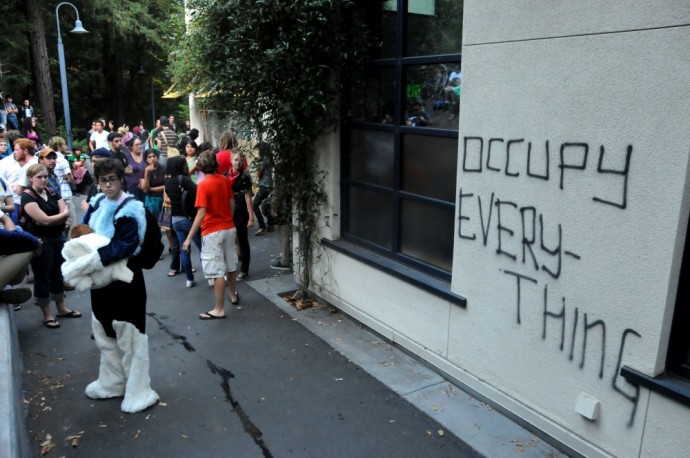
These impulses are shared with, and perhaps engendered by (in me at least), the recent movement toward the direct action tactic of occupations. That word which invokes the spectres of both home-ownership and military occupation, and which refers to the tactical taking over of a factory (or university) by the workers (or students) who perform work within it.

To offer a sort of concluding gesture, then, it might be pointed out that the term "housing bubble" refers not just to the market truth, but also, according to this new schematic, the way in which the "house" itself (under the right subjective conditions) becomes the ferrying mechanism which traverses the gap between balloons and diamonds. This is (or at least I certainly hope it is) more than just another way of making the observation that the house is the ultimate figure of the American Dream, with its dual ideal of speculative advancement and interpersonal mastery. It instead opens up (again, I hope) the possibility that the house, as the highest possible form of affective junk, can be made to operate not simply as a facilitator of capital, but also as a powerful impasse. Like Hello Kitty, standing rigid and plastic on the grass, dreaming without a dreamer of the little girl floating away on her balloons.

*If you've ever listened to an acapella of a Katy Perry song, especially I Kissed A Girl, you'll know what I'm talking about
**To put it in these new terms, one could say that the problem with the dominant analyses of Katy Perry are that they recognize her existence within this world where the diamonds and the balloons have become incommensurable, but focus only on the balloon-aspect of her performance.
***Not the least reason for this is that pop stars/celebrities are always figured as the objects of these bubbles, never the subjects.
****Craven's most recent, My Soul To Take, might also easily be seen to fall into this trap. I get the feeling that it does avoid this, but to explain precisely how it does evades me at this moment.

Thursday, November 25, 2010

Eating Death


If there is one moralistic message which underlines every cultural object I can think of, it is that to consume wrongly is to condemn oneself to death.

Could the obscene outpouring of pleasure at slaughtering zombies signify anything else? When ideological rigor is pursued - whether through veganism, socialism, free market capitalism - is this not the ultimate thesis we see being played out?

And, underlying it, the ideological equation of consumption with death.

Tuesday, November 9, 2010

Hello Kitty's Mouth

Jason Han, I Haz Mouth

There is something incredibly off-putting, to many people, about Hello Kitty's mouthlessness, that arguments from design pragmatism or relative degree of cuteness (rightly) don't quite squelch. The claim that it embeds her in an antifeminist position is well-taken, with the argument usually being that it reproduces a sense of the value of women as being contingent on their voicelessness. Jason Han's painting, I think, points a way through that impasse.

What we get, in this painting, is a suggestion that Hello Kitty with a mouth speaks not just imagistically, but that her speech is actually itself just a representation of her mouth. And, because of the very minimalism that supposedly accounts for her lack of a mouth, something even stranger – the speech bubble itself begins to look less like a representation of speech, and more like a third, incomplete Kitty, with the triangle at the bottom even serving as a potential ear. At a very basic level, then, we have the suggestion that when Kitty is given the tools of language, what she becomes capable of producing is a perfect partial self-representation.

The weirdness of this is compounded by the fact that the mouthless Hello Kitty is actually more expressive - there is an intuitive sense in which the !!! above her head signals something more concrete than the speech bubble with a mouth in it. Which is counterintuitive if you take the mouth to be something like the condition for the possibility of expression - in this case the mouth allows for the creation of an image which refers to an external language which itself is part of a specific discourse which is technologically and historically marked and gendered and so on, while the lack of a mouth allows for the expression of direct astonishment, which only after this is registered becomes ambiguous (is she astonished because her doppelganger* has evolved a mouth, is her astonishment a projection of envy, etc).

This ambiguity, though, is itself wrong, in a way. It is sort of weirdly genealogical, a reading forward through language the conditions of arriving at the beginning. That is, it is a sort of speculative historicizing, a guessing at the past on the evidence of its potential future. So to say something like that the !!! is one of envy, with the implication being that the mouthless Kitty has always desired a mouth, cannot help but be backwards, as we see in the painting itself that the expression of a desire for a mouth can only be predicated on actually having a mouth. Kitty can't want a mouth until she's got one – and when she does, it's what she's reduced to.

The equation, then, of a lack of a mouth with a lack of a voice, is made to seem outright perverse by this painting.** Which is, in itself, pretty great, but there is another aspect of Jason Han's painting that I think really cements its wonderfulness.


Renée Magritte, Les Deux Mystères

The most obvious way to read this painting is as a commentary on the more famous (and earlier) La Trahison des Images, where that painting is itself situated in this one, on an easel. Re-painting that painting certainly compounds the thematizing of semiotics, but instead of taking further the exploration of the insufficiency of the signifier, what we get is another realist representation of a pipe, and this one with no tagline disavowal. On the contrary, it almost seems to point up the interpretation that Foucault suggests of the earlier painting, that the painted words “ceci n'est pas une pipe” refer not to the pipe above but to themselves – this “this” is not “a pipe.” Because if we believe that the realist image must contain a linguistic disavowal to maintain the distance between a signifier and its signified, then mustn't we come to the conclusion, of this new pipe, that it is a pipe?

And certainly no one believes that pipe outside of the easel is any more a real pipe than the pipe within it. As Foucault also points out, the large pipe is not itself "in space" the same way the small pipe is - the large pipe could be on the wall in the back, but it could just as easily be floating in the foreground, actually the smaller of the two pipes; or it could be a sort of hazy apparition, no pipe at all but a dream of a pipe by the not-a-pipe on the easel.

Thus, the congruence; in one, the not-a-pipe that dreams a pipe; in the other, the mouth that speaks itself. Structurally, then, we have a sort of complicated coherence between the represented Treachery of Images and the two Kitties. Complicated because it is the Kitty who has been inducted into the linguistic order who is doing the dreaming, and the Kitty who is still outside of it that must, then, be the equivalent of the painted words.

This complication, I think, points to the basic disjunction in the mode of representation that exists between the pipe and Kitty. The whole argument of La Trahison des Images revolves around the pipe as representation, as it is its status as such that creates the space necessary to be able to coherently refer to it as not itself. Whereas with Kitty we are not dealing with a representation (in manifold, often very subtle ways) – such that a direct take-off of La Trahison des Images would necessarily mean something entirely different. A painting of Hello Kitty with “This is not a Hello Kitty” below it would necessarily mean something entirely orthogonal to the meaning of a painting of a pipe with “This is not a pipe” written beneath it.

The short of it, then, is that the gap between these apparently identical instances (of Kitty's potential mouth speaking only itself, and of the not-a-pipe that only dreams of a more-real pipe) is exactly the gap between an image and a representation. And, to put blithely what I've been trying to put subtly, that what this perhaps draws out is the insufficiency of a politics of representation to account for Kitty. Without, of course, simply shoving the question to the side altogether.


*One of the most basic ways you can tell a “real” Hello Kitty product from a counterfeit is that Hello Kitty always wears her bow on the left ear. Which means that the Kitty with the mouth would have to be either a counterfeit Kitty or, I guess, Kitty's twin sister Mimmy. I don't really find this particularly meaningful so much as funny.


**Two things: first, there are actually two ways in which Kitty has always been voiced, in that the first product of hers was a coin purse with HELLO printed in block caps over her head (thus her 'name' – although, canonically, her name is Kitty White) and also in that whenever she is put into a narrative context, or anywhere else where she needs to speak, she is perfectly capable of doing so. Second is that I think this is where the lolcats meme-speak of the title comes into play, for me at least, as that is exactly an example of voice being given to the voiceless as being infantilizing and generally the opposite of empowering.

Blog Archive